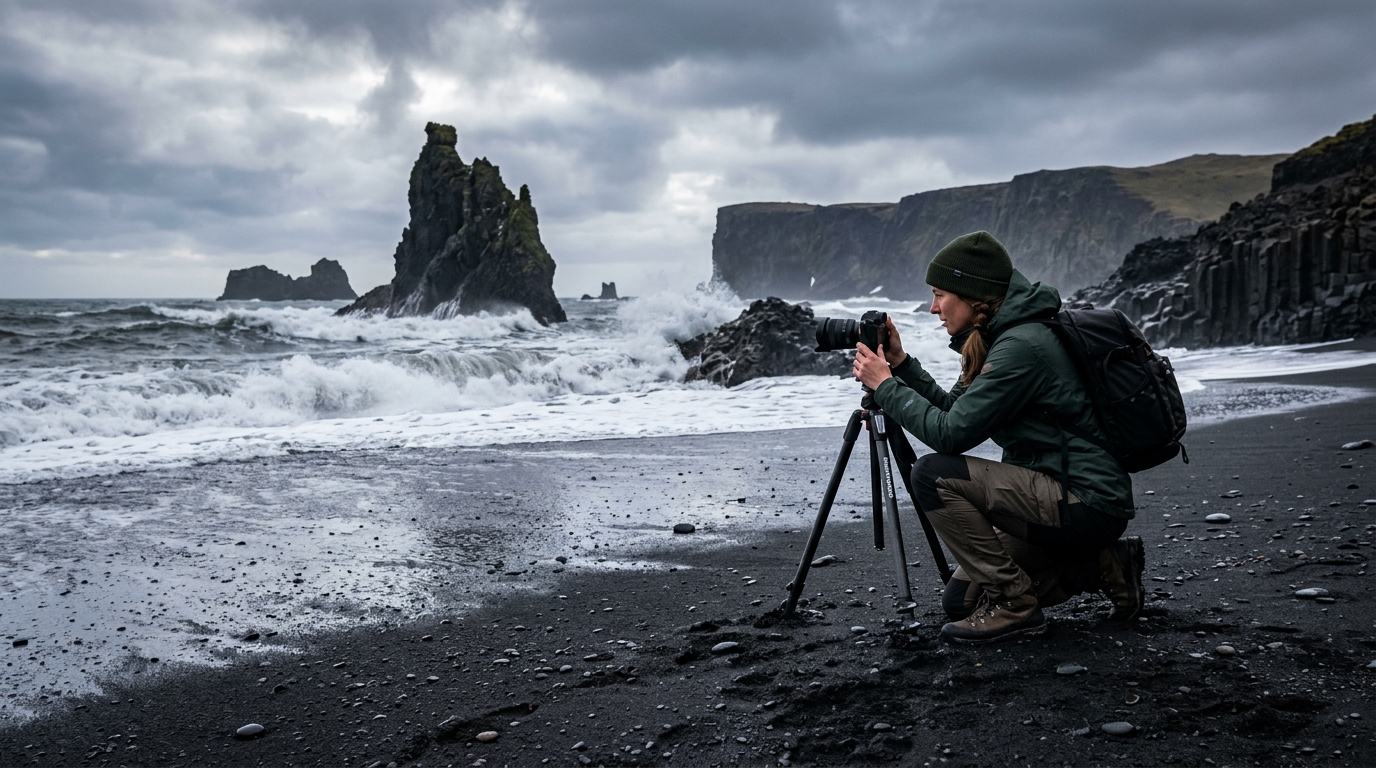
Iceland's black sand beaches are a realm of raw, untamed beauty, offering photographers unparalleled opportunities to capture dramatic landscapes. From the iconic basalt columns of Reynisfjara to the glistening ice diamonds of Jökulsárlón's Diamond Beach, these unique coastal stretches present a challenging yet immensely rewarding subject. This comprehensive Iceland black sand beach photography guide will equip you with the knowledge, techniques, and safety awareness needed to master these extraordinary environments in 2026.
Unlike typical golden or white sand beaches, Iceland's volcanic shores, formed from cooled lava interacting with the ocean, offer a stark, monochromatic palette that amplifies the drama of the crashing waves, the unique geological formations, and the ever-changing Icelandic light. For more on the geological wonders, you can explore resources like Guide to Iceland's explanation of black sand beaches. But beyond their undeniable allure, these beaches demand respect, preparation, and a keen eye for detail. Join us as we delve deep into the art and science of capturing their profound majesty.
Essential Gear for Capturing Black Sand Beach Landscapes
Photographing Iceland's black sand beaches is an exercise in preparedness. The unpredictable weather, harsh elements, and dynamic conditions demand a specific gear arsenal to ensure both stunning results and the protection of your equipment. Investing in the right tools is paramount for success.
Recommended Camera Bodies and Lenses
- Camera Body: A durable, weather-sealed DSLR or mirrorless camera is highly recommended. Brands like Canon, Nikon, Sony, and Fujifilm offer robust options that can withstand the inevitable sea spray and occasional rain. Features like good dynamic range are crucial for handling the often high-contrast scenes.
- Wide-Angle Lens (14-24mm or 16-35mm): This is your primary tool for expansive landscapes. A wide-angle lens allows you to capture the vastness of the beaches, the towering basalt columns, and the sweeping skies. Look for lenses with a fast aperture (f/2.8 or f/4) for versatility, though for landscape photography, you'll often be shooting at narrower apertures.
- Mid-Range Zoom Lens (24-70mm or 24-105mm): A versatile workhorse for general compositions, offering flexibility to frame tighter shots of interesting textures, distant features, or approaching waves without changing lenses too frequently in challenging conditions.
- Telephoto Lens (70-200mm or 100-400mm): Don't underestimate the power of a telephoto lens on these beaches. It's excellent for isolating details, compressing perspectives, and capturing dramatic wave patterns or distant icebergs on Diamond Beach. It can also be invaluable for capturing wildlife like puffins at Dyrhólaey during nesting season.
The Importance of a Sturdy Tripod
A high-quality, sturdy tripod is non-negotiable for black sand beach photography. It's essential for:
- Long Exposures: To achieve silky smooth water effects or capture ethereal cloud movement, a stable platform is critical.
- Sharpness: Even in good light, a tripod eliminates camera shake, ensuring the sharpest possible images, especially when shooting at narrower apertures for maximum depth of field.
- Compositional Precision: It allows you to meticulously craft your composition without worrying about holding the camera steady.
Opt for a carbon fiber tripod for its balance of weight and stability. Ensure it has sturdy leg locks and can withstand strong winds. Remember to regularly clean your tripod after use on a black sand beach, as sand and salt can seize up joints.
Filters: ND, CPL, and Graduated ND
Filters are powerful tools that can transform your black sand beach images:
- Neutral Density (ND) Filters: These reduce the amount of light entering your lens, allowing for longer shutter speeds even in bright conditions. A 6-stop or 10-stop ND filter is ideal for creating those characteristic smooth, misty water effects.
- Circular Polarizer (CPL) Filter: A CPL is invaluable for reducing glare and reflections from wet sand and water, enhancing color saturation (especially in the sky and sea), and making details beneath the water's surface more visible. It's particularly useful for bringing out the deep blues of the ocean and the rich blacks of the sand.
- Graduated Neutral Density (GND) Filters: These filters have a dark area that gradually transitions to clear, balancing the exposure between a bright sky and a darker foreground. Hard-edge GNDs are good for straight horizons, while soft-edge GNDs are better for uneven horizons or when elements protrude into the sky.
Protective Gear: Rain Covers, Lens Cloths, and Waterproof Bags
The Icelandic coast is a hostile environment for electronics. Protect your gear at all costs:
- Rain Covers: Essential for protecting your camera and lens from rain and sea spray. Even if it's not raining, a sudden gust can carry salt spray surprisingly far inland.
- Microfiber Lens Cloths: Carry several. Sea spray will inevitably get on your lens, and you'll need to clean it frequently to maintain image clarity.
- Waterproof Camera Bag: A well-sealed camera backpack or dry bag will protect your equipment during transport and when not in use. Consider a smaller dry bag for individual lenses or spare batteries.
- Blower Brush and Sensor Cleaning Kit: Black sand is fine and abrasive. Regular cleaning of your lens and camera body is crucial. A sensor cleaning kit can be a lifesaver if dust or sand makes its way onto your sensor.
Appropriate Footwear and Clothing
Your personal comfort and safety are as important as your gear's protection:
- Waterproof Hiking Boots: Sturdy, waterproof hiking boots with good ankle support and excellent grip are essential. The ground can be uneven, rocky, and wet.
- Waterproof Outer Layers: A high-quality waterproof and windproof jacket and pants are a must. Layering is key, as conditions can change rapidly from calm to gale-force winds and driving rain in minutes.
- Warm Layers: Even in summer, Iceland can be cold. Pack thermal base layers, a fleece mid-layer, and warm socks.
- Gloves and Hat: Protect yourself from the wind and cold, allowing you to focus on your photography without numb fingers.
Mastering Composition on Iceland's Black Sand Beaches
The stark beauty of Iceland's black sand beaches provides a dramatic canvas for photographic compositions. To truly capture their essence, understanding and applying fundamental compositional principles, tailored to this unique environment, is crucial. This section focuses on enhancing your black sand beach composition skills.
Utilizing Natural Leading Lines
Leading lines are powerful compositional tools that draw the viewer's eye into and through your image. On black sand beaches, you'll find an abundance of natural leading lines:
- Waves and Foam: The receding water and foam patterns left by waves often create dynamic, ephemeral lines that lead towards the ocean or a focal point.
- Basalt Columns: At locations like Reynisfjara, the hexagonal basalt columns provide strong vertical and diagonal lines that can guide the eye upwards or along the coastline.
- Driftwood: Especially on beaches like Djúpalónssandur, pieces of driftwood can act as natural leading lines, adding texture and a sense of direction.
- Ice Chunks: On Diamond Beach, the scattered ice formations can be arranged to create natural pathways or visual flow.
Experiment with different angles and perspectives to discover the most compelling leading lines. Get low to the ground to emphasize their length and impact.
Applying the Rule of Thirds and Golden Ratio
These classic compositional guidelines are particularly effective on vast landscapes:
- Rule of Thirds: Imagine your frame divided into nine equal sections by two horizontal and two vertical lines. Place your main subjects or points of interest along these lines or at their intersections. For instance, place the horizon along the upper or lower third, or a prominent rock formation on one of the power points.
- Golden Ratio (Phi Grid/Spiral): A more advanced compositional tool, the Golden Ratio offers a visually pleasing way to arrange elements. While more complex to apply in the field, understanding its principles can intuitively guide you to more harmonious compositions. It often involves placing key elements along a spiraling path or at specific intersections within a grid.
While these are guidelines, not strict rules, they provide a strong foundation for balanced and engaging compositions. Don't be afraid to break them once you understand them, but often with a purpose.
Incorporating Foreground Interest
Foreground interest is vital for creating depth and drawing the viewer into a landscape image. On black sand beaches, you have unique opportunities:
- Ice Chunks: On Diamond Beach, selecting a visually appealing iceberg in the foreground can anchor your composition. Look for interesting shapes, textures, and how they reflect the light.
- Pebbles and Unique Textures: The black sand itself, especially when wet, can offer fascinating textures. Look for patterns in the sand, small groups of smooth pebbles, or even unique volcanic rocks.
- Wave Patterns: The retreating water leaves intricate patterns and reflections on the wet sand, which can make for compelling foregrounds.
- Basalt Formations: Use smaller, isolated basalt rocks or the base of the columns as foreground elements at Reynisfjara.
When incorporating foreground interest, ensure it doesn't distract from your main subject but rather complements it and adds layers to your image.
Techniques for Capturing Stunning Reflections on Wet Sand
The wet, dark sand of Iceland's beaches acts like a giant mirror, offering incredible opportunities for capturing reflections black sand beach photography. This is especially true after a wave recedes, leaving a thin, smooth layer of water.
- Timing is Everything: Watch the waves. As a wave recedes, a brief window of perfectly smooth, wet sand appears before it begins to dry or new waves arrive. This is your moment.
- Low Perspective: Get low to the ground. This enhances the reflection by creating a wider angle between the reflective surface and your lens, making the reflection more prominent and encompassing.
- Polarizing Filter: While a CPL can reduce reflections, sometimes you want to enhance specific reflections while minimizing others. Experiment with rotating your CPL to achieve the desired effect. For maximum reflection, you might remove it or set it to its minimum effect.
- Stable Tripod: Essential for precise framing and long exposures that can smooth out any ripples in the reflective surface.
- Focus Stacking: If you have a close foreground element and a distant reflection, consider focus stacking to ensure sharpness throughout the entire image.
Reflections can dramatically enhance the symmetry and visual impact of your compositions, doubling the beauty of the scene.
Using Negative Space to Emphasize Vastness and Isolation
Negative space, the empty area around and between subjects, is a powerful compositional tool. On Iceland's black sand beaches, it can be used to emphasize the sheer vastness, isolation, and dramatic scale of the landscape.
- Expansive Skies: With wide-angle lenses, allow a large portion of the frame to be dedicated to the sky, especially when clouds are dramatic or the light is compelling.
- Open Beach: Frame a lone figure, a unique rock, or a single iceberg against a wide expanse of black sand, conveying a sense of solitude and the immense scale of the environment.
- Minimalism: Sometimes, less is more. Focus on a single, strong element and surround it with ample negative space to make it stand out and create a powerful, minimalist statement.
Thoughtful use of negative space can elevate your images from mere snapshots to evocative fine art pieces.
Dynamic Wave Photography: Capturing the Ocean's Power in Iceland
The crashing waves on Iceland's black sand beaches are a spectacle of raw power and beauty, offering incredible opportunities for dynamic photography. Capturing these liquid sculptures requires precision, understanding, and a keen sense of timing. This section focuses on mastering wave photography Iceland.
Choosing the Right Shutter Speed for Different Wave Effects
Shutter speed is the critical setting for wave photography, allowing you to dictate how motion is rendered:
- Freezing Action (1/500s - 1/2000s): To capture the intricate details of a breaking wave, the spray, and the peak of its power, you'll need a fast shutter speed to freeze the motion and showcase every droplet in stunning detail. The exact speed depends on the wave's speed and the light conditions, but aim for at least 1/500s, often faster. This technique emphasizes the power and energy of the ocean. For more in-depth guidance on mastering shutter speed for seascape photography, refer to resources like Digital Photography School's guide on shutter speed for seascape photography.
- Silky Smooth Water (1/2s - 30s+): For a more ethereal, dreamy look, slowing down your shutter speed will blur the water into a smooth, misty texture.
- Short Long Exposures (1/2s - 2s): These can create a soft, painterly effect on receding waves, showing motion without completely obliterating detail.
- Longer Long Exposures (5s - 30s+): With the aid of ND filters, these longer exposures will turn the ocean into a smooth, milky surface, emphasizing the static elements of the landscape. This works best when the waves are consistently moving.
Experimentation is key. Review your shots frequently to adjust your shutter speed based on the desired effect and the specific wave action.
Timing Your Shots to Capture the Peak of a Wave or Its Receding Foam
Wave photography is all about timing. It requires patience and anticipation:
- Peak of the Wave: To capture a wave at its most dramatic, watch its pattern. Waves often come in sets, with larger waves followed by smaller ones. Anticipate the largest waves and press the shutter just as the wave begins to break or reaches its highest point before crashing. This is where you'll find the most dynamic shapes and spray.
- Receding Foam and Patterns: Equally compelling are the patterns left by receding waves on the wet black sand. As the water pulls back, it creates intricate, often symmetrical, foam trails and reflections. This is an excellent opportunity for foreground interest and capturing the smooth, reflective surface of the sand. Wait for the water to be at its thinnest layer for the best reflections.
Don't just take one shot; use burst mode to capture a sequence of the wave's action, increasing your chances of getting that perfect moment.
Understanding Tide Patterns and Their Impact on Wave Photography
Tides significantly influence wave action and the photographic opportunities available:
- High Tide: At high tide, waves will crash closer to the shore, sometimes reducing the accessible beach area. This can be great for dramatic close-ups of powerful waves but also increases safety risks. The water might reach interesting rock formations or basalt columns that are usually dry.
- Low Tide: Low tide exposes more of the beach, revealing interesting sand patterns, rocks, and textures that are usually submerged. Waves will break further out, generally making the shoreline safer, but the action might be less dramatic for wave photography itself.
We recommend checking local tide charts before heading to the beach. Resources like the Tide-Forecast website for Vik i Myrdal or local weather services can provide accurate information for specific locations, ensuring you arrive at the optimal time for your desired shots.
Safety Considerations When Photographing Near Powerful Waves
This cannot be stressed enough: the waves on Iceland's black sand beaches are incredibly dangerous. Prioritize safety above all else. We will delve deeper into safety in a dedicated section, but for wave photography specifically:
- rarely Turn Your Back on the Ocean: This is the golden rule. Sneaker waves are common and can appear without warning, dragging you into the powerful undertow.
- often Maintain a Safe Distance: often stay well beyond the reach of the highest wave you observe. Better yet, stay much further back than you think necessary.
- Be Aware of Your Surroundings: Identify escape routes, watch for incoming waves, and be mindful of slippery rocks or unstable ground.
- Don't Be Alone: If possible, photograph with a companion who can keep an eye on the ocean while you focus on your camera.
No photograph is worth risking your life. Be patient, be vigilant, and always err on the side of caution. For more in-depth guidance on navigating Iceland's landscapes, explore our comprehensive resources on Iceland Photo Map.
Harnessing Light and Weather for Dramatic Black Sand Beach Shots
Iceland's weather is famously fickle, but for photographers, this unpredictability is a blessing. The dramatic interplay of light and weather on black sand beaches can create truly unique and powerful images. Learning to work with, rather than against, these elements is key.
Leveraging Golden Hour and Blue Hour for Magical Light
- Golden Hour: The hour after sunrise and before sunset bathes the landscape in soft, warm light. On black sand beaches, this light can illuminate the basalt columns, highlight textures in the sand, and create long, dramatic shadows. Reflections on wet sand become particularly vibrant, mirroring the golden hues of the sky. This is often the preferred time for capturing iconic, atmospheric shots.
- Blue Hour: The period just before sunrise and after sunset, when the sun is below the horizon but still illuminating the atmosphere, casts a cool, ethereal blue glow. This light is perfect for moody, serene long exposures, emphasizing the monochromatic nature of the black sand and the subtle tones of the sky. It's an excellent time for capturing the unique light on ice chunks at Diamond Beach or the silhouettes of distant mountains.
Plan your visits to coincide with these hours, allowing ample time for setup and scouting.
Embracing Overcast Conditions for Soft, Diffused Light and Rich Colors
Don't be disheartened by cloudy skies; overcast conditions are often ideal for black sand beach photography:
- Soft, Even Light: Clouds act as a giant diffuser, softening the light and eliminating harsh shadows. This allows for uniform exposure across the scene, making it easier to capture details in both the sky and foreground.
- Rich Colors: Overcast light can intensify colors, bringing out the deep blacks of the sand, the vibrant greens of moss on rocks, and the subtle blues and grays of the ocean. It's particularly effective for capturing the stark contrast between ice and sand at Diamond Beach.
- Moody Atmosphere: Cloudy skies naturally lend themselves to creating a dramatic, mysterious, and quintessentially Icelandic atmosphere, which often suits the rugged landscape of black sand beaches perfectly.
Techniques for Dramatic Storm Photography and Moody Atmospheres
While challenging, photographing during or just after a storm can yield incredibly powerful images:
- Safety First: Safety is paramount. Do not put yourself in danger for a shot. High winds, heavy rain, and powerful waves are extremely hazardous. often stay at a very safe distance.
- Embrace the Elements: Use the driving rain, wind-swept clouds, and turbulent seas to your advantage. These elements add drama, movement, and a sense of raw power to your images.
- Long Exposures: Long exposures can turn stormy skies into streaks of motion and turbulent waters into a misty blur, enhancing the sense of atmosphere and movement.
- Gear Protection: Ensure your camera is fully protected with rain covers. Regular cleaning of your lens from spray is crucial.
Dealing with Wind, Sand, and Sea Spray to Protect Your Gear
These elements are your biggest enemies on a black sand beach:
- Wind: Strong winds can cause camera shake, even on a sturdy tripod. Use a remote shutter release or the camera's self-timer to avoid touching the camera. Hang your camera bag from the tripod hook to add stability.
- Sand: Fine black sand gets everywhere. Avoid changing lenses in windy conditions. If you must, turn your back to the wind and shield your camera as much as possible. Use a blower brush regularly to remove sand from your camera body and lens. rarely wipe sand off a lens with a cloth without first blowing it away, as it can scratch the glass.
- Sea Spray: This is insidious. It leaves salt deposits that can corrode electronics and etch glass. Keep a lens cloth handy and wipe your lens frequently. Use rain covers even on sunny but windy days. After your trip, thoroughly clean your gear, paying special attention to lens mounts, buttons, and tripod legs.
Long Exposure Photography for Ethereal Water and Cloud Movement
Long exposure is a transformative technique for black sand beach photography:
- Silky Water: As discussed in wave photography, long exposures (using ND filters in daylight) smooth out the ocean's surface, turning crashing waves into a soft mist and highlighting the static elements like rocks or basalt columns.
- Streaky Clouds: If there's cloud movement, long exposures will blur the clouds into ethereal streaks, adding dynamism and a sense of passage to the sky.
- Creating Mood: The smoothing effect of long exposures often lends a serene, timeless, or even otherworldly quality to the dramatic black sand landscapes.
Start with shutter speeds around 1-2 seconds for subtle water movement, extending to 30 seconds or more with strong ND filters for extreme smoothing. often use a sturdy tripod and a remote shutter release.
Safety First: Navigating Iceland's Treacherous Black Sand Beaches
The breathtaking beauty of Iceland's black sand beaches often belies their inherent dangers. For any photographer, prioritizing safety is non-negotiable. Understanding and respecting these risks is crucial for a successful and safe photography trip. This section provides critical advice on safety black sand beaches.
Understanding the Dangers of Sneaker Waves and Strong Currents
This is arguably the single most important safety consideration on Iceland's black sand beaches, particularly at Reynisfjara:
- Sneaker Waves: These are rogue waves that appear larger and surge much further up the beach than preceding waves, often without warning. They can easily sweep unsuspecting individuals into the ocean. The strong undertow and cold water make survival extremely difficult.
- Strong Currents: The North Atlantic currents off Iceland's coast are powerful and unforgiving. If caught by a sneaker wave, the currents can quickly pull you away from shore.
There are no lifeguards on these beaches. Your vigilance is your only protection. often observe the ocean for at least 10-15 minutes before approaching the water's edge to understand wave patterns. Keep a significant distance from the water, much further than you think is necessary.
Always Being Aware of Tide Changes and Never Turning Your Back on the Ocean
These two rules go hand-in-hand for beach safety:
- Tide Changes: As discussed earlier, tides affect how far waves reach. A rising tide means the safe zone shrinks. often check tide charts before visiting and be aware of the tide's direction during your shoot.
- rarely Turn Your Back: This rule is paramount. When you are focused on your camera and composition, it's easy to become complacent. often maintain visual contact with the ocean. If you are photographing with a companion, take turns being the "wave watcher." This vigilance is your primary defense against sneaker waves.
It's better to miss a shot than to risk your life. Remember that the ocean is far more powerful than any human.
Identifying Slippery Surfaces and Unstable Ground
Beyond the waves, the ground itself can pose risks:
- Wet Rocks and Basalt: Basalt columns and other rock formations, especially when wet from sea spray or rain, can be incredibly slippery due to algae or smooth surfaces. Exercise extreme caution when walking on or near them.
- Loose Pebbles and Sand: The black sand can be loose and unstable, making footing tricky, especially on inclines or near the water's edge where the sand is saturated.
- Ice on Diamond Beach: The ice chunks at Diamond Beach, especially those closer to the water, are often extremely slippery. Wear appropriate footwear with good grip and be very careful when walking among them. Do not climb on unstable icebergs.
Good quality, waterproof hiking boots with excellent grip are essential. Take slow, deliberate steps and use your hands for balance if needed.
Respecting Warning Signs and Local Guidelines
Icelandic authorities have placed warning signs at dangerous locations for a reason. These signs are not advisory; they are critical safety instructions:
- Heed All Warnings: Pay close attention to signs detailing wave dangers, restricted areas, or specific hazards. They are based on real incidents and local knowledge.
- Stay Within Marked Paths: If paths or viewing platforms are provided, stay on them. They are designed to keep you safe from dangerous areas.
- Local Advice: If you receive advice from local guides, park rangers, or residents, take it seriously. They have firsthand experience with the conditions.
Disregarding these warnings not only puts you at risk but also potentially endangers rescue personnel. For more detailed safety information and local guidelines, always consult official Icelandic travel advisories, such as those provided by the Icelandic Association for Search and Rescue (SAFETERAVEL.IS)
Frequently Asked Questions
What makes Iceland's black sand beaches unique for photography?
Iceland's black sand beaches, formed from volcanic activity, offer a dramatic, monochromatic palette unlike typical golden or white sand beaches. Their unique geological formations like basalt columns, combined with the stark contrast of crashing waves and glistening ice (on Diamond Beach), provide unparalleled opportunities for powerful and atmospheric landscape photography. The volcanic origin, where cooled lava interacts with the ocean, creates these distinctive dark shores.
What are the most important safety tips for black sand beaches?
The most critical safety rules are: rarely turn your back on the ocean due to unpredictable "sneaker waves," often maintain a significant distance from the water's edge, and often be aware of tide changes. Additionally, watch out for slippery surfaces, unstable ground, and often respect warning signs and local guidelines. often prioritize safety above all else.
What essential gear should I bring for black sand beach photography?
Key gear includes a weather-sealed camera body, wide-angle and mid-range zoom lenses, a sturdy carbon fiber tripod, and essential filters (ND, CPL, GND). Crucially, bring protective gear like rain covers, waterproof bags, and multiple microfiber lens cloths to combat sea spray and sand. Don't forget waterproof hiking boots and warm, waterproof clothing for your personal comfort and safety.
Can I photograph black sand beaches in bad weather?
Yes, absolutely! While challenging, Iceland's "bad weather" (overcast skies, wind, rain) can create incredibly dramatic and moody photographs. Overcast conditions provide soft, diffused light that enhances the rich blacks of the sand and vibrant colors. Stormy weather, when approached with extreme caution and proper gear protection, can yield powerful images of turbulent seas and skies. often prioritize safety above all else.
What's the best time of year to photograph Iceland's black sand beaches?
Each season offers unique photographic opportunities. Summer (June-August) provides long daylight hours and opportunities to see puffins, but also more crowds. Winter (November-March) offers dramatic light, potential for Northern Lights, and more ice on Diamond Beach, but with colder temperatures and shorter daylight. Spring and Autumn provide a balance, with fewer crowds and dynamic weather. The "best" time depends on the specific look and experience you're seeking.