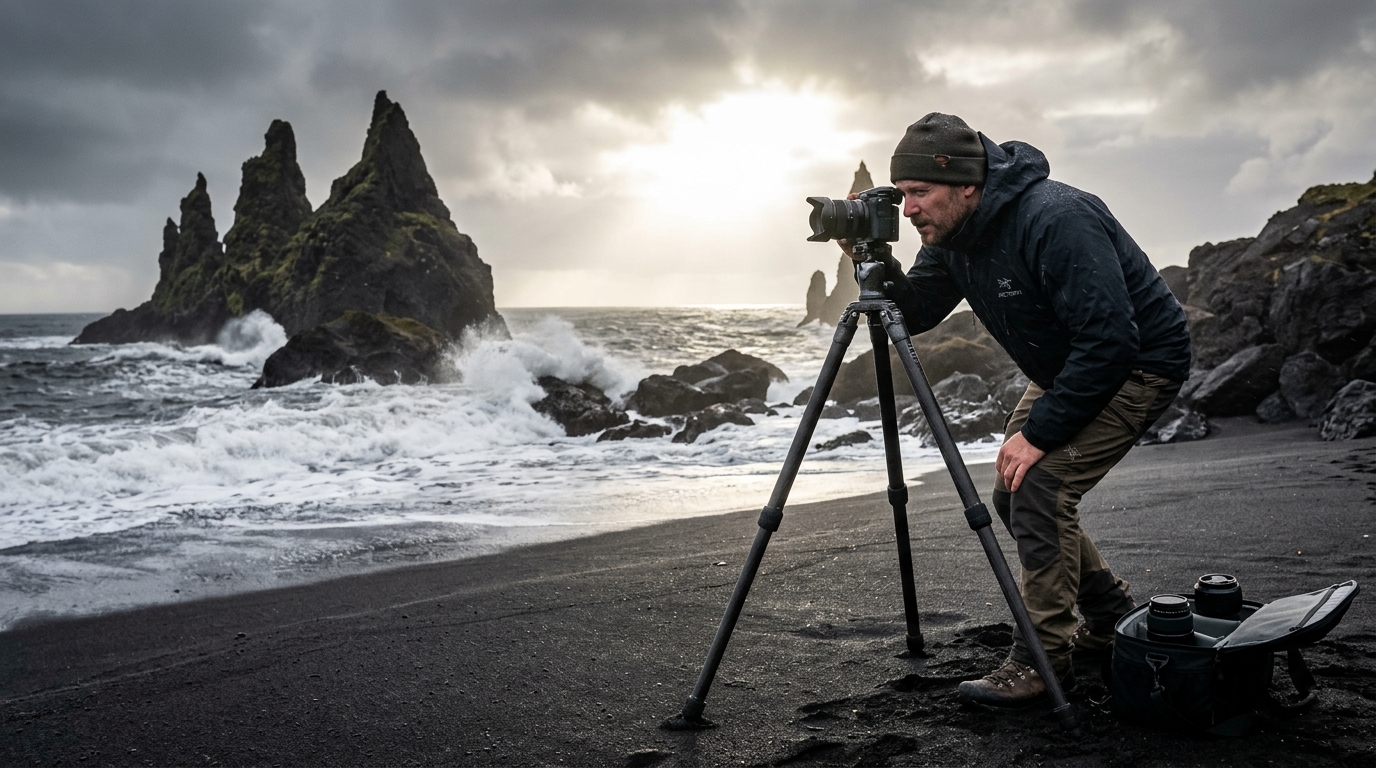
Iceland, the Land of Fire and Ice, offers photographers a canvas unlike any other. Its dramatic landscapes—volcanic beaches, towering glaciers, ethereal waterfalls, and rugged coastlines—are legendary. Yet, beneath this awe-inspiring beauty lies a formidable challenge: the light. Due to its high latitude and dynamic weather patterns, Iceland often presents photographers with extreme and rapidly changing lighting conditions. From the relentless glare of the midday sun to scenes with vast differences between bright skies and dark volcanic earth, photographing Iceland's harsh light demands skill, preparation, and a willingness to adapt.
Many photographers dream of capturing Iceland during the magical golden and blue hours. However, the reality of travel schedules and unpredictable weather means you'll inevitably find yourself shooting under less-than-ideal circumstances. This comprehensive guide is designed to equip you, the expert photographer, with the advanced strategies and practical techniques needed to not just survive, but thrive, when confronting Iceland’s most challenging light. We’ll explore everything from essential gear to creative post-processing, ensuring you can turn any extreme lighting situation into a photographic triumph.
Understanding Iceland's Unique Light Challenges
To master photographing Iceland's harsh light, it's crucial to first understand its unique characteristics. Iceland's geographical position, just south of the Arctic Circle, creates a lighting environment unlike anywhere else. These conditions are not merely inconvenient; they are intrinsic to the Icelandic landscape and offer unique creative opportunities for those prepared to embrace them.1
- The Midnight Sun Phenomenon: During the summer months (roughly May to August), Iceland experiences exceptionally long daylight hours. In June and July, the sun barely dips below the horizon, creating the famous "Midnight Sun." While this provides endless shooting time, the sun, even at its lowest point, can still be intensely bright. This low sun angle can create long, dramatic shadows and a prolonged "golden hour" that lasts for several hours, but it also means that what would typically be considered "midday" light can extend late into the evening, bringing with it the challenges of bright, direct illumination. Source: Guidetoiceland source.
- Short, Dramatic Winter Days: The inverse occurs in winter (November to February). Daylight hours are extremely limited, sometimes only 4-5 hours around the shortest day. However, this limited daylight is often incredibly soft and dramatic. The sun stays very low in the sky, creating an extended golden hour effect throughout much of the day. The challenge here isn't harshness, but rather the rapid changes in light quality as the sun arcs quickly, combined with often dark, overcast conditions that demand careful exposure management.
- High Dynamic Range Scenes: Iceland's landscapes are a masterclass in contrast. Imagine a bright, glacial tongue or a snow-capped peak under a clear sky, juxtaposed against a dark, volcanic black sand beach or a shadowed basalt column formation. Waterfalls, a quintessential Icelandic subject, often involve brilliant white spray against dark, wet rocks and a bright sky. These scenes present an enormous dynamic range, often exceeding what a single camera exposure can capture without losing detail in either the highlights or the shadows. This is where `high contrast iceland photography` really comes into play.
- Rapid Weather Shifts: Iceland's weather is famously fickle. It's not uncommon to experience all four seasons in a single day. A scene bathed in brilliant sunshine can transform into an overcast, misty, or even stormy tableau within minutes. This rapid fluctuation means photographers must constantly adjust their approach, exposure settings, and creative vision. While challenging, these shifts also offer incredible diversity in light quality, from piercing sun to diffused softboxes in an instant.
Essential Gear for Taming Intense Light
Conquering Iceland's extreme light begins with equipping yourself with the right tools. While a good camera is fundamental, a selection of high-quality filters and a sturdy tripod are arguably more critical for managing `dealing with bright sun iceland` scenarios.
-
Neutral Density (ND) Filters: These are your best friends for managing intense light. ND filters reduce the amount of light entering your lens, allowing for longer shutter speeds even in bright conditions. For a comprehensive guide on choosing and using ND filters, consult resources like B&H Photo Explora.2
- When to use them: Essential for smoothing out water (waterfalls, rivers, waves), blurring moving clouds, or creating a minimalist, ethereal look in brightly lit landscapes.
- Types: You'll want a range, from ND3 (3-stop) for slight reductions to ND1000 (10-stop) or even ND2000 (11-stop) for very long daytime exposures. A variable ND filter can offer convenience but may introduce color shifts or vignetting at extreme settings.
-
Circular Polarizer (CPL) Filters: A CPL filter is often considered an essential tool for Icelandic landscape photography.
- What they do: They reduce glare and reflections from non-metallic surfaces like water, wet rocks, and foliage, and they deepen blue skies while enhancing color saturation.
- When to use them: Perfect for making waterfalls pop by reducing reflections on wet rocks, cutting glare on lakes, and adding punch to an otherwise washed-out midday sky. Remember they work best at a 90-degree angle to the sun.
-
Graduated Neutral Density (GND) Filters: These filters are designed to balance exposure in scenes with a bright sky and a darker foreground—a common scenario in Iceland.
- Types: They come in various densities (e.g., 2-stop, 3-stop) and transitions (soft, medium, hard, reverse). Soft grads are versatile for uneven horizons (like mountains), while hard grads are better for flat horizons (like the sea). Reverse GNDs are excellent for sunrises/sunsets where the brightest part of the sky is near the horizon.
- System: A square filter system with a holder is generally preferred over screw-in GNDs, as it allows you to adjust the horizon line precisely.
- Lens Hoods: Often overlooked, a simple lens hood is vital for preventing lens flare when shooting into or near the sun, especially during the extended golden hours or when the sun is low. It also helps improve overall contrast by shielding the lens from stray light.
- Sturdy Tripods: For long exposures, bracketing, and precise composition, a robust tripod is non-negotiable. Iceland's winds can be ferocious, so invest in one that can handle strong gusts without vibrating. Carbon fiber models offer a good balance of stability and weight for hiking.
- Cameras with Good Dynamic Range and Bracketing Capabilities: Modern mirrorless and DSLR cameras excel at capturing a wide dynamic range, especially in their RAW files. Ensure your camera has a reliable auto-exposure bracketing (AEB) function, which is crucial for capturing high-contrast scenes efficiently.
Strategies for Photographing Iceland's Harsh Midday Sun
The midday sun, especially during Iceland's extended summer daylight, often means harsh, direct light, deep shadows, and blown-out highlights. While many photographers pack up during these hours, mastering iceland midday photography tips can unlock unique creative potential.
-
Seeking Natural Shade or Creating Your Own:
- Natural Shade: Look for opportunities where subjects are naturally shaded, such as within deep canyons (e.g., Fjaðrárgljúfur), under cliffs, or inside ice caves (though access varies by season and safety). Waterfalls often create their own shaded areas around the base, offering softer light.
- Artificial Shade: For smaller subjects or portraits, a large diffuser can soften direct sunlight. While impractical for vast landscapes, for intimate scenes or details, it can be a lifesaver.
-
Utilizing Strong Light for Dramatic Silhouettes and High-Key Images:
- Silhouettes: Position your subject (a lone church like Búðarkirkja, a person, or a distinct rock formation) directly against the bright sky or a reflective water surface. Expose for the background, letting the foreground fall into shadow. This emphasizes shape and form.
- High-Key: Embrace the brightness. Overexpose intentionally (but carefully) to create bright, airy images with minimal shadows. This works well for subjects like glaciers, snowfields, or light-colored geothermal areas, giving them an ethereal quality.
- Shooting Into the Sun for Sunbursts and Creative Lens Flare (with Caution): To achieve a starburst effect, use a small aperture (f/16 or higher) and position the sun peeking just over an object (a mountain peak, a rock, a lighthouse). This creates distinct rays. While often avoided, intentional lens flare can add a dreamy or cinematic feel. Experiment with different angles and lens hoods (or lack thereof) to control its intensity and placement. It's crucial to be cautious not to stare directly at the sun through your viewfinder, especially with telephoto lenses, as intense sunlight can cause severe and permanent eye damage.3
-
Focusing on Reflections in Water to Capture Softened Light:
- When the overhead light is too harsh, look down. Calm bodies of water (lakes, still rivers, tidal pools) can act as natural diffusers, reflecting the sky and softening the light. The reflected light is often less intense and more even than the direct light, offering beautiful, muted tones. Locations like Jökulsárlón or Fjallsárlón can be stunning for reflections, even at midday.
-
Converting to Black and White to Emphasize Form, Texture, and Contrast:
- Harsh light often creates strong contrasts and dramatic shadows that can be distracting in color but become powerful compositional elements in monochrome. By removing color, you force the viewer to focus on light, shadow, texture, and form. This is particularly effective for volcanic landscapes, basalt columns, or rugged coastlines. Consider converting to black and white in post-processing for maximum control.
Mastering High Contrast Scenes in Iceland
Iceland's landscapes frequently present scenes with an immense dynamic range, where bright skies and reflective surfaces meet deep shadows in volcanic rock or glacial crevices. `High contrast iceland photography` is a skill every serious photographer visiting the island must develop.
- Exposure Bracketing: Capturing Multiple Exposures: The Technique: This is your primary weapon against high contrast. Your camera takes a series of photos (typically 3, 5, or even 7) at different exposures—one correctly exposed for the mid-tones, one underexposed to capture highlight detail, and one overexposed to capture shadow detail. Implementation: Most modern cameras have an Auto Exposure Bracketing (AEB) function. Set it to capture at least 3 exposures, usually at +/- 1 or 2 stops. A tripod is often used for bracketing to ensure all frames align perfectly, especially in windy conditions or when using longer exposures.
-
High Dynamic Range (HDR) Photography Techniques and Software:
- Purpose: Once you have your bracketed exposures, you can merge them into a single HDR image using software like Adobe Lightroom, Photoshop, Aurora HDR, or Photomatix Pro. The software intelligently combines the best parts of each exposure to create an image with detail across the entire dynamic range.
- Considerations: While powerful, HDR can sometimes produce an unnatural, "painterly" look if overdone. Aim for a natural blend that enhances detail without looking artificial. Modern HDR algorithms are very sophisticated, allowing for subtle and realistic results.
-
Understanding Your Camera's Dynamic Range Limitations:
- Every camera sensor has a finite dynamic range. While RAW files offer significant latitude for recovery, there's a limit. Knowing your camera's strengths and weaknesses helps you decide when bracketing is absolutely necessary versus when a single, well-exposed RAW file can be sufficiently adjusted in post-processing. Generally, it's easier to recover detail from shadows than from blown-out highlights.
-
Using Fill Flash or Reflectors for Balancing Light on Subjects:
- Fill Flash: For close-up subjects or portraits in harsh light, a subtle fill flash can lift shadows and add sparkle to eyes without overpowering the natural light. Use it at a low power setting, often in combination with slow sync speed, to balance ambient light.
- Reflectors: A portable reflector can bounce available light onto your subject, softening harsh shadows and providing a more even illumination. Like diffusers, these are more practical for smaller scenes or people.
-
Composing to Minimize Extreme Contrast:
- Strategic Framing: Sometimes, the best solution is compositional. Can you frame out the brightest part of the sky? Can you move to a position where the sun isn't directly hitting the darkest elements of your scene? For example, when shooting a waterfall like Dettifoss, adjust your angle to minimize direct sun on the water while still capturing its power.
- Waiting for Clouds: A passing cloud can act as a giant diffuser, temporarily reducing contrast and making the scene more manageable. Patience is a virtue in Iceland!
Creative Approaches to Challenging Light
Rather than seeing harsh light as a limitation, view it as an opportunity for unique artistic expression. Some of the most compelling images come from photographers who aren't afraid to experiment with light, even when it's extreme.
-
Intentional Underexposure to Create Moody, Dramatic Images:
- Technique: Deliberately underexpose your shot by 1-2 stops, especially when the sky is bright and the foreground is dark. This can deepen colors, enhance textures, and create a sense of mystery or drama. It's particularly effective for stormy skies, dark volcanic beaches, or rugged mountainscapes.
- Effect: This approach often yields images with rich, saturated tones and a powerful atmosphere, especially when combined with a strong post-processing workflow to selectively lift shadows if needed.
-
Using Long Exposures to Smooth Out Bright Water or Skies:
- Purpose: As mentioned with ND filters, long exposures transform bright, choppy water into silky smooth surfaces and turn fast-moving clouds into streaky blurs. This simplifies the scene and emphasizes the static elements.
- Application: This is a classic technique for waterfall photography (like Seljalandsfoss or Skógafoss) and coastal scenes. Even under bright sun, a 10-stop ND filter can allow for exposures of several seconds, creating that signature ethereal look.
-
Focusing on Abstract Details, Textures, and Patterns Revealed by Strong Light:
- Shift Your Focus: When the grand landscape is overwhelming due to extreme light, zoom in. Strong, directional light can accentuate textures in ice, volcanic rock, black sand, or weathered wood. Look for patterns created by light and shadow.
- Examples: The intricate patterns in basalt columns (like at Reynisfjara), the shimmering details in a glacier, or the unique formations of lava fields can become compelling subjects in themselves.
-
Capturing Light Rays and Atmospheric Effects:
- God Rays: When the sun breaks through clouds or mist, it creates dramatic light rays (often called "God rays"). These are often enhanced by dust, mist, or rain in the air, which are common in Iceland. Position yourself to capture these ethereal beams as they illuminate parts of the landscape.
- Mist and Fog: Harsh light interacting with mist or fog can create beautiful, diffused scenes. While challenging to expose for, these conditions can lead to incredibly atmospheric and moody photographs.
-
Experimenting with Different White Balance Settings to Alter Mood:
- Beyond Auto WB: While Auto White Balance (AWB) is generally reliable, manually adjusting your white balance can profoundly impact the mood of a photo.
- Warm vs. Cool: A warmer white balance (e.g., "Cloudy" or "Shade") can enhance golden hour tones or make a cold scene feel slightly more inviting. A cooler white balance (e.g., "Fluorescent" or lower Kelvin values) can emphasize the starkness of ice and snow or the blue tones of twilight. Experiment in-camera or adjust precisely in post-processing.
Post-Processing Techniques for Harsh Light Photos
The journey of capturing stunning images in Iceland's harsh light doesn't end when you press the shutter. Post-processing is a critical phase where you can refine, recover, and enhance your vision, especially when dealing with challenging exposures.
- Recovering Blown-Out Highlights and Crushed Shadows in RAW Files: It's recommended to shoot in RAW format. RAW files contain significantly more data than JPEGs, offering immense flexibility to recover detail in both highlights and shadows. In Lightroom, Capture One, or similar software, the "Highlights" and "Shadows" sliders are your first line of defense. Pulling down highlights can often bring back detail in bright skies or clouds, while lifting shadows can reveal hidden elements in dark foregrounds. Be mindful of introducing noise when pushing shadows too far.
-
Using Local Adjustments (Gradient Filters, Radial Filters, Brushes) to Balance Exposure:
- Targeted Adjustments: Global adjustments affect the entire image. For high-contrast scenes, local adjustments are essential.
- Gradient Filters: Perfect for balancing bright skies against darker foregrounds. Apply a graduated filter to the sky to reduce exposure, lower highlights, or adjust white balance, leaving the foreground unaffected.
- Radial Filters: Useful for drawing attention to a specific subject or area, or for subtly brightening/darkening a circular or oval region.
- Adjustment Brushes: For precise control, brushes allow you to paint in adjustments to specific areas, such as lifting shadows under a rock formation or darkening a distracting bright spot.
-
Applying Dehaze and Clarity to Enhance Detail and Contrast:
- Dehaze: This slider (found in Lightroom/ACR) is fantastic for cutting through atmospheric haze, common in Iceland, and adding punch to skies and distant landscapes. Use it subtly to avoid an artificial look.
- Clarity: Increases mid-tone contrast, making textures pop. It's excellent for enhancing the ruggedness of volcanic rock, the details in ice, or the spray of a waterfall. Again, use with a light hand.
-
Careful Color Grading to Manage Intense Hues:
- Taming Saturation: Bright, direct light can sometimes lead to overly saturated colors. Use the HSL (Hue, Saturation, Luminance) panel in your editing software to selectively reduce saturation in specific colors that appear too strong, or to adjust their luminance for a more balanced look.
- Split Toning/Color Grading: Experiment with split toning or more advanced color grading tools to add a specific mood or aesthetic to your images. For example, adding cool tones to shadows and warm tones to highlights can enhance the dramatic feel of an Icelandic landscape.
Frequently Asked Questions
What are the best times of year to photograph Iceland's light?
Iceland offers unique lighting year-round. Summer (May-August) features the "Midnight Sun," providing endless daylight and extended golden hours, ideal for long shooting sessions. Winter (November-February) has very short, dramatic daylight hours with the sun staying low, creating a prolonged soft, golden light perfect for moody landscapes and aurora photography. Spring and autumn offer a balance, with changing light and fewer crowds.
What essential gear should I bring for challenging light in Iceland?
Key gear includes a sturdy tripod to combat wind and enable long exposures, and a range of filters. Neutral Density (ND) filters are crucial for managing bright light and smoothing water, while Circular Polarizer (CPL) filters reduce glare and enhance colors. Graduated Neutral Density (GND) filters help balance bright skies with darker foregrounds. Lens hoods are also vital for preventing flare.
How can I avoid blown-out skies or dark shadows in my Iceland photos?
To manage high contrast, utilize exposure bracketing to capture multiple exposures (underexposed for highlights, overexposed for shadows, and a mid-tone). These can then be merged in post-processing using HDR techniques. Additionally, use GND filters in-camera, or employ local adjustments like gradient filters and adjustment brushes in software to balance exposure across your image.
Is it possible to take good photos in Iceland during midday?
Absolutely! While midday sun can be harsh, it offers unique creative opportunities. You can seek natural shade in canyons or behind cliffs, use strong light for dramatic silhouettes, or create high-key images of glaciers and snowfields. Focusing on reflections in water can also soften the light, and converting to black and white can emphasize form and texture over distracting colors.
How can Iceland Photo Map help me plan my photography trip around light conditions?
Iceland Photo Map provides detailed location guides and maps that can help you scout ideal spots for different times of day and light conditions. By understanding the orientation of locations and potential light angles, you can better plan your itinerary to maximize your chances of capturing stunning images, whether you're chasing the golden hour or mastering midday challenges.