Golden Circle Photo Spots: The Ultimate Iceland Photography Guide
Welcome to the Land of Fire and Ice, a destination that sits at the very top of almost every landscape photographer's bucket list. If you are planning a trip to this magnificent country, finding the best Golden Circle photo spots should be your first priority. This iconic route offers a concentrated dose of Iceland’s raw, untamed beauty, making it the perfect introduction to the island's dramatic scenery. From towering waterfalls and erupting geysers to the jagged edges of tectonic plates pulling apart, the photographic opportunities are truly endless.
Whether you are a seasoned professional with a bag full of lenses or an enthusiastic beginner looking to capture the perfect travel memories, navigating this famous route requires a bit of planning. In this comprehensive guide, we will break down exactly where to go, what gear to bring, and how to master the camera settings needed to capture the magic of Iceland. Let's dive into the ultimate itinerary for photographing the Golden Circle.
Why Golden Circle Photo Spots Are a Must for Every Photographer
The Golden Circle is a renowned 300-kilometer (186-mile) circular route in southern Iceland. While the entire country is a paradise for visual artists, the Golden Circle photo spots remain a staple for very good reasons. First and foremost is the sheer concentration of world-class subjects. Nowhere else on the island can you photograph a massive glacial waterfall, an active geothermal geyser, and the rift valley of two continental tectonic plates all within a few hours' drive of one another.
Furthermore, accessibility plays a massive role in the route's popularity. Starting and ending in Reykjavik, the Golden Circle can easily be completed as a day trip. This makes it an ideal excursion for photographers who have limited time, or those who want to use the capital city as a comfortable basecamp before venturing further along the Ring Road. The roads are fully paved and well-maintained year-round, meaning you don't need a specialized 4x4 vehicle to reach these iconic locations.
Finally, the incredible diversity of the terrain is a major draw. Within a single day, you will transition from capturing the lush, green moss of a historic national park to the barren, steaming earth of a geothermal valley. By exploring our interactive maps of diverse Icelandic landscapes, you can see just how drastically the scenery changes over short distances, allowing you to build a rich, varied portfolio in a matter of hours.
Essential Gear for Your Golden Circle Photography Guide
To truly make the most of your trip, having the right equipment is just as important as knowing the locations. No Golden Circle photography guide would be complete without a deep dive into the essential gear required to tackle Iceland's unique and often challenging environmental conditions.
- Wide-Angle Lenses: The landscapes in Iceland are massive. To truly capture the sweeping scale of the tectonic plates at Thingvellir or the expansive canyon at Gullfoss, a wide-angle lens is non-negotiable. A focal length between 14mm and 24mm (on a full-frame camera) is ideal for fitting these colossal scenes into a single frame.
- Telephoto Lenses: While wide-angles are standard, don't leave your telephoto lens at the hotel. A 70-200mm lens is fantastic for isolating specific details, such as the boiling steam vents at Geysir or compressing the distant mountain peaks against the horizon.
- Sturdy Tripod: Iceland is notoriously windy. A flimsy travel tripod will result in blurry images and could easily be blown over, damaging your camera. Invest in a sturdy, carbon-fiber tripod with spiked feet to ensure stability during long exposure shots, especially when standing on icy or uneven terrain.
- ND Filters and Circular Polarizers: Neutral Density (ND) filters are essential for achieving that silky, smooth look on waterfalls and moving clouds. A 6-stop or 10-stop ND filter will allow you to shoot long exposures even in broad daylight. Additionally, a circular polarizer will help cut through the glare on wet rocks and enhance the natural greens and blues of the landscape.
- Weather-Sealed Gear and Microfiber Cloths: The weather in Iceland can change from bright sunshine to horizontal rain in five minutes. Furthermore, the massive waterfalls generate heavy, soaking mist. Ensure your camera body and lenses are weather-sealed. Bring a rain sleeve for your camera and pack at least five to ten microfiber cloths—you will need to wipe your lens constantly when shooting near the falls.
Thingvellir Photography: Capturing the Continental Divide
Your first major stop when departing Reykjavik will be Thingvellir (Þingvellir) National Park, a UNESCO World Heritage site of immense historical and geological importance. This is the only place in the world where you can stand in the rift valley between the North American and Eurasian tectonic plates. Thingvellir photography is all about capturing dramatic textures, leading lines, and the fascinating intersection of history and nature.
One of the best compositions in the park is framing the Almannagjá gorge. The towering, jagged rock walls of the tectonic plates create natural leading lines that draw the viewer's eye through the image. Look for interesting foreground elements, such as colorful autumn brush or geometric basalt rocks, to give your photos depth and scale.
While exploring the gorge, you will undoubtedly hear the roar of Öxarárfoss. This stunning waterfall cascades directly over the edge of the tectonic plate and tumbles into a rocky pool below. When photographing Öxarárfoss, set up your tripod low to the ground to include the dark, wet rocks in the foreground. Use an ND filter to drag your shutter speed to around 1 to 2 seconds. This specific shutter speed retains some texture in the falling water while still providing a beautiful, ethereal blur.
The best lighting conditions for Thingvellir occur during the golden hour. Because the park features deep gorges and high rock walls, midday sunlight creates harsh, unmanageable shadows. Arriving at sunrise allows the soft, warm light to illuminate the moss-covered rocks and reflect off the calm waters of Thingvallavatn, the largest natural lake in Iceland.
Geysir Geothermal Area: Timing the Perfect Eruption Shot
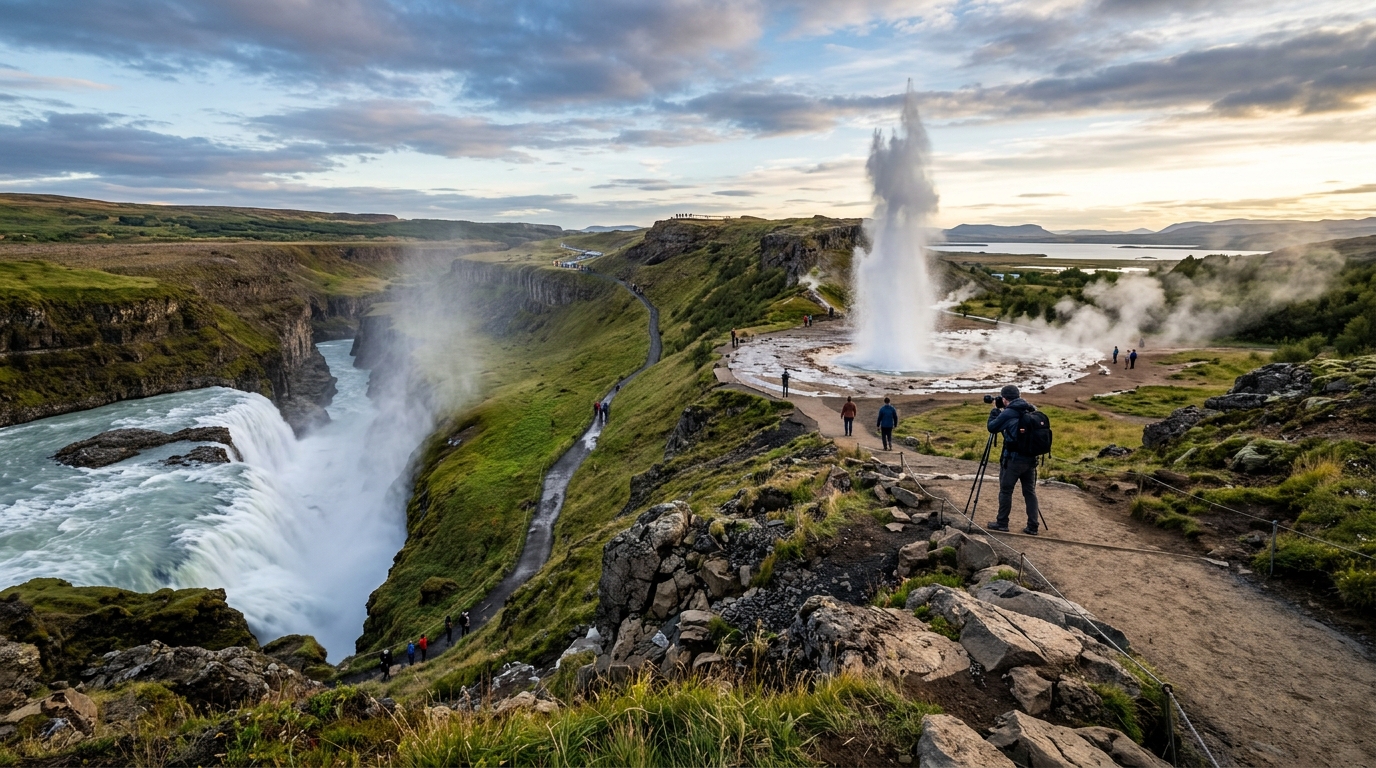
Continuing along the route, your next destination is the Haukadalur geothermal area, home to the Great Geysir (which gave all geysers their name) and the highly active Strokkur geyser. While the Great Geysir is largely dormant today, Strokkur is a photographer's dream, erupting every 5 to 10 minutes and shooting boiling water up to 30 meters (100 feet) into the air.
Timing the perfect eruption shot requires patience, anticipation, and the right camera settings. Because the eruption happens in a fraction of a second, you must freeze the action. Switch your camera to Shutter Priority (or Manual) mode and dial in a fast shutter speed of at least 1/1000th of a second. Ensure your camera is set to continuous high-speed shooting (burst mode).
The most coveted shot among professional photographers is the "blue bubble." Just milliseconds before the water column shoots into the sky, the surface tension of the pool stretches into a massive, translucent blue dome. To capture this, pre-focus on the surface of the pool, lock your focus, and begin holding down your shutter button the moment you see the water begin to swell.
Beyond the geyser itself, the entire geothermal area is filled with bubbling mud pots, steaming fumaroles, and vividly colored earth. The mineral deposits paint the ground in striking shades of sulfur yellow, copper red, and vibrant green. Use a polarizing filter to cut the glare on the hot springs, revealing the stunning, deep blue clarity of the boiling water below.
Gullfoss Photo Locations: Mastering the Golden Falls
Just a short ten-minute drive from Geysir lies the crown jewel of the route, and one of the most famous Gullfoss photo locations. Gullfoss, which translates to "Golden Falls," is a massive, two-tiered waterfall where the glacial river Hvítá plunges 32 meters into a deep, dramatic canyon. The sheer volume and power of the water are staggering, making it a spectacular subject for landscape photography.
When you arrive, you will find two main perspectives to shoot from: the upper viewing deck and the lower path. The upper viewing deck provides a fantastic panoramic vantage point. From here, you can use a wide-angle lens to capture the entirety of the falls, the deep canyon stretching into the distance, and the distant Langjökull glacier on a clear day. This is also the best spot to capture the massive rainbows that frequently form in the waterfall's mist during sunny afternoons.
The lower path takes you right to the edge of the roaring water. This perspective is incredibly intimate and showcases the sheer power of the falls. However, this is where your weather-sealed gear and microfiber cloths will be put to the test. The mist generated by Gullfoss is equivalent to a heavy rainstorm. To get a clear shot, compose your frame, dial in your settings, cover your lens with a cloth, and only remove the cloth at the exact moment you press the shutter.
If you want to practice smoothing out the massive volume of water, this is a prime location. By utilizing a 6-stop ND filter, you can slow your shutter speed down to 0.5 or 1 second. Be sure to include the jagged, dark canyon walls in your frame to provide a stark, static contrast to the dynamic, blurred motion of the water. For more inspiration on capturing these natural wonders, explore our guide to photographing Iceland's majestic waterfalls.
Hidden Gems: Lesser-Known Golden Circle Photo Spots
While Thingvellir, Geysir, and Gullfoss make up the "Big Three" of the route, there are several lesser-known Golden Circle photo spots that are equally stunning and far less crowded. Adding these hidden gems to your itinerary will elevate your photography portfolio and provide a more unique perspective of the Icelandic landscape.
Brúarfoss: Capturing Iceland's Bluest Waterfall
Brúarfoss is often referred to as Iceland's bluest waterfall. Fed by glacial meltwater, the river cascades into a deep, narrow crevice, creating a striking, almost neon-blue color. While it requires a bit of a hike to reach (about 1.5 hours round trip), the photographic reward is immense. A circular polarizer is absolutely essential here to remove the glare from the water's surface, allowing the camera to capture the true depth and vibrancy of the blue hues.
Kerið Volcanic Crater: A Study in Contrast
Kerið is a striking volcanic crater lake located just off the main Golden Circle route. What makes Kerið a fantastic photo spot is the intense color contrast. The walls of the crater are composed of deep red volcanic rock, dotted with vibrant green neon moss, all surrounding a pool of opaque, teal water at the bottom. A wide-angle lens is necessary to fit the entire crater into your frame from the upper rim. Alternatively, you can walk down to the water's edge for a unique, upward-facing perspective.
Faxi Waterfall: The Quiet Alternative
Often bypassed by the massive tour buses, Faxi (also known as Vatnsleysufoss) is a wide, serene waterfall located on the Tungufljót river. While it lacks the towering height of Gullfoss, its width and peaceful surroundings make it an excellent location for practicing your long exposure photography without the pressure of crowds jostling your tripod. It is an idyllic spot to capture the midnight sun reflecting off the gentle cascades during the summer months.
Best Stops Golden Circle Iceland: Itinerary & Logistics
To capture the best lighting and avoid the crowds, planning your logistics is crucial. When researching the best stops Golden Circle Iceland has to offer, you must factor in driving times, crowd management, and seasonal weather conditions.
Driving Times and Route Planning: The pure driving time for the entire loop starting and ending in Reykjavik is approximately 3.5 hours. However, for a dedicated photography trip, you should allocate a minimum of 8 to 10 hours. A common breakdown looks like this: Reykjavik to Thingvellir (45 minutes), Thingvellir to Geysir (50 minutes), Geysir to Gullfoss (10 minutes), and the return trip via Kerið crater (1.5 hours).
Avoiding the Crowds: The Golden Circle is the most popular tourist route in Iceland. Between 10:00 AM and 4:00 PM, the major sites are packed with dozens of massive tour buses. To get clean landscape shots without hundreds of people in your frame, you must shoot outside of these hours. Renting a car and driving yourself is essential. Aim to arrive at your first location by 6:00 AM, or alternatively, start your tour late in the afternoon and shoot into the evening.
Seasonal Considerations: Your experience will vary wildly depending on the time of year. During the summer (June to August), Iceland experiences the Midnight Sun. This provides nearly 24 hours of daylight and an incredibly prolonged "golden hour" that lasts for hours in the middle of the night—perfect for crowd-free, beautifully lit photography. In contrast, winter (December to February) offers only 4 to 5 hours of daylight. However, the landscape is transformed into a snowy, frozen wonderland, and the long, dark nights provide the perfect canvas for photographing the Northern Lights dancing over the frozen waterfalls. To find the exact coordinates of these locations, you can browse our directory of top photography sites across the country.
Conclusion: Mapping Out Your Iceland Photography Adventure
Photographing the Golden Circle is an unforgettable experience. From the historic, moss-draped tectonic plates of Thingvellir and the explosive power of Strokkur geyser, to the roaring, misty depths of Gullfoss, this 300-kilometer loop offers a lifetime of photographic opportunities in a single day. By packing the right gear, understanding the ideal camera settings, and venturing slightly off the beaten path to hidden gems like Brúarfoss and Kerið, you will return home with a truly spectacular portfolio.
As you plan your journey, we highly encourage you to utilize digital tools to maximize your time. Knowing exactly where to park, where the trails begin, and where the best vantage points are located saves precious hours of daylight. Before you pack your camera bag, learn how to use our interactive maps to seamlessly plan your daily routes.
Finally, as landscape photographers, it is our duty to protect the environments we capture. The Icelandic nature, particularly the moss, is incredibly fragile and takes decades to recover if trampled. Always stay on marked paths, respect safety barriers at the cliffs and geothermal areas, and practice Leave No Trace principles. By doing so, we ensure these magnificent Golden Circle photo spots remain pristine for generations of photographers to come.
Frequently Asked Questions
What is the best time of day to photograph the Golden Circle?
The best time to photograph the Golden Circle is either very early in the morning (before 9:00 AM) or late in the evening (after 6:00 PM). During these times, you will avoid the massive crowds brought in by commercial tour buses, ensuring clean, people-free landscape shots. Additionally, these times align with the "golden hour," providing soft, warm, directional light that enhances the textures of the waterfalls and canyons, whereas midday light in Iceland can be quite harsh and flat.
How long does it take to drive and photograph the entire Golden Circle?
While the actual driving time for the 300-kilometer loop is only about 3.5 hours, photographers should plan for an 8 to 10-hour day. This allows for 1 to 2 hours of shooting at each of the major locations (Thingvellir, Geysir, and Gullfoss), plus additional time to hike to hidden gems like Brúarfoss, set up tripods, experiment with long exposures, and account for unpredictable weather changes.
Do I need a drone for Golden Circle photography?
While drones can capture incredible aerial perspectives of Iceland, they are strictly prohibited at all the major Golden Circle locations, including Thingvellir National Park, the Geysir geothermal area, and Gullfoss waterfall. These rules are enforced to protect the delicate environment, ensure the safety of the thousands of visitors, and preserve the natural tranquility of the sites. You can capture stunning, professional-grade images using standard wide-angle and telephoto lenses from the designated walking paths.
Are the Golden Circle photo spots accessible in winter?
Yes, the Golden Circle is accessible year-round. The main roads connecting Reykjavik, Thingvellir, Geysir, and Gullfoss are paved and regularly plowed during the winter months. However, winter photography requires extra preparation. You will need microspikes for your boots, as the paths around the waterfalls become incredibly icy from frozen mist. You should also bring extra camera batteries, as cold temperatures drain battery life much faster. The reward, however, is photographing a magical, snow-covered landscape and potentially capturing the Northern Lights.
Ready to plan your exact route? Explore our interactive Iceland Photography Map to find the exact coordinates for all these Golden Circle photo spots and more!