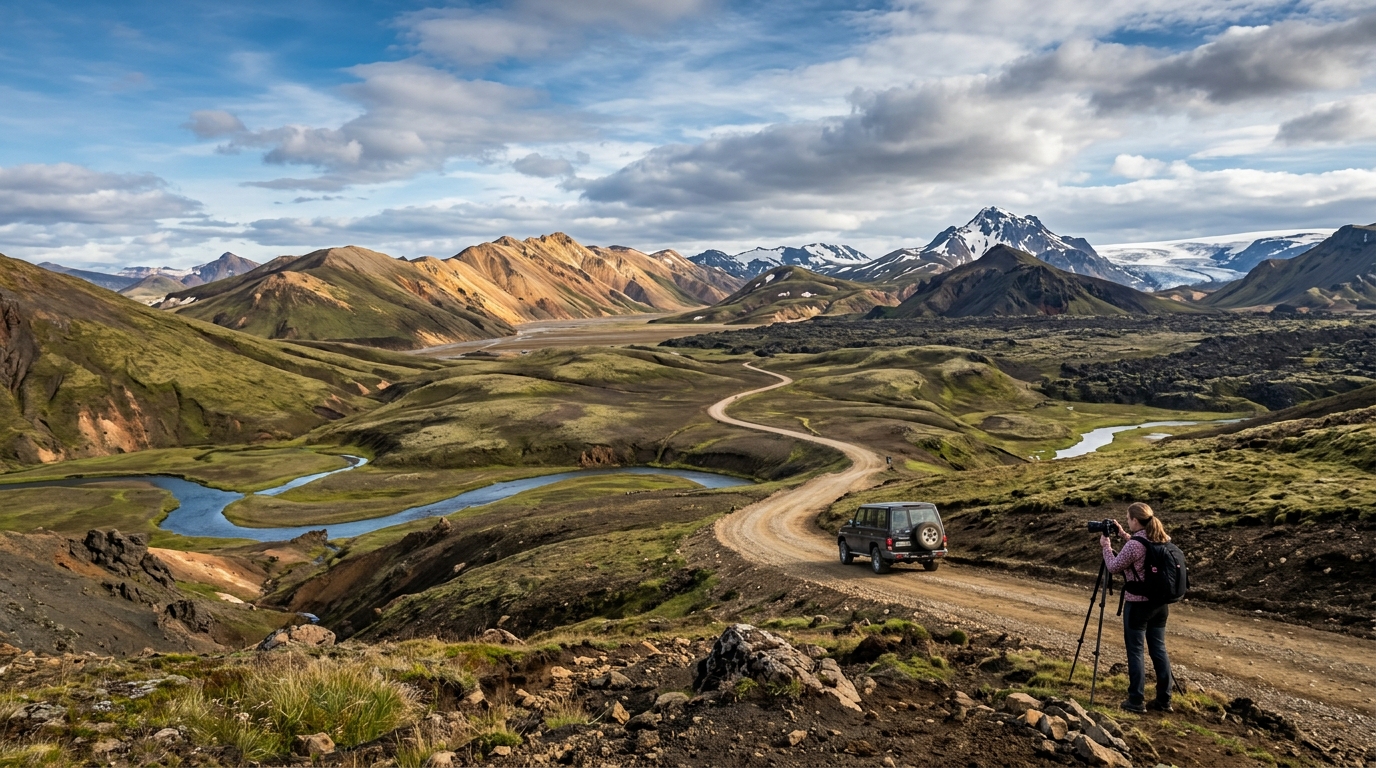
Introduction: The Raw Beauty of the Interior
When most travelers envision a trip to the Land of Fire and Ice, they picture the iconic waterfalls of the South Coast, the majestic glacier lagoons, and the dramatic sea cliffs that line the famous Ring Road. However, for those willing to venture off the beaten path, the true heart of the country lies deep within its rugged interior. Finding the best Iceland highlands photography spots is a rite of passage for landscape photographers seeking untouched, otherworldly terrain. Here, the paved roads end, and a vast, wild wilderness of colorful mountains, steaming geothermal vents, and sweeping black sand deserts begins.
The highlands offer some of the most unique landscape photography opportunities in the world. Unlike the accessible coastal routes, the interior challenges you with unpredictable weather, unbridged river crossings, and rough dirt tracks. But the reward for this effort is unparalleled. You will find yourself standing before sweeping vistas that look more like Mars or a fantasy realm than planet Earth, often with absolutely no one else around to disrupt your composition.
In this comprehensive guide, we will set your expectations for a successful highland expedition. We will cover the absolute must-visit locations, detail the essential camera gear you need to survive the elements, and provide critical travel tips for navigating the challenging terrain. Whether you are aiming to capture the vibrant rhyolite peaks or the haunting beauty of a glacial river delta from above, this guide will help you prepare for the ultimate photographic adventure.
Why You Must Visit These Iceland Highlands Photography Spots
If you have ever driven the Ring Road during the peak summer months, you know that Iceland's popularity has skyrocketed. While locations like Skógafoss and Kirkjufell are undeniably beautiful, it can be incredibly frustrating to wait for crowds of tourists to clear out of your frame. The highlands offer a stark and welcome contrast. By venturing into the interior, you trade the tour buses and crowded viewing platforms for absolute solitude. The isolation allows you to take your time, study the light, and connect with the landscape on a much deeper level.
The geological features found at these Iceland highlands photography spots are entirely distinct from the rest of the country. The volcanic activity beneath the surface has scarred and shaped the land into a surreal tapestry of textures and colors. You will encounter towering rhyolite mountains painted in shades of mustard yellow, rust red, and seafoam green. You will drive through vast, desolate black sand deserts that stretch to the horizon, interrupted only by the neon green moss that clings to ancient lava fields. Glacial rivers weave through the valleys, creating intricate, braided patterns that are a dream to photograph, especially if you have a drone.
However, accessing this pristine wilderness comes with a significant catch: a very short travel window. The highland roads, known as F-roads, are strictly regulated and only open for a brief period during the summer, typically from mid-June to early September. For the rest of the year, the interior is buried under impassable snow and ice. This fleeting accessibility makes planning your trip all the more critical. You must be ready to strike when the roads open, armed with a solid itinerary and a reliable 4x4 vehicle to conquer the rugged terrain.
Photographing Landmannalaugar: The Colorful Mountains
No trip to the interior is complete without photographing Landmannalaugar. Nestled within the Fjallabak Nature Reserve, this area is world-renowned for its brilliantly colored rhyolite mountains and expansive lava fields. The mineral-rich earth creates a mesmerizing palette of pinks, greens, yellows, and blacks, making it a playground for landscape photographers looking to capture striking contrasts and abstract natural patterns.
To get the best vantage points, you need to hit the hiking trails. While the view from the valley floor near the campsite is beautiful, gaining elevation is key to revealing the true scale and color of the region. The hike up Mt. Bláhnúkur (Blue Peak) is arguably the most rewarding for photographers. As you ascend the steep, dark blue-black slopes, panoramic views of the surrounding colorful valleys open up. A wide-angle lens is excellent for capturing the sweeping vistas, but do not forget to use a telephoto lens (such as a 70-200mm) to isolate specific peaks, compress the colorful ridges, and create stunning abstract compositions.
Lighting conditions in Landmannalaugar can dramatically alter the appearance of the landscape. While golden hour provides a beautiful, warm directional light that accentuates the ridges and valleys, overcast days are surprisingly ideal for this specific location. Soft, diffused light eliminates harsh, distracting shadows and allows the vibrant pastel colors of the rhyolite rock to truly pop. If you are blessed with dramatic, moody skies or a passing rainstorm, the wet rock will appear even more saturated. Using a circular polarizer is highly recommended here to cut through the atmospheric haze and enhance the natural saturation of the mountains and the lush green moss.
Kerlingarfjoll Photo Spots: Geothermal Wonders
Located in the central highlands, the Kerlingarfjöll mountain range is another crown jewel of the Icelandic interior. The highlight of this area for photographers is the Hveradalir geothermal valley. Stepping into Hveradalir feels like stepping onto another planet. The valley is a labyrinth of rust-orange clay mountains, bubbling mud pots, and roaring fumaroles that constantly spew thick white steam into the cool mountain air.
When seeking out the best Kerlingarfjoll photo spots, the wooden staircases and winding paths that descend into the valley offer numerous elevated perspectives. The key to a successful photograph here is capturing the dramatic contrast of the environment. In the early summer or early autumn, you will often find patches of pure white snow clinging to the bright orange and red geothermal clay. When combined with the billowing steam and the deep blue of the sky (or the brooding gray of a storm), the color palette is simply extraordinary.
Photographing in a highly active geothermal area requires special care for your gear. The steam rising from the vents is heavily laden with sulfur and moisture, which can quickly coat your lens element and potentially damage your camera's internal electronics if exposed for too long. Always keep a microfiber cloth handy to wipe down your front element or filters between shots. It is best to shoot from a slight distance using a mid-range zoom lens to compress the steam against the mountainsides, rather than standing directly in the path of the fumaroles. Additionally, be patient; the wind constantly shifts the steam, revealing and obscuring different parts of the landscape. Shoot in burst mode when the steam parts to reveal the perfect composition.
More Must-See Iceland Highlands Photography Spots: Fjallabak & Fagrifoss
Beyond the famous hubs of Landmannalaugar and Kerlingarfjöll, the highlands are brimming with hidden gems. The greater Fjallabak Nature Reserve encompasses a massive area of sweeping, untouched landscapes that see far fewer visitors. Driving the winding F-roads through this reserve reveals endless opportunities for roadside photography. You will find mirror-like crater lakes, jagged volcanic spires, and expansive valleys carved by ancient glaciers. The sheer emptiness of Fjallabak allows you to capture the profound isolation that defines the Icelandic interior.
Another incredible Iceland highlands photography spots destination is Fagrifoss, which translates to "Beautiful Waterfall." Located on the F206 road en route to the famous Laki craters, this lesser-known highland waterfall is an absolute masterpiece. The river drops dramatically over a rugged, moss-covered cliff face into a deep gorge. Because it is located on a challenging 4x4 route, you will likely have the waterfall entirely to yourself.
When photographing massive landscapes like Fjallabak or towering features like Fagrifoss, composition is everything. It can be difficult to convey the immense scale of these locations in a two-dimensional image. To solve this, always look for a sense of scale. Include a distant Super Jeep, a tiny hiker on a ridge, or a small flock of highland sheep in your frame. For Fagrifoss, use a sturdy tripod and a neutral density (ND) filter to experiment with long exposures. A shutter speed of 0.5 to 2 seconds will beautifully blur the cascading water while maintaining the sharp, aggressive textures of the surrounding volcanic rock.
Mastering Iceland F-Roads Photography and Travel
To access the interior, you must travel on F-roads (Fjallavegir), which are rugged mountain tracks maintained only during the short summer season. Iceland F-roads photography is an adventure in itself, but it requires serious preparation. These roads are unpaved, full of deep potholes, large boulders, and steep inclines. By Icelandic law, and for your own physical safety, an AWD or 4x4 vehicle is an absolute necessity to drive on any road marked with an "F".
The most daunting aspect of F-road travel is the unbridged river crossings. Glacial rivers can swell rapidly depending on rainfall and temperature (which causes glacier melt). Never cross a river if you are unsure of its depth, and always cross downstream at an angle. For photographers, these river crossings also present incredible photo opportunities. If you are traveling with another vehicle, coordinate to photograph their Super Jeep splashing through the water, capturing the rugged essence of highland exploration.
The beauty of F-road travel is that the journey is just as photogenic as the destination. The weather in the highlands changes by the minute, casting dynamic light and dramatic shadows across the barren landscape. Keep your camera easily accessible in the passenger seat. You will frequently want to make impromptu stops to photograph a sudden rainbow over a black sand desert or a shaft of sunlight piercing through heavy storm clouds to illuminate a lone mountain peak. Just ensure you pull over safely, as the roads are narrow and blind crests are common.
Essential Gear for Highland Landscape Photography
Photographing the harsh environment of the Icelandic interior demands a well-thought-out gear kit. The conditions are unforgiving, and being underprepared can result in missed shots or damaged equipment. First and foremost, your lens selection is crucial. A high-quality wide-angle lens (such as a 16-35mm) is essential for capturing the vast, sweeping landscapes, dramatic foregrounds, and expansive skies. However, a telephoto lens (like a 70-200mm or even a 100-400mm) is equally, if not more, important in the highlands. A telephoto allows you to compress distant mountain peaks, isolate abstract patterns in the rhyolite hills, and photograph distant river braids without losing detail.
A sturdy, heavy-duty tripod is non-negotiable. The highlands are notorious for aggressive, howling winds that can easily knock over a lightweight travel tripod or cause micro-vibrations that ruin long-exposure shots. Look for a carbon fiber tripod with a hook at the bottom of the center column, allowing you to hang your camera bag for added stability.
Weather-sealing is your best friend in Iceland. Even in the middle of summer, you can experience rain, sleet, snow, and sandstorms all in a single day. Ensure your camera body and lenses are weather-sealed, and pack dedicated rain covers for your gear. Bring plenty of microfiber cloths to constantly clean your lenses from rain and mist. Finally, cold temperatures drain lithium-ion batteries rapidly. Always pack three to four extra batteries and keep the spares in an inside pocket of your jacket so your body heat keeps them warm and fully charged.
Using an Iceland Highlands Map to Plan Your Route
Because the highlands are vast, remote, and completely devoid of traditional road signs or tourist information centers, meticulous planning is required. You cannot simply drive into the interior and hope to stumble upon the best locations. This is where utilizing a dedicated Iceland highlands map becomes a game-changer for your photography itinerary.
Using the Iceland Photo Map platform allows you to find exact GPS coordinates for both famous landmarks and hidden gems. When you are navigating a maze of dirt tracks, having precise coordinates ensures you don't waste precious daylight driving down the wrong F-road. Furthermore, cell service is virtually non-existent once you leave the Ring Road. It is absolutely critical that you download offline maps to your phone or GPS device before you lose your signal.
To optimize your road trip, you can use our platform to filter locations based on your specific photographic interests. For example, if you want to focus entirely on dramatic vistas, you can explore our landscape photography map to build a custom route connecting the most striking valleys, mountains, and volcanic craters. Grouping locations geographically will save you hours of driving on rough terrain, allowing you to spend more time behind the lens and less time behind the wheel.
Conclusion: Start Planning Your Highland Adventure
The Icelandic highlands offer a landscape photography experience unlike anywhere else on the planet. From the vibrant, colorful slopes of Landmannalaugar to the steaming, alien valleys of Kerlingarfjöll, the interior provides an endless canvas of raw, dramatic beauty. By venturing onto the F-roads, you escape the crowds and immerse yourself in the true, untamed spirit of Iceland.
As you plan your journey to these incredible Iceland highlands photography spots, please remember that this environment is incredibly fragile. The moss that covers the lava fields takes hundreds of years to grow and can be destroyed by a single footstep. Always practice Leave No Trace principles, stay on marked trails, and never drive off-road. Respecting the landscape ensures that these pristine locations remain beautiful for generations of photographers to come.
Ready to capture the raw beauty of the interior? Explore our interactive Iceland Photo Map to get exact GPS coordinates for these highland locations and plan your ultimate photography road trip today!
Frequently Asked Questions
When is the best time to visit the Iceland highlands for photography?
The best and only practical time to visit the highlands is during the short summer window, typically from mid-June to early September. During this time, the snow melts enough for the authorities to open the F-roads. For photography, late August to early September is particularly magical. The crowds begin to thin, the midnight sun fades to provide true, dark nights (offering a chance to photograph the Northern Lights), and the autumn colors begin to turn the low-lying highland vegetation into vibrant shades of red and gold.
Do I absolutely need a 4x4 vehicle for Iceland F-roads photography?
Yes, absolutely. It is illegal to drive a standard 2WD rental car on any road marked with an "F" in Iceland. Doing so will void your rental insurance and put you in severe physical danger. F-roads feature deep potholes, steep inclines, loose gravel, and unbridged river crossings. For the best safety and clearance, rent a large 4x4 SUV or a modified Super Jeep, especially if you plan to visit areas with known deep river crossings like the route to Askja or Þórsmörk.
Are drones allowed in the Iceland highlands?
Generally, drones are allowed in Iceland, and the highlands offer some of the most spectacular aerial photography opportunities in the world, particularly over braided glacial rivers. However, there are strict exceptions. Drones are strictly banned in all National Parks (such as Vatnajökull National Park, which covers a large portion of the highlands) and in certain protected nature reserves, unless you have obtained a special permit well in advance. Always check local signage and the environment agency's website. Furthermore, the highland winds are notoriously fierce; always check wind speeds before taking off to avoid losing your drone.
How do I protect my camera gear from Iceland's harsh highland weather?
Highland weather is notoriously unpredictable, often shifting from sunshine to horizontal rain in minutes. To protect your gear, always keep a dedicated rain cover attached to your camera bag. Use specialized camera rain sleeves when shooting in wet conditions or near splashing waterfalls. Protect your lens's front element by attaching a high-quality UV or clear protective filter, which is much cheaper to replace than a scratched lens. Bring a generous supply of microfiber cloths to wipe away mist and volcanic dust. Finally, when moving from the cold outdoors into a warm vehicle or tent, leave your camera in its bag to acclimatize slowly, preventing internal condensation from forming on your sensor and lenses.