The Complete Iceland Winter Photography Guide: Spots, Safety, and Lighting
Introduction: The Magic of Iceland in Winter
There is arguably no place on earth that transforms quite as magically as Iceland during the coldest months of the year. Imagine standing beneath a sky ablaze with the dancing green ribbons of the Northern Lights, or listening to the deafening roar of a partially frozen waterfall as it crashes into a snow-covered canyon. Welcome to the ultimate Iceland winter photography guide. If you are seeking to capture the ethereal, otherworldly beauty of this Nordic island, the winter season offers an unparalleled canvas of deep blue ice, stark black volcanic rock, and pristine white snow.
However, capturing this raw beauty requires more than just a good eye and a high-end camera. The Icelandic winter is notoriously fierce, unpredictable, and entirely unforgiving. In this comprehensive Iceland winter photography guide, we will cover absolutely everything you need to know to ensure your trip is a resounding success. We will dive deep into the essential gear required to protect both you and your equipment, pinpoint the most breathtaking locations, outline crucial safety protocols, and share expert advice on mastering tricky winter lighting.
Whether you are an amateur enthusiast or a seasoned professional, photographing this spectacular country in the depths of winter presents unique challenges—but the massive rewards are more than worth the effort. Prepare to step out of your comfort zone, brave the biting Arctic winds, and return home with a portfolio of awe-inspiring images.
Why Photographing Iceland in Winter is a Unique Experience
If you have only ever visited Iceland during the midnight sun of summer, you have only seen half of what this incredible country has to offer. Photographing Iceland in winter is a fundamentally different experience, driven largely by the unique behavior of the sun. Due to Iceland's extreme northern latitude, the winter sun barely breaks the horizon. Instead of rising high into the sky, it arcs low across the southern horizon, casting long, dramatic shadows and creating an extended "Golden Hour" that can literally last for four to five hours a day.
This prolonged, soft, directional light is a landscape photographer's dream. It allows you to shoot incredible, warm-toned images without the frantic rush normally associated with sunrise and sunset. Furthermore, your Iceland winter photography guide experience is defined by the stark, high-contrast environment. The visual drama of dark basalt sea stacks jutting out of roaring, white-capped waves, or the vibrant, electric blue of ancient glacial ice resting on pitch-black volcanic sand, creates incredibly striking compositions that simply do not exist in the summer months.
Finally, winter unlocks exclusive photographic phenomena. While the summer offers endless daylight, the dark winter nights are your only opportunity to witness and photograph the Aurora Borealis. Additionally, the colder months grant access to the mesmerizing crystal blue ice caves beneath the Vatnajökull glacier—temporary, magnificent structures that melt and collapse when the weather warms. These fleeting subjects make a winter expedition an absolute must for any serious photographer.
Essential Gear for Your Iceland Winter Photography Guide
When you are out in the elements, your success depends entirely on your preparation. No Iceland winter photography guide would be complete without a deep dive into the specialized gear required to survive and thrive in sub-zero temperatures and gale-force winds.
Protecting Your Camera Equipment
Iceland's weather can shift from a calm snowfall to sideways freezing rain in a matter of minutes. You must protect your camera.
- Weather-Sealed Bodies and Lenses: Whenever possible, use professional-grade, weather-sealed equipment that can withstand moisture and freezing temperatures.
- Rain Covers: A simple plastic rain sleeve or a dedicated fabric camera cover is essential to keep snow and sea spray off your electronics.
- Lens Hoods: Always keep your lens hood attached. Not only does it prevent lens flares from the low winter sun, but it also acts as a physical barrier, keeping blowing snow off your front glass element.
- Microfiber Cloths: Bring dozens of them. Keep them in a warm, dry pocket to constantly wipe away sea spray and melting snowflakes.
Stability in High Winds
The wind in Iceland is legendary. A flimsy travel tripod will not survive here. You need a sturdy, heavy-duty tripod, preferably made of carbon fiber (which doesn't get as painfully cold to the touch as aluminum). Ensure your tripod has spiked feet to grip into solid ice, and a hook on the center column so you can hang your camera bag for added downward weight and stability.
Battery Management
Cold weather is the nemesis of lithium-ion batteries. A battery that lasts for 800 shots in the summer might only last for 200 shots in the Icelandic winter. The golden rule of this Iceland winter photography guide is to bring at least three to four spare batteries. Keep your unused batteries in an inner pocket of your mid-layer, close to your body heat, to preserve their charge. When a battery dies in your camera, swap it with a warm one; often, the "dead" battery will regain some charge once it warms back up in your pocket.
Personal Survival Gear
You cannot focus on composition if you are shivering uncontrollably. Dressing appropriately is paramount.
- Layering System: Start with a high-quality merino wool base layer to wick away sweat. Add a thick fleece or down mid-layer for insulation, and finish with a heavy-duty, windproof, and waterproof Gore-Tex outer shell.
- Photography Gloves: Thick ski gloves make operating camera dials impossible. Invest in specialized photography gloves that feature a warm mitten outer layer and a thinner merino wool inner liner with fold-back fingertips.
- Footwear and Traction: Insulated, waterproof winter boots are non-negotiable. More importantly, you must pack a set of heavy-duty crampons or microspikes. Many of the best shooting locations are covered in a slick sheet of black ice.
Top Winter Photo Spots Iceland Has to Offer
Knowing where to go is half the battle. While the entire country is photogenic, there are specific winter photo spots Iceland is world-renowned for. Here are some of the absolute must-visit locations to add to your itinerary.
Iconic Frozen Waterfalls
Iceland's waterfalls take on a completely different character in the winter. Skógafoss, with its massive 60-meter drop, often features incredible icicle formations clinging to the adjacent cliffs. Gullfoss, located on the Golden Circle, partially freezes over, surrounded by a dramatic, snow-filled canyon. Because these locations can be tricky to navigate, we highly recommend using our interactive waterfall photography map to find the safest and most compelling vantage points for these icy giants.
Glacier Lagoons & Diamond Beach
No Iceland winter photography guide is complete without mentioning Jökulsárlón Glacier Lagoon and the adjacent Diamond Beach. At the lagoon, massive icebergs break off the Breiðamerkurjökull glacier and float toward the sea. When they wash up on the black volcanic sands of Diamond Beach, they create an unparalleled photographic opportunity. The contrast of the brilliant blue and clear white ice against the pitch-black sand is breathtaking. Use a polarizing filter to cut the glare off the wet ice, and experiment with shutter speeds around 1/2 to 2 seconds to capture the motion of the waves washing around the ice chunks.
Famous Landscapes: Kirkjufell and Vestrahorn
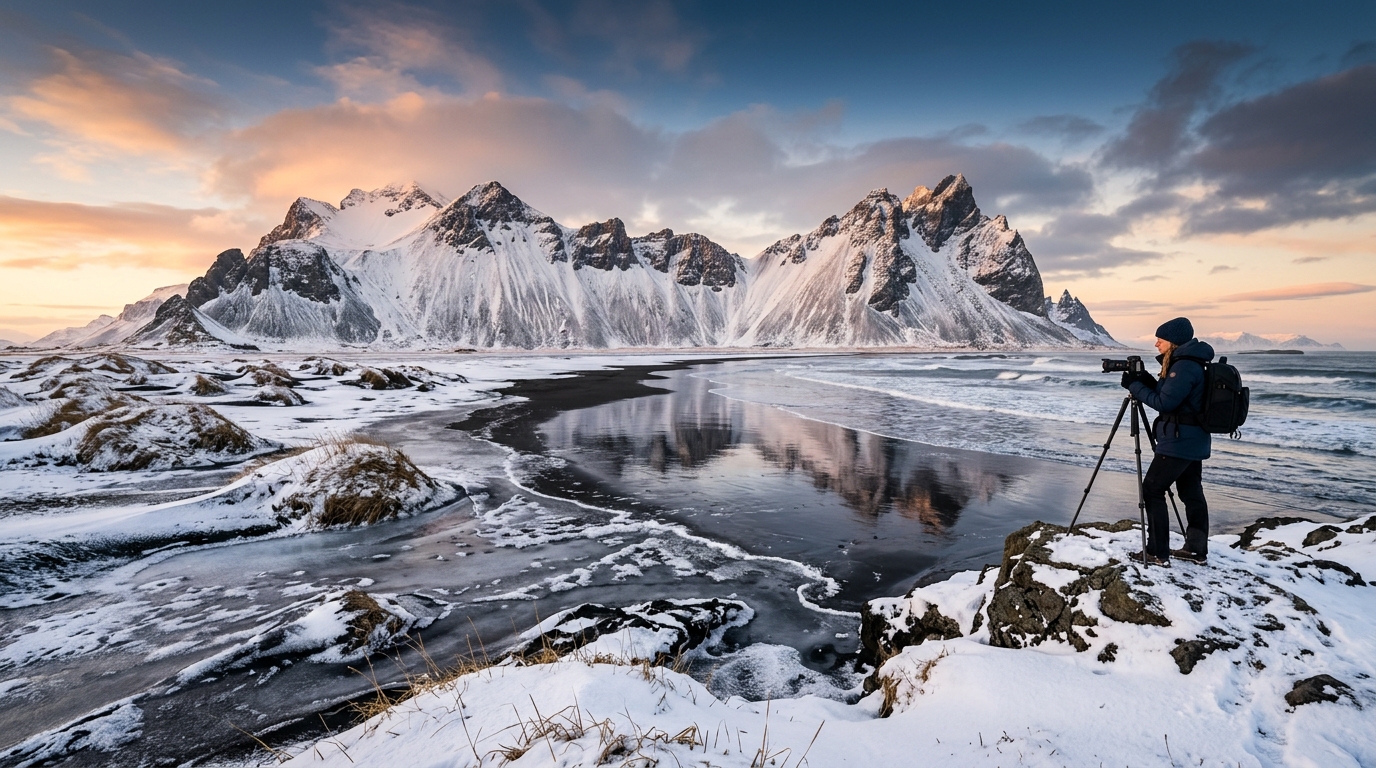
On the Snæfellsnes Peninsula lies Kirkjufell, the most photographed mountain in Iceland. In winter, the mountain is dusted in snow, and the nearby Kirkjufellsfoss waterfall often features beautiful ice formations in the foreground. On the opposite side of the country, in the southeast, lies Vestrahorn (Stokksnes). The jagged, dramatic peaks look incredibly menacing when coated in winter snow. Finding the exact spots to capture the perfect reflections of these mountains can be tough in deep snow, so be sure to consult our detailed landscape photography map to pinpoint the exact GPS coordinates of the best compositions.
Crystal Blue Ice Caves
Located primarily within the Vatnajökull glacier, ice caves offer a surreal, subterranean photography experience. The ice here is compressed to such a degree that it absorbs all colors of the spectrum except blue, resulting in a vibrant, glowing sapphire environment. Crucial note: You must never enter an ice cave without a certified local glacier guide. The caves are constantly shifting, and guides know which ones are structurally sound and safe to explore.
Planning Your Iceland Winter Road Trip Photography Itinerary
Executing a successful Iceland winter road trip photography adventure requires meticulous planning and, above all else, absolute flexibility. The weather dictates everything in Iceland during the winter, and your itinerary must be adaptable.
The Importance of Flexibility
You might have a rigid schedule planned, but a sudden blizzard can shut down the Ring Road for 24 to 48 hours. When planning your route, build in "buffer days." Do not book non-refundable accommodations on the opposite side of the country with the expectation that you will definitely make it there on time. A highly adaptable mindset is the most important tool in this Iceland winter photography guide.
Vehicle Choice and Driving Conditions
Do not attempt an Iceland winter road trip photography tour in a standard 2-wheel-drive compact car. You absolutely must rent a capable 4x4 vehicle equipped with studded winter tires. The roads are frequently covered in compacted snow, black ice, and slush. Keep a physical map in the car, as GPS signals can occasionally drop in remote fjords, and ensure your rental includes a scraper and a snow brush.
Essential Weather and Road Resources
Before you even start your engine each morning, you must check two websites: Vedur.is (the Icelandic Meteorological Office) for wind, precipitation, and aurora forecasts, and Road.is for real-time road conditions and closures. If Road.is says a mountain pass is closed or "impassable," do not attempt to drive it under any circumstances.
Managing Limited Daylight
In mid-winter (December to January), Iceland only sees about 4 to 5 hours of daylight. The sun might rise at 11:00 AM and set by 3:30 PM. To maximize your shooting time, you must do your driving in the dark. Plan to arrive at your first location an hour before sunrise, shoot through the short daylight window, and then use the evening darkness to travel to your next basecamp or hunt for the Northern Lights.
Crucial Safety Tips for Your Iceland Winter Photography Guide
Capturing the perfect shot is never worth risking your life. Iceland's natural wonders are beautiful, but they are also incredibly dangerous if not respected. This section of our Iceland winter photography guide highlights the life-saving safety protocols every photographer must follow.
Beware the Sneaker Waves
Reynisfjara black sand beach is one of the most stunning locations in the country, but it is also one of the deadliest. The beach is notorious for "sneaker waves"—massive, powerful waves that unpredictably surge dozens of meters further up the beach than the previous waves. They can easily knock a person off their feet and drag them into the freezing, turbulent ocean. When photographing the sea stacks, never turn your back on the ocean. Keep a safe distance from the waterline, and never compromise your safety for a slightly better angle.
Fragile Ice and Geothermal Areas
When shooting near partially frozen rivers or at the edges of waterfalls, it can be tempting to step out onto the ice to get a clearer view. Never do this. The ice is often paper-thin, with freezing, fast-moving water rushing just beneath the surface. Stick to marked trails and solid ground. Similarly, in geothermal areas like Hverir, snow can obscure boiling mud pots and fragile crusts. Stay strictly on the designated wooden boardwalks.
Wind Safety for You and Your Car
We mentioned tripod stability earlier, but the wind poses other unique threats. A common mistake tourists make is opening their car doors carelessly. A sudden gust of Icelandic wind can easily bend a car door backward, snapping the hinges—a costly mistake rarely covered by standard rental insurance. Always park facing into the wind, and hold the door handle firmly with both hands as you open it.
Preventing Hypothermia
Astrophotography and capturing the Northern Lights involve standing completely still in freezing temperatures for hours on end. Hypothermia and frostbite are real risks. If you lose feeling in your toes or fingers, pack up your gear and get back to the heated car immediately. No photograph is worth losing a digit.
Mastering Winter Lighting and Exposures
The technical aspect of shooting in a winter wonderland can be frustrating for those unaccustomed to it. Snow and ice play tricks on your camera's internal metering system, and the extreme dynamic range of the low winter sun requires advanced techniques to master.
Exposing Properly for Snow
Your camera's light meter is calibrated to expose for "18% middle gray." When you point your camera at a landscape completely covered in bright white snow, the meter gets confused. It thinks the scene is far too bright and will automatically darken the image to bring that bright white down to a dull, muddy gray. To combat this, you must take manual control. Depending on the lighting conditions, you will generally need to overexpose your image by +1 to +2 stops using your Exposure Compensation dial. Always check your histogram to ensure your highlights are pushed as far to the right as possible without clipping (blowing out) the pure white details.
Managing Dynamic Range
Because the sun stays so low on the horizon, you will frequently find yourself shooting directly into the light. This creates massive contrast between the bright sky and the dark, shadowed foregrounds (especially when dealing with black volcanic rock). To capture the full dynamic range, utilize exposure bracketing. Take a series of 3 to 5 shots at different exposure levels and blend them in post-processing. Alternatively, use high-quality Graduated Neutral Density (GND) filters to darken the sky while properly exposing the dark foreground.
Settings for the Northern Lights
Capturing the Aurora Borealis is the holy grail for many visiting photographers. Because you are shooting in near-total darkness, you need to maximize the amount of light hitting your sensor. Here is a solid baseline for your settings:
- Aperture: Open your lens as wide as it will go (f/2.8 or faster is ideal).
- ISO: Don't be afraid of noise. Push your ISO to 1600, 3200, or even 6400 depending on your camera's low-light capabilities.
- Shutter Speed: This depends on how fast the aurora is moving. If the lights are a faint, slow-moving glow, use a 15 to 20-second exposure. If the aurora is dancing rapidly across the sky, a long exposure will turn it into a blurry green soup. In that case, shorten your shutter speed to 3 to 5 seconds to freeze the distinct pillars and ribbons of light.
- Focus: Switch to manual focus and set your lens to infinity. Use your camera's live view to zoom in on a bright star and adjust the focus ring until the star is a sharp, pinpoint dot.
Conclusion: Ready for Your Winter Photography Adventure?
Embarking on a photographic journey to Iceland during the winter is a challenging, thrilling, and deeply rewarding endeavor. As we've covered in this Iceland winter photography guide, success comes down to meticulous preparation. You must protect your gear from the harsh elements, prioritize your personal safety above all else, remain endlessly flexible with your itinerary, and master the technical challenges of shooting in snow and low light.
To ensure you don't waste precious daylight searching for the best vantage points, we highly recommend utilizing the Iceland Photo Map. Our interactive, highly detailed maps provide you with the exact GPS coordinates, lighting tips, and compositional advice for the country's most spectacular locations, from hidden ice caves to iconic coastal mountains.
The raw, untamed beauty of the Icelandic winter is waiting for you. Pack your warmest layers, charge your batteries, and get ready to capture the breathtaking contrast of fire and ice in a way that few ever get to experience.
Frequently Asked Questions
What is the best month for winter photography in Iceland?
While the winter season stretches from November to March, February and early March are widely considered the best months for photography. During this time, the landscape is still completely blanketed in beautiful snow and ice, but the days are beginning to get slightly longer. You get a perfect balance: enough daylight (around 7 to 9 hours) to comfortably photograph landscapes and travel between locations, yet still enough darkness to hunt for the Northern Lights at night.
Do I need a 4x4 for an Iceland winter road trip photography tour?
Yes, absolutely. A 4x4 vehicle equipped with studded winter tires is mandatory for a safe and successful winter trip. Icelandic weather changes rapidly, and you will frequently encounter unplowed roads, deep slush, black ice, and sudden snowdrifts. A standard 2-wheel-drive vehicle will easily get stuck, potentially leaving you stranded in dangerous, freezing conditions. Always prioritize safety and rent a capable 4-wheel-drive SUV or truck.
How do I protect my camera gear from the Icelandic winter weather?
Protection comes down to blocking moisture and managing temperature changes. Always use a rain cover or plastic sleeve to protect your camera body and lens from snow and sea spray. Keep your lens hood on to block blowing snow. Crucially, when bringing your cold camera back into a warm car or hotel room, condensation will immediately form inside the lens and body. To prevent this, place your camera inside a sealed plastic ziplock bag or tightly close your camera backpack before going indoors, allowing the gear to slowly acclimate to the room temperature over an hour or two.
What are the safest winter photo spots in Iceland?
The safest spots are generally those along the Golden Circle (such as Þingvellir National Park, Geysir, and Gullfoss) and the major stops along the South Coast (like Skógafoss and Seljalandsfoss). These locations are highly trafficked, meaning the access roads are frequently plowed, and the walking paths are maintained. However, "safest" is a relative term in Iceland. Even at these popular tourist sites, the viewing platforms and paths are often covered in thick ice. You must always wear microspikes or crampons over your boots, even at the most accessible locations.
Ready to plan your ultimate winter shooting itinerary? Explore our comprehensive Iceland Photography Maps to find the exact coordinates of the best winter spots and never miss a shot!