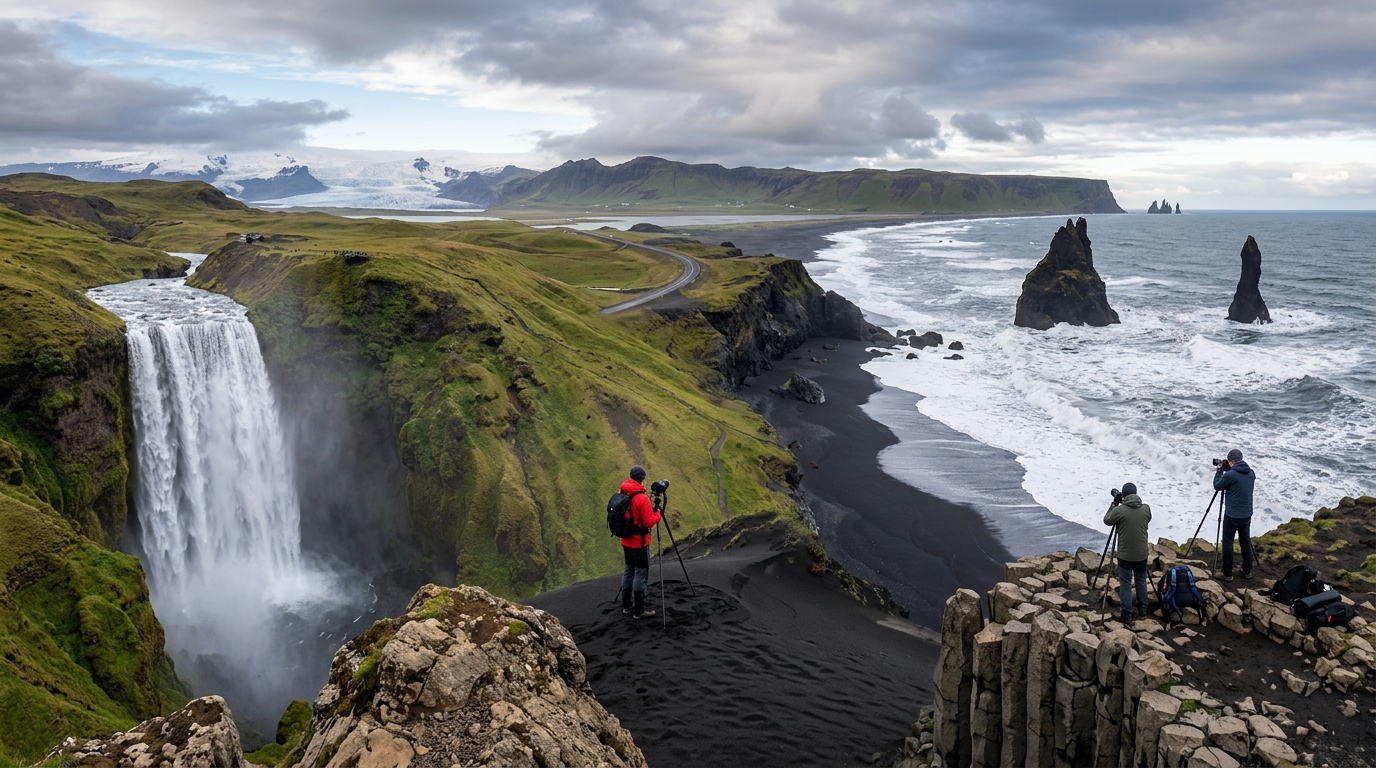
The Ultimate South Coast Iceland Photography Itinerary (3-5 Days)
Introduction: Welcome to Iceland's Photographer Paradise
Welcome to the land of fire and ice, a place where dramatic, untamed landscapes seem custom-built for the camera lens. From thundering waterfalls plunging over lush green cliffs to hauntingly beautiful black sand beaches battered by the North Atlantic, the southern stretch of Iceland is nothing short of a visual masterpiece. To truly make the most of this spectacular region, planning the perfect South Coast Iceland photography itinerary is absolutely essential.
Why is the South Coast so revered among creatives? The answer lies in its unparalleled diversity and accessibility. Whether you are an amateur enthusiast armed with a modern smartphone or a seasoned professional hauling medium-format gear and heavy glass, the South Coast offers high-reward shooting locations just steps from the legendary Route 1 (the Ring Road). You don't need to embark on grueling multi-day treks to capture world-class landscape imagery; the magic is right there waiting for you.
In this comprehensive guide, we will walk you through a meticulously crafted 3 to 5-day timeline. We will cover the iconic must-see landmarks, hidden gems, and crucial logistical tips to ensure you return home with memory cards full of breathtaking shots. Grab your camera bag, and let’s dive into the ultimate South Coast Iceland photography itinerary.
Essential Gear for Your South Coast Iceland Photography Itinerary
Before you hit the road on your South Coast Iceland photography itinerary, it is vital to pack the right equipment. Iceland’s weather is notoriously unpredictable, and the environment can be harsh on sensitive electronics. Here is a breakdown of the essential gear you need to bring:
- Weather-Sealing and Rain Covers: You will be shooting near powerful waterfalls that produce intense mist and standing on beaches with blowing sand. A weather-sealed camera body is highly recommended. Regardless of your camera’s rating, pack dedicated rain covers or even simple plastic sleeves to protect your gear during unexpected downpours. Bring plenty of microfiber cloths to constantly wipe your lens elements.
- The Right Lenses: A versatile kit is crucial. A wide-angle lens (such as a 16-35mm) is your best friend for capturing the vast, sweeping landscapes, massive waterfalls, and expansive glacial lagoons. However, do not leave your telephoto lens at home. A 70-200mm or even a 100-400mm lens is perfect for isolating distant mountain peaks, compressing the dramatic sea stacks, and photographing wildlife like the beloved Atlantic puffins.
- A Sturdy Tripod: Iceland is famously windy. A flimsy travel tripod will vibrate in the gusts, ruining your long-exposure shots. Invest in a heavy-duty, sturdy tripod—preferably carbon fiber, as aluminum can become painfully cold to the touch in winter. A solid base is non-negotiable for capturing the northern lights, smoothing out waterfalls, or shooting in low-light conditions.
- ND Filters and Polarizers: Neutral Density (ND) filters are essential for creative control. A 6-stop or 10-stop ND filter will allow you to achieve those silky-smooth water effects on waterfalls and ocean waves, even in the middle of the day. A circular polarizer is equally important for cutting through the glare on wet rocks and glacial ice, as well as punching up the contrast in the sky.
Day 1: Majestic Waterfalls and Hidden Canyons
Your 3 day Iceland photo itinerary begins as you drive southeast from the capital city of Reykjavik. Day one is all about capturing the sheer power and scale of Iceland’s most famous cascades.
Your first major stop is Seljalandsfoss. This iconic waterfall drops 60 meters and is unique because you can walk entirely behind it.
Photography Tip: When shooting behind Seljalandsfoss, use an ultra-wide-angle lens to capture the water framing the landscape beyond. The spray here is intense, so keep your lens cap on until the exact moment you are ready to shoot, and wipe the glass immediately before pressing the shutter.
Just a short walk down the path from Seljalandsfoss lies a hidden treasure: Gljúfrabúi. Tucked away inside a narrow canyon, you will need to wade through a shallow stream to access it. The lighting inside the canyon can be tricky with high contrast, so consider bracketing your exposures to capture details in both the dark cave walls and the bright sky above the falls.
Continuing east along Route 1, your next stop is the mighty Skógafoss. This massive, rectangular waterfall is a classic landscape subject. On sunny days, the heavy mist generated by the falls almost guarantees a vibrant rainbow. You can shoot from the flat riverbed at the base to emphasize the waterfall's towering scale (try placing a person in the frame for perspective), or climb the steep staircase to the right for a top-down vantage point.
To find the exact parking coordinates and optimal shooting angles for these locations, be sure to explore our dedicated waterfall photography map. It will help you plan your driving route seamlessly.
Day 2: Dramatic Vik Photography Locations and Sea Stacks
On the second day, your journey brings you to the southernmost village in Iceland. The Vik photography locations are characterized by moody, gothic landscapes, roaring oceans, and striking geological formations.
Start your morning at Reynisfjara Black Sand Beach. The contrast of the white foam crashing against the pitch-black volcanic sand is a monochromatic dream. Here, you can photograph the incredible basalt column cliffs that look like a giant pipe organ.
Safety Warning: Reynisfjara is notorious for "sneaker waves"—massive, unpredictable waves that surge far higher up the beach than normal. Never turn your back to the ocean while framing a shot, and keep a safe distance from the water's edge.
From the beach, turn your lens toward the ocean to capture the Reynisdrangar sea stacks. According to local folklore, these jagged basalt sea stacks are petrified trolls caught in the sunlight. They make for phenomenal silhouettes at sunrise or sunset. Use a telephoto lens to compress the distance between the crashing waves and the towering rocks.
Next, drive up to the Dyrhólaey promontory. This massive stone arch offers panoramic views of the entire black sand coastline. If you are visiting between May and August, Dyrhólaey is one of the best places on the South Coast to photograph Atlantic puffins nesting on the cliffs. To locate the best spots for wildlife, check out our Iceland bird photography map.
Conclude your day by shooting the iconic Vik i Myrdal Church. Perched on a hill overlooking the town, this red-roofed church pops beautifully against the green summer mountains or the stark white winter snow. It is a quintessential Icelandic scene. For more architectural inspiration, you can browse our map of picturesque Icelandic churches.
Day 3: Glacial Lagoons and Diamond Beach
Day three of your South Coast Iceland photography itinerary takes you further east into the realm of ice. As you drive toward Vatnajökull National Park—home to Europe’s largest glacier—the landscape transforms dramatically.
Your primary destination today is the world-famous Jökulsárlón Glacier Lagoon. Here, massive icebergs calve from the Breiðamerkurjökull glacier and float serenely in a deep blue lagoon before drifting out to sea. The photographic opportunities here are endless. Use a telephoto lens to capture the intricate textures, deep blue hues, and volcanic ash lines trapped within the ice. Keep an eye out for harbor seals swimming among the bergs, which make for fantastic wildlife subjects.
Just across the highway from the lagoon is the awe-inspiring Diamond Beach. As the icebergs wash out to the ocean, the tide pushes chunks of ice back onto the black sand beach, where they glisten like massive diamonds.
Photography Tip: Diamond Beach is the perfect place to practice slow shutter speed photography. Put your camera on a tripod, attach an ND filter, and experiment with shutter speeds between 1/4 of a second and 1 full second. This specific timing will capture the dynamic motion of the water washing around the static ice chunks, creating beautiful leading lines of white foam without completely blurring the ocean into a featureless mist.
For those strictly adhering to a 3 day Iceland photo itinerary, this glacial wonderland serves as an unforgettable grand finale before making the long drive back to Reykjavik.
Extending to 5 Days: Hidden South Iceland Photo Spots
If you have the luxury of time, extending your trip to five days allows you to slow down, wait for optimal lighting, and explore some of the more hidden South Iceland photo spots that tourists often rush past.
With an extra two days, you must visit Fjaðrárgljúfur. This massive, winding canyon features steep, grass-covered walls and a serpentine river flowing through its base. It is a drone photographer's paradise (though be sure to check current drone regulations) and offers incredible leading lines from the designated viewing platforms. Note: The canyon is occasionally closed to protect the fragile vegetation, so always respect local signage and stay on marked paths.
Further east, past the glacier lagoon, lies the dramatic Vestrahorn mountain on the Stokksnes peninsula. Often referred to as "Batman Mountain" due to its jagged peaks, Vestrahorn is arguably one of the most photogenic mountains in the world. The best shots are taken from the black sand dunes covered in tufts of green grass, or by capturing the mountain's perfect reflection in the wet sand when the tide retreats.
You should also dedicate time to exploring lesser-known glacier tongues like Svinafellsjökull. Famous for being a filming location for the movie Interstellar, this glacier features sharp, ash-covered ice ridges that look truly otherworldly.
To discover more of these off-the-beaten-path locations and plan a longer route, utilize our comprehensive landscape photography maps to pinpoint exact GPS coordinates and hidden gems.
How to Optimize Your South Coast Iceland Photography Itinerary with Our Maps
Executing a flawless South Coast Iceland photography itinerary requires more than just knowing where the locations are; it requires strategic planning to ensure you arrive at the right place at the right time. This is where Iceland Photo Map becomes your most valuable travel companion.
Our interactive platform allows you to plan your daily driving routes with precision. Instead of relying on vague blog descriptions, you can view exact pin drops for parking lots and trailheads. You can easily filter our maps by specific categories—such as Waterfalls, Landscapes, or Birds—to tailor the map to your specific photographic interests on any given day.
We highly encourage users to save their favorite locations within the platform. By grouping your saved spots geographically, you can maximize your shooting time during the golden hours of sunrise and sunset, and minimize time wasted driving back and forth along the Ring Road. Proper route optimization is the secret to a stress-free and highly productive photography trip.
Conclusion: Start Planning Your Icelandic Adventure
The southern region of Iceland offers an incredibly dense concentration of photographic wonders. From the thundering curtain of Skógafoss to the tranquil, ancient ice of Jökulsárlón, a well-planned South Coast Iceland photography itinerary will guide you through some of the most diverse and dramatic landscapes on earth.
As you prepare for your journey, remember that Iceland’s nature is as fragile as it is fierce. Always stay on marked trails, respect safety closures, and never compromise your personal safety for a photograph. The majestic beauty of South Iceland photo spots will leave you breathless, but returning home safely with your stunning images is the ultimate goal.
Frequently Asked Questions
What is the best time of year for a South Coast Iceland photography itinerary?
The "best" time depends entirely on what you want to capture. Summer (June to August) offers endless daylight, the midnight sun, vibrant green moss, and the opportunity to photograph puffins. Winter (November to March) transforms the landscape into a snowy wonderland, offering the chance to shoot the aurora borealis (Northern Lights) and explore stunning blue ice caves. Both seasons provide a spectacular, albeit completely different, South Coast Iceland photography itinerary.
Can I complete a South Iceland photo itinerary in 3 days?
Yes, a 3 day Iceland photo itinerary is entirely possible and very popular. In three days, you can comfortably drive from Reykjavik to Jökulsárlón Glacier Lagoon and back, stopping at major highlights like Seljalandsfoss, Skógafoss, Reynisfjara, and Diamond Beach. However, a 3-day pace is brisk. Extending to 4 or 5 days allows for a more relaxed pace, better lighting opportunities, and time to explore hidden spots.
Where are the best Vik photography locations?
The best Vik photography locations include the Reynisfjara Black Sand Beach, the towering Reynisdrangar sea stacks, the Dyrhólaey promontory (great for coastal panoramas and puffins), and the picturesque red-roofed Vik i Myrdal Church. There are also several lesser-known viewpoints in the hills above the town that offer sweeping views of the village against the ocean backdrop.
Do I need a 4x4 vehicle to photograph the South Coast?
If you are traveling exclusively along the South Coast during the summer and sticking to the main Ring Road (Route 1) and paved access roads to major waterfalls and beaches, a standard 2WD vehicle is perfectly fine. However, if you are visiting in the winter when roads can be snowy and icy, or if you plan to venture onto F-roads into the highlands, renting a 4x4 vehicle is absolutely necessary for safety and access.
Don't miss a single shot! Explore our interactive Iceland Photography Maps to pinpoint exact locations, plan your driving route, and discover hidden gems along the South Coast.