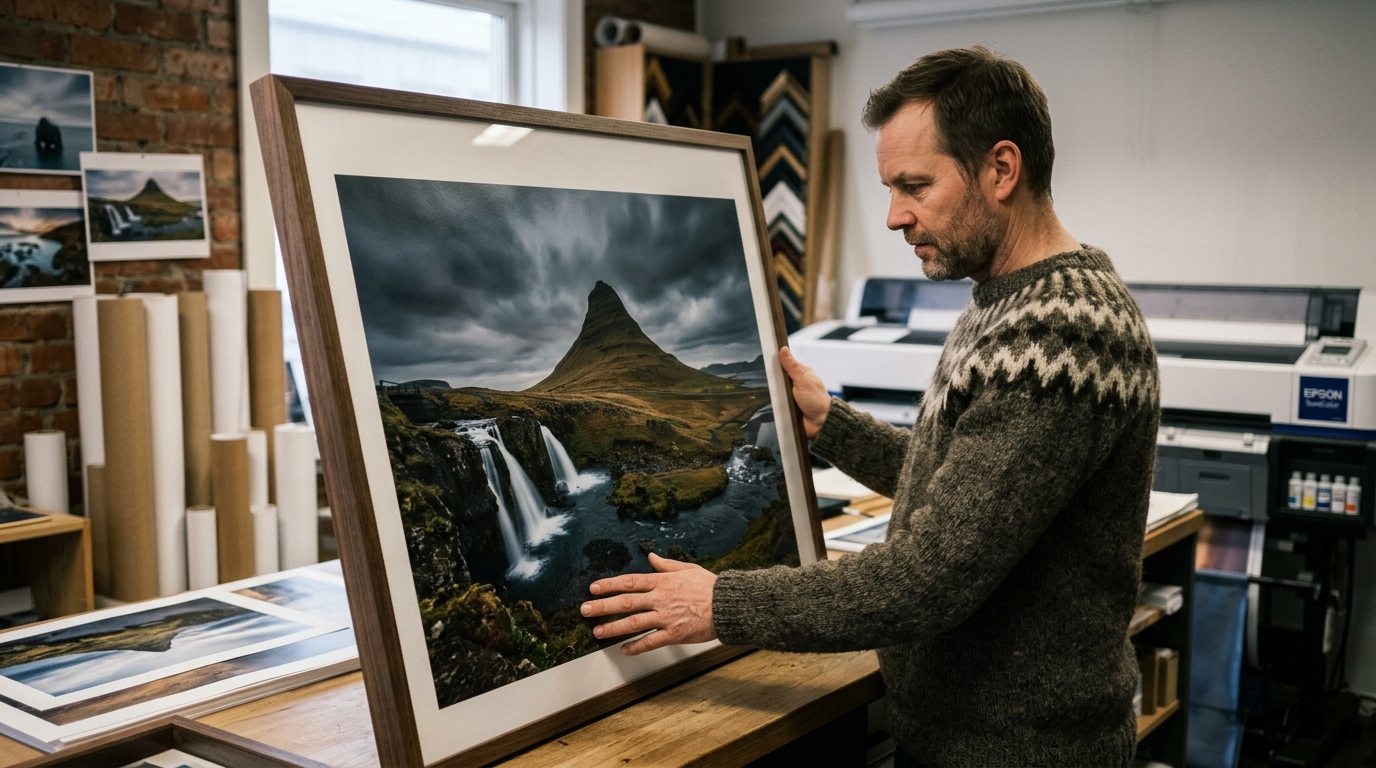
The ethereal light of the Icelandic highlands, the crushing weight of a glacial tongue, and the midnight sun casting long shadows over basalt columns—these are the moments that define a photographer’s journey. Yet, all too often, these digital masterpieces languish on external hard drives, their impact diminished by suboptimal display. To truly honor the raw power of the Arctic, you need professional Iceland photography print services that understand the unique demands of high-latitude aesthetics. Bringing your vision from a sensor to a wall requires more than just a high-resolution file; it requires a deep understanding of color science, paper texture, and the physics of light.
Why Iceland Photography Print Services Require Specialized Attention
Icelandic landscapes present a unique technical challenge that standard consumer printing labs often struggle to resolve. The primary hurdle lies in the high dynamic range of the environment. Consider the contrast between the deep, inky blacks of volcanic sand at Dritvik Djúpalónssandur and the brilliant, translucent whites of glacial ice. Consumer printers frequently struggle to render these extremes, potentially losing the subtle texture of volcanic grit or blowing out highlights in the ice.
Professional Iceland photography print services utilize high-end inkjet systems capable of reproducing a wider color gamut than standard CMYK printers. These labs rely on precise ICC (International Color Consortium) profiles, which act as a translator between your monitor’s color space and the printer’s ink-and-paper combination. According to the International Color Consortium, standardized color management is essential for maintaining color consistency across different output devices, ensuring the "glacial blue" you edited in Lightroom does not shift toward a muddy cyan on paper. Furthermore, as noted by the International Organization for Standardization (ISO), adherence to color management standards like ISO 12647 is a foundational practice for professional print production to ensure predictable color reproduction.
Furthermore, standard retail printers often use "all-purpose" papers that lack the archival depth required for fine art. Icelandic scenes benefit from papers with a high dMax—a measure of the deepest black a paper can achieve—to maintain the visceral impact of the landscape. Professional labs provide the structural integrity and ink-loading capacity necessary to render the fine, jagged details of a mountain ridge without the ink bleeding or losing sharpness.
Evaluating Professional Iceland Photography Print Services
When selecting a print house for your Iceland landscape wall art, you must look beyond price. The gold standard for professional output is the fine art giclée process. Unlike traditional photographic C-prints, which are exposed onto light-sensitive paper and processed in chemicals, giclée printing uses archival pigment-based inks sprayed onto heavy-weight, acid-free rag papers. As noted by the Wilhelm Imaging Research institute, pigment-based inks on acid-free substrates are generally preferred for long-term display stability, which is essential for the vibrant greens of moss-covered lava fields.
Criteria for your selection should include:
- Archival Rating: Ensure the laboratory uses inks and papers tested for long-term display life under normal lighting conditions.
- Paper Selection: Consider matte, satin, or gloss options, often available in many cotton rag or alpha-cellulose bases, which provide different tactile experiences for the viewer.
- Mounting Options: For large-scale work, the mounting substrate (such as Dibond or aluminum) is vital to prevent warping over time.
- Color Management: A professional lab should provide downloadable ICC profiles for their specific paper-printer combinations, allowing you to perform accurate soft-proofing before you commit to a final print.
Proper color management is the bridge between the digital file and the physical reality. Relying on "auto-correct" features at a local kiosk is a recipe for disappointment; you need a lab that allows you to bypass automated adjustments entirely and take control of your color profile.
Selecting the Right Medium for Your Iceland Landscape Wall Art
Matching the medium to the subject matter is an art form in itself. For the dramatic, high-contrast scenes often found in the South Coast, different materials offer vastly different emotional experiences.
Metal Prints: These are ideal for images with high specular highlights, such as water reflecting off a waterfall or the crystalline structure of ice. The dye-sublimation process infuses the ink directly into a coated aluminum sheet, creating an image with exceptional luminosity and depth. The surface is durable and moisture-resistant, making it a practical choice for long-term display.
Acrylic Face-Mounts: If you want your waterfall photography to look as though you are looking through a window, acrylic is the choice. The print is bonded to the back of a polished acrylic sheet, which refracts light to increase perceived contrast and color saturation. It provides a modern, "gallery-grade" aesthetic that works exceptionally well for large, wide-angle vistas.
Fine Art Rag: For scenes that require a more tactile, painterly feel—such as the soft, ethereal light over a remote church—a heavy-weight matte rag paper is superior. It absorbs light rather than reflecting it, providing a sophisticated, glare-free viewing experience that emphasizes the texture of the paper itself.
Preparing Your Files for Large Format Printing
Scaling your work for a wall-sized display requires meticulous preparation. Resolution is a common consideration; while a 24-megapixel sensor is excellent for web display, a high-quality 30-inch print generally benefits from high pixel density to maintain sharpness. If your source file is smaller, consider using professional upscaling workflows, as viewing distance often compensates for resolution loss in large prints.
Soft-proofing is your most vital step. By installing the printer's ICC profile in your editing software, you can toggle a view that simulates how the printer will render your colors. You will often find that the shadow recovery in your digital file needs to be adjusted; the print will inherently have a different dynamic range than your monitor. Adjust your contrast and sharpening specifically for the output medium—sharpening for a matte paper, for instance, requires a different approach than sharpening for a high-gloss metal surface, where over-sharpening can lead to visible artifacts.
Integrating Your Prints with Iceland Photo Map Resources
A professional portfolio is more than a collection of pretty pictures; it is a narrative. By using the location data available through Iceland Photo Map, you can curate a thematic series of prints that tell a geographical story. Whether you are documenting the unique architecture of the Búðakirkja black church or capturing the power of Dettifoss, our maps provide the precise coordinates and context to elevate your work from a "vacation photo" to a studied landscape series.
Consider organizing your wall art by region. A triptych featuring different textures from the Westfjords creates a cohesive visual experience that anchors your space. Documenting the specific conditions—time of day, weather, and gear used—at each location adds a layer of professional provenance to your work, which is highly valued by collectors and galleries alike.
Common Pitfalls in Landscape Photography Printing
Even the best photographers fall into traps when moving to print. One of the most significant errors is over-sharpening. Digital sharpening creates edge contrast that looks great on a 4K monitor but can look jagged and artificial on physical media. Review your image at many and apply sharpening selectively to the areas where fine detail is essential, such as the texture of rock or the spray of water.
Another common mistake is ignoring the ambient lighting of the installation site. If you plan to hang your print in a room with warm, incandescent lighting, your "cool" glacial blues may appear muted. Conversely, bright, cool-toned LED lighting can make a warm sunset look clinical. It is standard practice to test a small proof print in the intended space before ordering a large-format piece.
Finally, avoid compromising on mounting materials. Non-archival adhesives can cause prints to yellow or bubble over time. Opt for pH-neutral, archival-grade mounting boards and ensure the environment is climate-controlled, as recommended by the Library of Congress for the long-term preservation of photographic materials, particularly in spaces where temperature fluctuations are common.
Conclusion: Elevating Your Photography Through Print
The transition from a digital capture to a physical masterpiece is a transformative process. It forces you to be deliberate, to refine your vision, and to respect the medium as much as the subject. By choosing professional Iceland photography print services and selecting the right materials for your specific landscapes, you ensure that the majesty of Iceland is preserved for years to come. Invest in quality, curate your series with intent, and let your work stand as a testament to the wild beauty of the North.
Frequently Asked Questions
What is the best paper type for printing Iceland landscape photos?
For most Iceland landscapes, a high-quality matte or luster cotton rag paper is ideal. Matte paper provides a sophisticated, non-reflective finish that emphasizes the texture of the landscape, while luster offers a slight sheen that helps "pop" the contrast in deep shadows and bright highlights without the overwhelming glare of a high-gloss finish.
How do I ensure my prints match the colors I see on my monitor?
The key is color management. You must calibrate your monitor using a hardware device to ensure your brightness and white point are accurate. Then, use the specific ICC printer profiles provided by your professional print lab to "soft-proof" your images in your editing software. This will show you how the colors will translate to the specific ink and paper combination of the printer.
Should I choose metal or acrylic for my Iceland wall art?
Choose metal if you want a modern, durable, and highly luminous look that excels at showing off water and ice reflections. Choose acrylic if you want maximum depth and a luxurious, gallery-like finish that makes the image appear to have a three-dimensional quality. Acrylic is generally heavier and more expensive, while metal is lighter and more resistant to physical wear.
How large can I print my photos without losing quality?
As a general rule, aim for high pixel density for high-quality printing. However, for large-scale wall art, you can often use lower PPI settings, as these prints are meant to be viewed from a further distance. The quality of your raw file and the effectiveness of your sharpening techniques are more important than the raw pixel count. Many modern professional labs also offer AI-based upscaling services that can significantly extend the usable size of your files.
Ready to showcase your best shots? Use our Iceland Photo Map to identify your next location, then visit our printing guide to ensure your final output is gallery-ready.