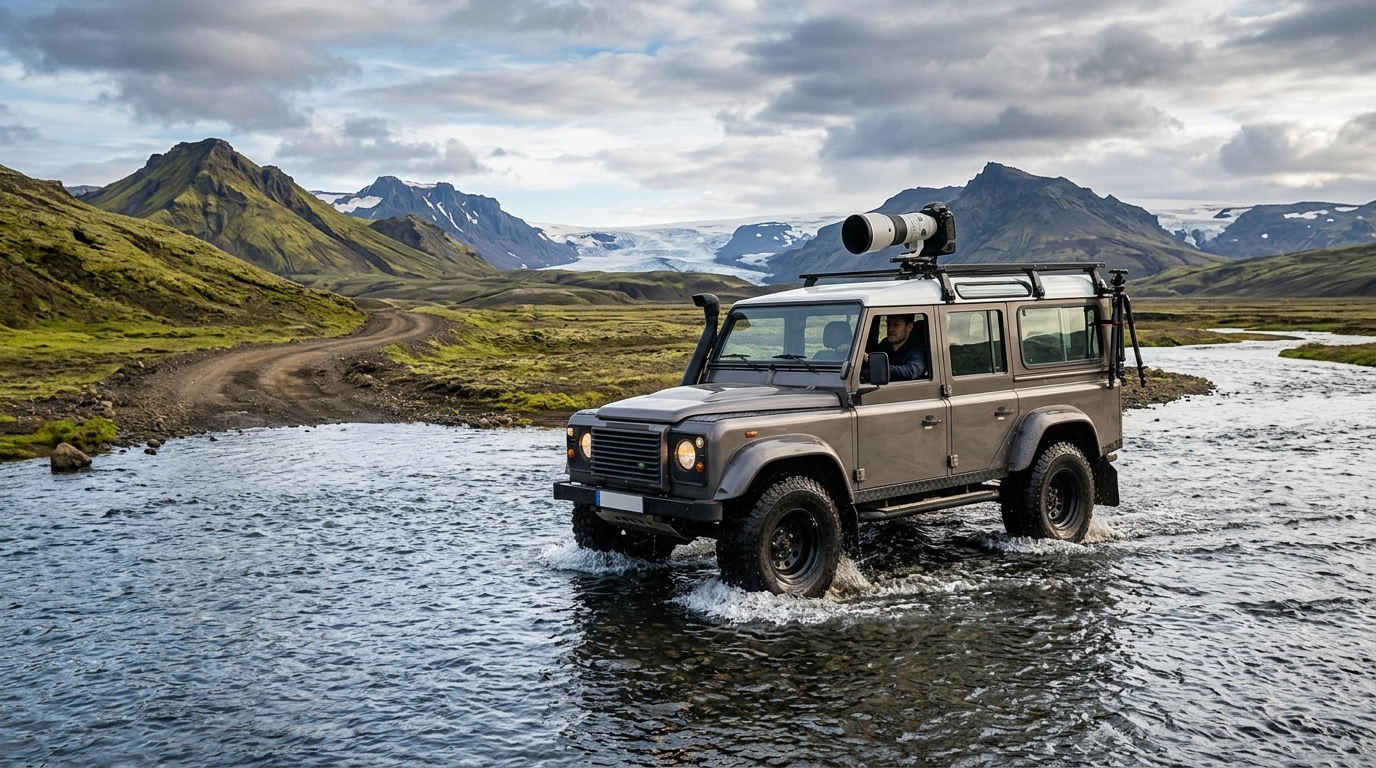
Planning a photography expedition to the rugged interior of Iceland requires meticulous preparation, which is why we have created this ultimate Iceland F-road driving guide for photographers. The Icelandic Highlands offer some of the most dramatic, raw, and otherworldly landscapes on Earth. However, reaching these pristine locations requires navigating the country's notorious "F-roads"—mountain tracks that demand specialized vehicles, precise driving skills, and a deep respect for the unpredictable Arctic environment. In this comprehensive guide, we will break down everything you need to know to safely navigate these routes, protect your expensive camera gear, and capture the shot of a lifetime during your 2026 summer expedition.
What are F-Roads and Why Do Photographers Need Them?
In Iceland, the letter "F" prefixed to a road number stands for Fjallvegur, which translates directly to "mountain road." These are unpaved, gravel, or dirt tracks that cut through the uninhabited interior of the country, commonly referred to as the Highlands. F-roads are not maintained in the same manner as the Ring Road (Route 1). They feature steep inclines, sharp switchbacks, deep ruts, loose volcanic gravel, and, most challenging of all, unbridged river crossings.
Because of extreme winter weather and heavy snowpack, F-roads are closed for most of the year. They open seasonally, typically between mid-June and early July, and close by mid-to-late September when the first winter storms arrive. The exact opening dates are determined annually by the Icelandic Road and Coastal Administration (Vegagerðin) based on road conditions, moisture levels, and structural safety.
For landscape photographers, F-roads are the gateway to composition heaven. The most dramatic volcanic craters, vast black sand deserts, neon-green moss-covered canyons, and the colorful rhyolite mountains of Landmannalaugar are completely inaccessible without utilizing these routes. If you restrict your trip to the paved Ring Road, you will miss the raw, primordial heart of Iceland. Utilizing a dedicated, interactive Iceland Photo Map can help you plan your route to these remote destinations safely, ensuring you map out your photography stops alongside real-time accessibility updates.
Choosing the Best Car for Iceland Highlands Photography Trips
Selecting your vehicle is the single most critical decision you will make when planning a highland photography trip. According to regulations detailed by SafeTravel Iceland, standard two-wheel-drive (2WD) passenger cars and small two-wheel-drive campers are strictly prohibited on all F-roads. This is not merely a recommendation; it is a legal requirement enforced by heavy fines, and driving a 2WD vehicle on these roads will immediately void any rental insurance policy.
To legally and safely travel in the Highlands, you must rent a 4x4 vehicle. However, not all 4x4s are created equal. Understanding the difference between a standard All-Wheel Drive (AWD) crossover and a true 4x4 SUV with high ground clearance is essential to selecting the best car for iceland highlands photography adventures.
AWD Crossovers vs. True 4x4 SUVs
- AWD Crossovers (e.g., Dacia Duster, Toyota RAV4): These vehicles are suitable for "light" F-roads, such as the F35 (Kjalvegur) or the northern section of the F208 to Landmannalaugar. They have decent traction but limited ground clearance (usually around 18-20 cm) and lack a low-range gearbox. They are not suitable for deep river crossings or highly technical, rocky tracks.
- True 4x4 SUVs (e.g., Toyota Land Cruiser, Jeep Wrangler): These vehicles feature robust body-on-frame construction, excellent ground clearance (22 cm or more), and low-range transfer cases that provide maximum torque at slow speeds. This class of vehicle is highly recommended for challenging highland routes that involve significant river crossings, such as the F249 to Þórsmörk or the southern section of the F208.
- Modified Super Jeeps: For the most extreme routes (such as F210 or F26), hiring a specialized Super Jeep with massive 38-inch to 46-inch tires is the safest option. These vehicles can traverse deep glacial rivers and rough volcanic terrain that would swallow a standard rental SUV.
Crucial Rental Insurance Considerations
When renting a vehicle for the Highlands, standard collision damage waiver (CDW) policies are insufficient. You must ensure your rental package includes specialized protections:
- Gravel Protection (GP): Highland roads are composed of loose volcanic stone. Passing vehicles will kick up gravel, which can easily chip your windshield or damage your vehicle's paintwork. GP is highly recommended for anyone driving on F-roads.
- Sand and Ash Protection (SAAP): High winds in the volcanic plains can create severe dust and ash storms, which can strip the paint off a vehicle. This damage is incredibly costly to repair, making SAAP a wise investment for summer travel in the interior.
- The Ultimate Caveat: It is vital to note that almost no standard rental car insurance policy covers water damage caused by river crossings. If you flood your engine, you will be personally liable for the full cost of the vehicle recovery and engine replacement, which often results in catastrophic out-of-pocket expenses because standard rental insurance policies explicitly exclude water damage.
Essential Rules for Driving on F-Roads Iceland
Operating a vehicle in the Icelandic Highlands requires a different mindset than driving on paved highways. As emphasized by SafeTravel Iceland, safety and environmental stewardship must always take precedence over getting the perfect shot.
First and foremost, off-road driving is strictly illegal in Iceland. The delicate volcanic soil and sub-Arctic vegetation, particularly the thick green woolly fringe-moss (Racomitrium lanuginosum), are incredibly fragile. A single set of tire tracks can compress the soil, destroy the root systems, and leave scars that take decades or even centuries to heal. Violators face massive criminal fines, potential court appearances, and the rightful anger of the local community. As strictly enforced by local authorities and highlighted by SafeTravel Iceland, you must always stay on the designated, marked F-road tracks, even if a muddy patch makes you want to drive around it.
When driving on f-roads iceland, you must also master the local right-of-way rules. Many mountain passes are narrow, winding, and single-lane. According to driving guidelines from the Icelandic Road and Coastal Administration (Vegagerðin), the vehicle traveling uphill always has the right of way, as it is much harder for a heavy vehicle to regain momentum on a steep incline. Additionally, single-lane bridges are common; as outlined by the Icelandic Road and Coastal Administration (Vegagerðin), the vehicle closer to the bridge has priority, and you should always slow down or stop at the designated passing pockets to allow oncoming traffic to pass safely.
Before heading out each morning, you must check real-time road conditions. Weather in Iceland is notoriously volatile, and a sudden storm can wash out roads or dramatically increase river levels. Always consult the Icelandic Road and Coastal Administration (Vegagerðin) for current road closures and check the Icelandic Meteorological Office for wind speeds, rain forecasts, and active weather alerts. High winds can make driving top-heavy 4x4 campers incredibly dangerous, especially on exposed mountain ridges.
Mastering Highland River Crossings Iceland: A Step-by-Step Guide
For many photographers, the thought of crossing an unbridged river is the most nerve-wracking aspect of exploring the Highlands. However, mastering highland river crossings iceland is an essential skill if you want to access the most dramatic vistas. By approaching each crossing with patience, analysis, and the correct technique, you can mitigate the risks entirely.
Step 1: Understand the Insurance Reality
As mentioned previously, rental insurance does not cover water damage. If you cross a river, you do so entirely at your own risk. If you are in doubt about the depth of a river or your vehicle's capabilities, do not cross . It is often better to turn back or wait for another experienced driver to arrive so you can watch their line or cross together.
Step 2: Assess the River Before Entering
rarely drive blindly into a river. Stop your vehicle, get out, and inspect the crossing point:
- Check the Depth: Walk along the bank to locate the shallowest section. Note that the widest part of a river is often the shallowest, while narrow channels tend to be deep and fast-moving. According to safety guidelines from SafeTravel Iceland, if the water level is above your knees (or above the center of your vehicle's wheels), it is likely too deep for a standard 4x4 SUV.
- Check the Current: Look at how fast the water is flowing. A fast-moving, knee-deep river can easily sweep a vehicle off its path.
- Identify Obstacles: Look for large, submerged boulders or deep ruts carved by previous vehicles.
- Observe the Exit: Ensure the exit ramp on the opposite bank is clear, stable, and not blocked by mud or steep embankments.
Step 3: Executing the Crossing Technique
Once you have determined that the river is safe to cross, prepare your vehicle and execute the crossing using these precise steps:
- Engage 4WD Low: If your vehicle has a manual 4WD selector or low-range gearbox, engage it before entering the water. Turn off traction control to prevent the vehicle's computer from cutting power if the tires slip slightly on the riverbed gravel.
- Select Your Gear: Put the vehicle into first gear (or manual mode if it is an automatic) to prevent the transmission from shifting gears mid-river, which can cause a momentary loss of momentum and allow water to enter the exhaust pipe.
- Drive Slowly and Diagonally Downstream: Enter the water slowly to avoid creating a massive splash or "bow wave" that can flood your engine's air intake. Drive at a slow, walking pace. Point your vehicle slightly downstream, letting the current work with you rather than fighting against it.
- Maintain Steady Momentum: Keep your foot steadily on the accelerator. Do not stop, do not shift gears, and do not panic. Maintain a consistent speed until your front tires have firmly gripped the opposite bank and the vehicle has fully exited the water.
Top Highland Photography Locations Accessed via F-Roads
Now that you understand the vehicle requirements and safety protocols, let us look at the breathtaking locations you can capture by venturing onto the F-roads.
The Fjallabak Nature Reserve (F208 & F225)
The Fjallabak Nature Reserve is a masterpiece of volcanic geology. Accessible via the F208 or the scenic F225, this region features surreal, multicolored rhyolite mountains, expansive black sand fields, and deep blue crater lakes. The northern approach via F208 is relatively straightforward and does not require river crossings, making it accessible for standard 4x4 crossovers. However, the southern approach of the F208 is a challenging, deeply rutted track with multiple medium-sized river crossings that require high ground clearance. The rewards are endless: dramatic panoramic views, shifting light across volcanic ridges, and deep-green moss contrasting against black volcanic ash.
Fagrifoss Waterfall (F206)
Located in the southern Highlands, Fagrifoss waterfall (meaning "Beautiful Falls") is a stunning, multi-tiered cascade that plunges into a deep, moss-covered basalt canyon. To reach Fagrifoss, you must navigate the F206. This road is rough and bumpy, requiring a sturdy 4x4. It features a few shallow river crossings that can become deep after heavy rainfall. The compositions here are spectacular, especially when using a wide-angle lens to capture the scale of the canyon walls framing the rushing waters.
To capture these locations in their best light, you must carefully time your drives. During the midnight sun of the summer months, the golden hour and blue hour blend together, lasting for several hours throughout the night. Driving during these off-peak hours not only provides you with spectacular, soft lighting conditions but also ensures you will have these popular locations entirely to yourself, free from other tourists.
An Iceland F-Road Driving Guide for Photographers: Safety Checklist
To ensure your highland photography expedition is successful, safe, and stress-free, we have compiled this essential safety checklist. Carrying heavy, expensive camera gear into remote areas requires extra precautions to protect both yourself and your equipment.
| Category | Item / Action | Why It Matters for Photographers |
|---|---|---|
| Vehicle Prep | Verify Spare Tire & Jack | Highland gravel is sharp. A flat tire is highly likely, and cell service may be unavailable to call for help. |
| Gear Safety | Secure Camera Bags | F-roads are incredibly bumpy. Unsecured camera bodies and lenses can easily slide, bounce, and sustain damage inside the vehicle. Use padded cases and secure them with seatbelts or cargo nets. |
| Navigation | Offline GPS Maps | Cellular network coverage is highly spotty in the deep valleys of the Highlands. Always download offline maps, such as our interactive Iceland Photo Map, before departing. |
| Communication | Satellite Communicator | A Garmin inReach or similar satellite device allows you to send SOS messages, check weather updates, and communicate without cellular service. |
| Emergency | Register Travel Plan | Always register your route and expected return time with SafeTravel Iceland. If you do not check in by your designated time, search and rescue services will be deployed to your last known location. |
| Survival | Extra Food, Water, & Layers | If your vehicle breaks down or gets stuck in a river, you may have to wait several hours for assistance. Pack high-calorie food, plenty of water, and windproof/waterproof thermal layers. |
How to Use Our Iceland F-Road Driving Guide for Photographers to Plan Golden Hour Shoots
Planning a successful landscape shoot in the Highlands requires balancing driving times, weather, and lighting. Because F-roads are rough, unpaved, and highly technical, you cannot calculate your travel times using standard highway speeds. On most F-roads, your average speed is significantly lower than on paved roads, often hovering between 20 km/h and 40 km/h depending on the terrain. A journey of just 40 kilometers can easily take two hours or more, especially when you factor in stopping to assess river crossings or navigating steep, rocky switchbacks.
If you rush on these roads to chase a sunset, you risk popping a tire, damaging your vehicle's undercarriage, or misjudging a river crossing. To avoid this, build a generous buffer into your itinerary. If your GPS indicates a destination is one hour away, allocate two full hours to get there safely.
By utilizing our specialized landscape photography maps, you can pinpoint the exact GPS coordinates of hard-to-find vantage points, assess the driving difficulty rating of the roads leading to them, and plan your arrival perfectly to coincide with the soft, glowing light of the midnight sun. This ensures you can focus entirely on your compositions without the stress of getting lost, losing cell service, or damaging your rental vehicle.
Conclusion: Respecting the Power of the Icelandic Highlands
The Icelandic Highlands are a place of unparalleled, raw beauty, offering landscape photographers a canvas unlike any other on earth. But this beauty comes with a price: the environment is unforgiving, and the weather can turn hazardous in an instant. As a photographer, your primary goal must often be safety. No photograph, no matter how spectacular, is worth risking your life, your passenger's safety, or your vehicle.
often respect the power of nature, monitor road conditions diligently, and rarely underestimate a river crossing. Furthermore, practice the core principles of Leave No Trace. Respect the fragile volcanic moss, pack out all of your trash, and leave this pristine wilderness exactly as you found it so that future generations of photographers can experience its untamed magic.
Frequently Asked Questions
When do F-roads in Iceland open for the summer season?
F-roads typically open between mid-June and early July. The exact opening dates vary every year depending on snowmelt, road moisture, and structural conditions. The Icelandic Road and Coastal Administration (Vegagerðin) monitors these roads daily and publishes official opening updates on their website as summer approaches.
Can I drive on F-roads with a standard rental car?
No. Standard two-wheel-drive (2WD) vehicles are strictly prohibited on all F-roads. Driving a standard car on these routes is illegal, highly dangerous due to rough terrain and river crossings, and will immediately void your rental vehicle insurance, leaving you personally liable for any damages.
Does rental car insurance cover river crossings in Iceland?
Almost all standard rental car insurance policies in Iceland—including CDW, Super CDW, Gravel Protection, and Sand and Ash Protection—do not cover water damage caused by crossing rivers. If you flood your engine or damage your vehicle during a river crossing, you will be responsible for the entire cost of vehicle recovery and repairs.
What should I do if my vehicle gets stuck in a river crossing?
If your vehicle becomes stuck, stay calm. Keep the engine running unless you suspect water has entered the engine's air intake (which will cause the engine to stall). Do not attempt to restart a stalled engine in water, as this can cause catastrophic engine failure. Use your satellite communicator or phone to contact emergency services or search and rescue via SafeTravel Iceland. If it is safe to do so, secure your camera gear on the roof or high up in the cabin to protect it from rising water.
Ready to explore the untamed beauty of the Icelandic Highlands? Don't leave your route to chance. Get our comprehensive Iceland Photo Map today to unlock exact GPS coordinates, detailed driving difficulty ratings, and insider photography tips for the most remote F-road locations.