Where to Photograph Puffins in Iceland: A Wildlife Photographer's Guide
Introduction to Iceland Puffin Photography
With their vibrant, multi-colored beaks, expressive eyes, and charmingly clumsy waddling, the Atlantic Puffin is undeniably one of the most captivating birds on the planet. Often affectionately referred to as the "clown of the sea" or the "sea parrot," these small seabirds are a dream subject for nature enthusiasts. If you are planning a trip to the Land of Fire and Ice, knowing exactly where to photograph puffins in Iceland is likely at the top of your itinerary. Securing that perfect, frame-filling shot of a puffin with a beak full of silver sandeels is an unforgettable experience that draws thousands of creatives to the country every single year.
There is a very good reason why this Nordic island is considered the ultimate destination for avian enthusiasts: Iceland is the undisputed puffin capital of the world. Every summer, the dramatic coastal cliffs and remote islands transform into a bustling breeding ground, hosting over 60% of the global Atlantic Puffin population. That equates to roughly 8 to 10 million individual birds coming ashore to nest, mate, and raise their young. The sheer volume of wildlife provides unparalleled opportunities to observe these fascinating creatures in their natural habitat.
The purpose of this comprehensive guide is to help you navigate the vast and varied landscapes of the country to find the absolute best colonies. Whether you are a seasoned professional with a massive telephoto lens or an enthusiastic amateur with a starter camera, this guide will provide you with the exact locations, optimal timing, essential gear recommendations, and technical techniques necessary to capture breathtaking images of Iceland's most iconic seabird.
The Best Time to See Puffins in Iceland
Timing is everything when it comes to capturing the perfect wildlife image. Unlike some resident bird species, puffins spend the vast majority of their lives out on the open ocean, braving the harsh North Atlantic waves. They only return to land for one specific purpose: to breed. The puffin breeding season dictates their presence on land, typically beginning in late April when the first scouts arrive to reclaim their burrows, and concluding in mid-to-late August when the fully fledged chicks (known as pufflings) head out to sea.
If your primary goal is capturing action shots and intimate portraits, the absolute peak months for photography are June and July. During this window, the eggs have hatched, and the parents are incredibly active. They spend their days flying back and forth between the ocean and their cliffside burrows, bringing back beaks overflowing with small fish to feed their hungry chicks. This frantic feeding activity provides the classic, highly sought-after photographic opportunities that make the trip worthwhile.
Understanding the best time to see puffins Iceland has to offer also means considering the time of day. Puffins are diurnal but tend to be most active around their colonies during the early morning hours (between 6:00 AM and 10:00 AM) and in the late evening (from 6:00 PM until midnight). Fortunately, if you visit during June or July, you will experience the phenomenon of the Midnight Sun. This provides photographers with hours upon hours of extended "golden hour" lighting. The low angle of the sun casts a warm, soft, and directional light that beautifully illuminates the puffins' colorful features while creating a magical, glowing backdrop against the dark ocean.
Top Locations: Where to Photograph Puffins in Iceland
Finding the right colony is crucial for getting close enough to your subjects without causing them stress. The country boasts numerous nesting sites, but some are far more accessible and photogenic than others. Here is a breakdown of exactly where to photograph puffins in Iceland for the best possible results.
Látrabjarg Cliffs (Westfjords)
Located at the westernmost point of Iceland—and indeed, one of the westernmost points of Europe—the Látrabjarg cliffs are legendary in the wildlife photography community. Stretching for 14 kilometers and rising up to 440 meters above the crashing waves, these sheer cliffs are home to millions of seabirds. The puffins here are famously fearless. Because they have very few natural land predators in this remote region, they are incredibly tolerant of humans. Photographers can often get within a few feet of the birds, making it an ideal spot for frame-filling portraits. The dramatic, plunging cliffs also provide a spectacular, moody backdrop for your shots.
Grímsey á Steingrímsfirði (Strandir, Westfjords)
Grímsey á Steingrímsfirði holds about 1% of Iceland’s entire puffin population, and you reach it by a ten-minute boat ride. It is a small island off Drangsnes on the Strandir coast, and Náttúrufræðistofnun's 2015 count put roughly 23,250 breeding pairs of puffin on it — about 1.1% of the entire Icelandic population. The crossing from the village takes about ten minutes. Unlike the reserve on Flatey, nothing here imposes a closed season.
The draw is density rather than drama. One percent of a national population on a small island means the birds are close enough for a moderate telephoto, which is the opposite of what the big cliff colonies ask of you: photographers who have made the trip say they shoot the eastern side, which is essentially one long cliff, and get usable frames at 400mm. Boat trips have run from Drangsnes at 09:00 and 13:30 in summer, operated by Malarhorn — confirm the current schedule with the operator before you build a day around it, because a cancelled sailing cannot be worked around.
One caution about the name, because it trips up a lot of trip planning. This is not the Grímsey most English-language articles mean. It is also not a nature reserve, despite how it is sometimes listed: the island is on Iceland's náttúruminjaskrá and is recognised as an Important Bird Area, and it has been proposed for future protection — a proposal, not a designation.
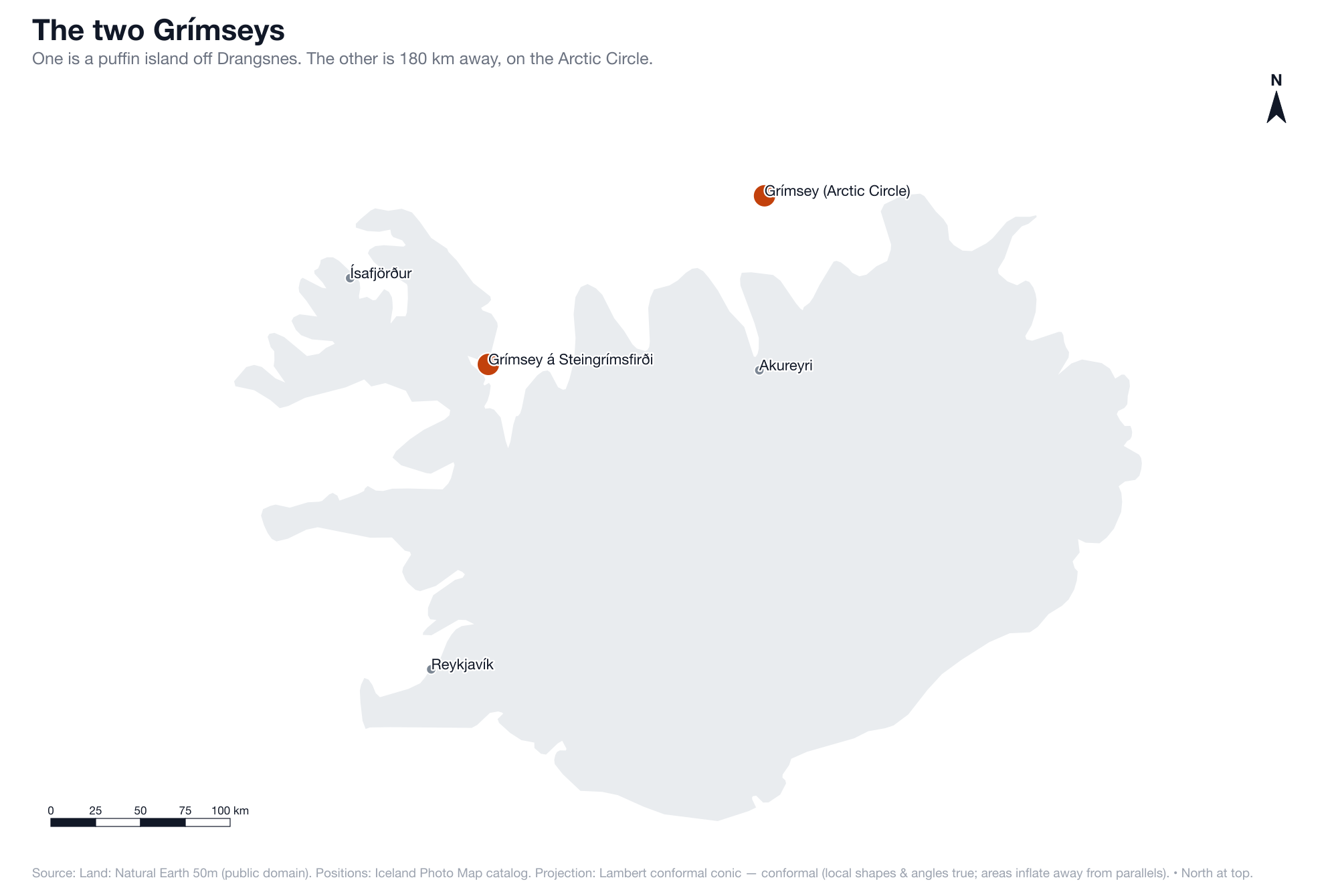
Which Grímsey has the puffins?
Both do — but they are completely different trips, and booking the wrong one costs you a day.
| Grímsey á Steingrímsfirði | Grímsey (Arctic Circle) | |
|---|---|---|
| Where | Off Drangsnes, Steingrímsfjörður, Strandir coast, Westfjords | Off the north coast, 180 km away |
| How you get there | About a 10-minute boat trip from Drangsnes | Ferry from Dalvík, or a flight from Akureyri |
| Crosses the Arctic Circle | No | Yes — that is the whole draw |
| Population | Uninhabited; seasonal use only | A working village |
| Closed season | None found | None; ferry runs year-round |
If an article puts a puffin island called Grímsey "on the Arctic Circle" and then describes a ten-minute boat ride, it has merged the two. Our catalog lists them as separate locations: Grímsey á Steingrímsfirði and Grímsey.
Both sets of coordinates are in the Iceland bird photography map — every bird location in the catalog as KML, GPX and GeoJSON, so the waypoints drop straight into Google Earth, Gaia GPS, OsmAnd or a Garmin. Bird locations are included in Iceland Complete, delivered by email with a 30-day file compatibility guarantee. If you would rather see the format before paying anything, the free five-waypoint sample is the same files with fewer points.
Borgarfjörður Eystri (East Iceland)
If you are exploring the eastern side of the country, Borgarfjörður Eystri is arguably the safest and most accessible puffin viewing location in Iceland. At the Hafnarhólmi marina, local authorities have constructed a series of wooden boardwalks, staircases, and viewing platforms that weave directly through a thriving puffin colony. This infrastructure allows you to get exceptionally close to the birds without any risk of stepping on their fragile burrows. It is a fantastic location for photographers of all mobility levels and offers incredible angles for capturing birds in flight as they return to the hillside.
Dyrhólaey (South Coast)
For those short on time or sticking close to the capital, Dyrhólaey is an excellent option. Located on the South Coast just before the town of Vík, this massive rock promontory features a historic lighthouse and sweeping views of black sand beaches. The puffin colony here is smaller than those in the Westfjords, but it is easily accessible from Reykjavik. Dyrhólaey is particularly special because it allows you to combine wildlife photography with stunning scenery. If you want to seamlessly integrate your bird shots with dramatic coastal vistas, checking out a dedicated landscape photography map can help you plan the perfect dual-purpose shoot in this area.
Vestmannaeyjar / Westman Islands
The Westman Islands, an archipelago off the South Coast, are home to the largest single puffin colony in the entire world. The main island, Heimaey, is accessible via a short ferry ride. Here, you can photograph puffins nesting on the sea cliffs or take a boat tour to see them diving into the water. The islands also have a heartwarming local tradition: in August, when the pufflings leave their nests, they sometimes get confused by the town's lights and crash-land in the streets. Local children stay up late to rescue these pufflings and release them safely to the sea the next morning, a testament to the deep connection between the locals and the wildlife.
Tjörnes Peninsula (North Iceland)
If you are driving the full Ring Road and heading up north near the whale-watching capital of Húsavík, the Tjörnes Peninsula is a must-stop destination. The cliffs at Voladalstorfa and the trails around the peninsula offer fantastic, less-crowded opportunities to photograph puffins. The viewing areas here look out over the Skjálfandi bay, providing a beautiful, serene, and often less tourist-heavy environment for dedicated photographers wanting a quiet moment with nature.
Other puffin and seabird sites worth routing
A few more that rarely make the lists. Krísuvíkurberg is 47 km from Reykjavík — the closest large seabird cliff in this catalog by a wide margin — and works as a half-day trip rather than an expedition. Rauðinúpur and Rauðanes sit on the far north-east coast, where you will usually have the birds to yourself. And one warning worth planning around: the nature reserve on Flatey is closed to all traffic from 15 April to 15 July under Auglýsing nr. 955/2021 — which covers most of the puffin season, so the usable window there is late July and August.
Essential Gear for Iceland Puffin Photography
Capturing professional-quality images of small, fast-moving seabirds in a rugged environment requires the right equipment. While you can certainly get snapshot memories with a smartphone at places like Borgarfjörður Eystri, dedicated camera gear is necessary to truly capture the intricate details of a puffin's plumage and the rapid action of their flight.
First and foremost, a high-quality telephoto lens is the most critical piece of gear in your bag. To get intimate close-ups without disturbing the birds, lenses with a focal length between 200mm and 600mm are ideal. A 100-400mm or a 150-600mm zoom lens provides excellent versatility, allowing you to shoot tight portraits of a bird resting on the cliff edge, and then zoom out slightly to track a bird in flight. The compression provided by a long telephoto lens also helps to beautifully blur the background (creating a soft bokeh), ensuring the vibrant puffin stands out against the harsh rocks or ocean.
Because Iceland puffin photography involves spending hours exposed to the elements on coastal cliffs, a weather-sealed camera body and lens combination is non-negotiable. Icelandic weather is notoriously unpredictable; a sunny afternoon can quickly turn into horizontal rain and biting wind. Your gear must be able to withstand sea spray, mist, and sudden downpours. Always carry a rain cover for your camera and plenty of microfiber cloths to keep your front lens element clear of water droplets.
Stability is another crucial factor. The winds on Icelandic cliffs can be fierce, making it difficult to handhold a heavy telephoto lens steady. A sturdy carbon-fiber tripod or a versatile monopod can save your arms from fatigue and ensure your shots remain tack-sharp. If using a tripod, ensure it has spiked feet to grip the grassy, uneven terrain near the cliff edges.
Finally, do not forget to pack a wide-angle lens (such as a 16-35mm or 24-70mm). While the telephoto is for the birds, a wide-angle lens allows you to capture stunning environmental portraits. Showing a tiny puffin perched on the edge of a massive, plunging cliff face tells a much broader story about the bird's dramatic habitat than a tight close-up ever could.
Camera Settings and Techniques for Wildlife Photography in Iceland
Having the right gear is only half the battle; knowing how to use it in challenging, fast-paced situations is what separates a good photo from a great one. Puffins are deceptively fast. Despite their somewhat rotund appearance, they can fly at speeds up to 55 miles per hour, flapping their short wings up to 400 times a minute. Capturing this action requires specific technical knowledge.
To freeze a puffin in flight, you need an incredibly fast shutter speed. A minimum of 1/2000th of a second is recommended, though 1/3200th or even 1/4000th of a second is safer if you want to completely freeze the rapid motion of their wings. When the birds are stationary on the cliffs, you can lower your shutter speed to 1/500th or 1/1000th of a second to allow more light into the sensor, thereby keeping your ISO lower for cleaner, noise-free images.
Your aperture settings will depend on the story you want to tell. If you want a classic portrait with a beautifully blurred background that isolates the puffin, shoot wide open at f/4 or f/5.6. If you want to show the context of the landscape—perhaps a puffin in the foreground with the jagged coastline visible in the background—stop down to f/8 or f/11 to increase your depth of field.
Autofocus is perhaps the most critical setting to master for any wildlife photography Iceland adventure. Set your camera to Continuous Autofocus (AF-C on Nikon/Sony, AI Servo on Canon). This ensures the camera constantly adjusts focus as the bird moves toward or away from you. If your modern mirrorless camera features Bird Eye Autofocus or animal tracking, turn it on. This technology is a game-changer for puffin photography, as it will automatically lock onto the bird's distinctive eye, allowing you to focus entirely on composition and panning smoothly with the bird's flight path.
Ethical Guidelines for Photographing Puffins
As photographers, it is our fundamental responsibility to protect the subjects we love. Puffins are a vulnerable species, and their breeding grounds are incredibly fragile ecosystems. Unlike many birds that build nests in trees, Atlantic Puffins dig burrows into the soft, grassy soil at the very edges of cliffs.
The most critical ethical guideline is to never walk on the grass near the cliff edges, and always stay behind any marked barriers or ropes. Puffin burrows are shallow, and the weight of a human walking overhead can easily cause the burrow to collapse, tragically crushing the egg or the chick inside. Even if you don't see a bird, the ground beneath your feet could be a nursery. Always lie flat on your stomach if you are trying to shoot over an unmarked cliff edge—this distributes your body weight and prevents the edge from giving way.
Furthermore, never attempt to feed, touch, or crowd the birds. If a puffin has a beak full of fish and is pacing back and forth rather than diving into its burrow, it means you are standing too close to its nest, and the bird is too afraid to feed its chick. If you notice this behavior, immediately back away. Adhere strictly to "leave no trace" principles: pack out all trash, do not disturb the local flora, and respect the natural environment that makes Iceland so magical.
How to Plan Your Route to Photograph Puffins in Iceland
Integrating puffin photography into your Icelandic adventure requires a bit of logistical planning, especially if you are driving the famous Ring Road (Route 1). Because the major colonies are spread out across the Westfjords, the East, and the South, you will need to map your route efficiently.
If you have a standard 7-to-10-day Ring Road itinerary, Dyrhólaey and Borgarfjörður Eystri are the easiest locations to incorporate without taking massive detours. If you have 14 days or more, dedicating time to the remote Westfjords to visit Látrabjarg is highly recommended for serious photographers.
To maximize your time, utilizing a reliable comprehensive map of all Iceland photo spots is incredibly beneficial. These maps provide exact GPS coordinates, designated parking areas, and hiking trailheads, ensuring you don't waste precious golden hour light searching for a colony. Additionally, because you will be visiting exposed coastal cliffs, it is vital to check local weather and road conditions daily on safetravel.is. High winds can make cliff-side photography exceedingly dangerous, so always prioritize your personal safety over a photograph.
Conclusion: Ready to Capture Iceland's Iconic Seabirds?
Photographing the Atlantic Puffin in its natural, dramatic Icelandic habitat is a bucket-list experience for any wildlife photographer. By understanding the breeding seasons, targeting the best locations like Látrabjarg or Borgarfjörður Eystri, packing the appropriate telephoto gear, and employing fast shutter speeds, you are setting yourself up for spectacular results.
Above all, remember that patience and respect for the wildlife are your most valuable tools. Take the time to sit quietly on the cliffs, listen to the sounds of the ocean, and observe the fascinating behaviors of these beautiful birds. We encourage you to share your resulting photos and stories with the wider photography community, inspiring others to appreciate and protect these incredible seabirds.
When you are ready to turn this into an actual route, the Iceland bird photography map has the GPS coordinates for every bird location in the catalog in KML, GPX and GeoJSON — included in Iceland Complete, emailed immediately with a 30-day file compatibility guarantee. Planning the whole trip rather than one morning? Iceland Complete covers all 121 locations for $49. Not ready to pay for coordinates you have not seen? Take the free five-waypoint sample first.
Frequently Asked Questions
What month is best to see puffins in Iceland?
The absolute best months to see and photograph puffins in Iceland are June and July. During this time, the eggs have hatched, and the adult puffins are highly active, constantly flying back and forth from the ocean to bring fish to their chicks. While puffins arrive in late April and leave by mid-August, mid-summer offers the highest volume of activity and the best lighting conditions with the Midnight Sun.
Can you see puffins in Iceland in winter?
No, you cannot see puffins in Iceland during the winter. Atlantic Puffins are pelagic birds, meaning they spend the majority of their lives resting and feeding on the open ocean. They only return to land to breed during the summer months. By late August or early September, the entire colony heads back out to the sea, and they will not return to the Icelandic cliffs until the following spring.
What camera lens do I need for puffin photography?
For the best results, a telephoto lens with a focal length of at least 200mm to 400mm is highly recommended. Lenses like a 100-400mm, 150-600mm, or a 70-200mm (perhaps with a teleconverter) allow you to get detailed, close-up shots of the puffins without invading their space or stressing the birds. A longer lens also provides beautiful background compression, making your subject pop against the coastal scenery.
Which Grímsey in Iceland has the puffins?
Both islands named Grímsey have puffins, but they are different trips 180 km apart. Grímsey á Steingrímsfirði is a small uninhabited island reached by a roughly ten-minute boat trip from Drangsnes on the Strandir coast, and Náttúrufræðistofnun counted about 23,250 breeding pairs there in 2015. The better-known Grímsey is the inhabited island on the Arctic Circle, reached by ferry from Dalvík or a flight from Akureyri. English-language guides regularly confuse the two.
Are puffins in Iceland afraid of humans?
In many of Iceland's major colonies, puffins are surprisingly tolerant of humans and do not display significant fear. In remote areas like the Látrabjarg cliffs, where there are few natural land predators, they will often sit peacefully just a few feet away from respectful observers. However, they are still wild animals. If you move too quickly, make loud noises, or stand too close to their burrows, you will cause them stress and they will fly away.
Ready to plan your wildlife photography adventure? Explore our interactive Birds Photo Map to find the exact coordinates of Iceland's best puffin colonies and start building your perfect itinerary today!