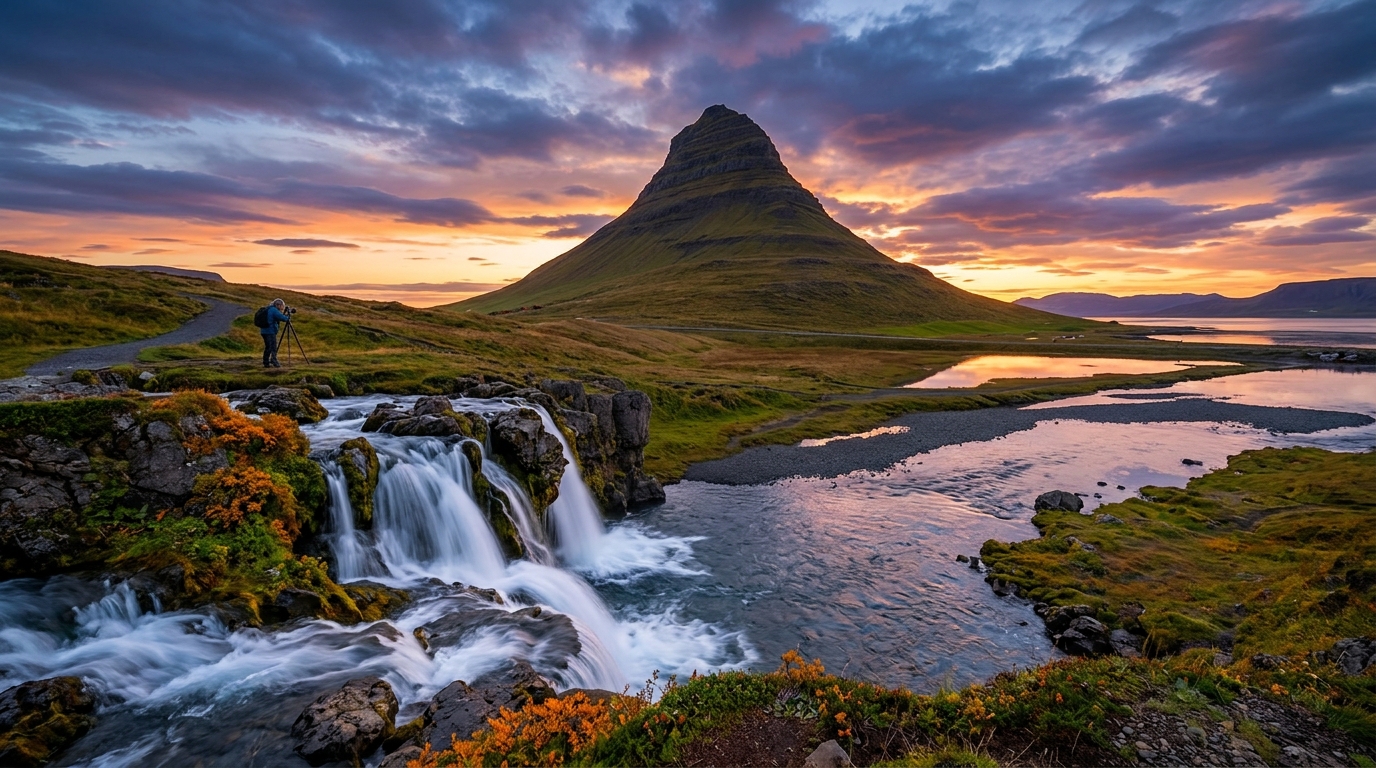
Rising dramatically from the northern coastline of the Snæfellsnes Peninsula, Mount Kirkjufell—often referred to as "Church Mountain"—stands as Iceland’s most photographed landmark. With its distinct, symmetrical arrowhead shape and the elegantly cascading tiers of the nearby waterfalls, this location offers a landscape composition that feels almost mathematically perfect. However, capturing a truly unique and tack-sharp image of this iconic scene requires more than just showing up. In this Kirkjufell photography guide, we will break down the exact techniques, seasonal nuances, and technical execution required to elevate your portfolio.
Because this location is heavily visited by tourists and workshop groups alike, simply pointing a camera at the mountain will yield the same snapshot millions of others have taken. As experts at Iceland Photo Map, we have designed this Kirkjufell photography guide to provide you with actionable, advanced steps to capture unique images. From navigating the 2026 parking logistics to executing complex focus stacks in freezing mist, this guide will help you return home with gallery-quality results.
What to Expect from This Kirkjufell Photography Guide
Before you step foot on the peninsula, proper preparation is mandatory. The weather on the Snæfellsnes Peninsula is notoriously volatile, and the physical environment around the falls presents specific challenges for camera gear. Throughout this Kirkjufell photography guide, we emphasize the importance of specialized equipment and logistical planning.
Your gear list should start with a remarkably sturdy tripod. The coastal winds here can easily reach gale force, rendering lightweight travel tripods useless for long exposures. You will also need a wide-angle lens to capture the entire scene; a 14-24mm or 16-35mm lens on a full-frame body is the industry standard for this location. Because you will be shooting near rushing water, pack multiple highly absorbent microfiber cloths to deal with inevitable lens spray.
Logistically, the infrastructure around the mountain has evolved. As of 2026, the parking lot at Kirkjufellsfoss requires a fee, according to the official tourism board at Visit West Iceland. The area utilizes a mandatory pay-to-park system to fund the maintenance of the trails and viewing platforms. Visitors must pay the parking fee via a mobile app or the on-site automated machines immediately upon arrival to avoid fines. The physical layout of the area is straightforward: the parking lot sits right off Route 54, and a well-maintained gravel path leads directly up the hill to the waterfall viewpoints. Understanding this layout allows you to plan your walking route efficiently, especially if you are arriving in the dark for a sunrise or Northern Lights shoot.
Locating the Iconic Kirkjufell Photo Spot
Finding the definitive Kirkjufell photo spot is a rite of passage for landscape photographers. From the parking lot, you will embark on a short, 2-to-5-minute walk up a slight incline. You will cross a small walking bridge that spans the river. Immediately after crossing this bridge, you will find yourself on the opposite bank, looking back toward the mountain. This is the staging ground for the classic composition.
The area features two distinct tiers of the waterfall. The upper viewpoint allows you to capture the top cascade with the mountain looming directly behind it. The lower viewpoint requires you to carefully navigate down the embankment (staying strictly behind the marked ropes to protect the fragile flora) to incorporate both the upper and lower falls into a sweeping foreground. To create a powerful composition, use the curving river and the diagonal lines of the cascading water as leading lines that draw the viewer's eye from the bottom left of your frame directly to the peak of Mount Kirkjufell in the upper right.
Because this is the premier Kirkjufell photo spot, you will rarely be alone. Navigating the crowds requires patience and etiquette. Arrive well before your target light to secure a prime tripod location along the rope line. If the prime spots are taken, do not trespass beyond the barriers; instead, use a slightly longer focal length to compress the scene from a higher vantage point, or communicate politely with other photographers to rotate positions between exposures.
Mastering Kirkjufellsfoss Waterfall Photography
Executing high-level Kirkjufellsfoss waterfall photography involves balancing the intense dynamic range of the sky with the movement of the water. To achieve those highly sought-after silky water textures without overexposing your background, Neutral Density (ND) filters are essential. A 3-stop (ND8) or 6-stop (ND64) filter is usually sufficient for daytime and golden hour shooting. Avoid 10-stop filters unless you are shooting in the glaring midday sun, as they will require excessively long shutter speeds that turn the water into a featureless, milky blur.
One of the most frustrating aspects of Kirkjufellsfoss waterfall photography is lens spray. The wind frequently whips mist directly into the face of your lens. To manage this, employ the "wipe and shoot" technique. Frame your shot, set your exposure, and switch to a 2-second self-timer. Hold a dry microfiber cloth completely over the front element of your lens. Press the shutter, wait one second, and swiftly pull the cloth away just before the exposure begins. Keep your lens hood attached at all times to act as a physical barrier against the mist.
Furthermore, to ensure both the rushing water mere feet from your lens and the distant mountain are tack sharp, you must utilize focus stacking. Even at f/11, a 16mm lens focused on the immediate foreground will render the mountain peak slightly soft. Switch your camera to manual focus and use live view magnification. Take one exposure focused on the closest rock in the water, a second exposure focused on the middle of the river, and a third exposure focused on the peak of Kirkjufell. Blend these exposures later in post-processing for infinite depth of field.
The Best Time to Photograph Kirkjufell: Seasons & Lighting
Determining the best time to photograph Kirkjufell depends entirely on the mood and atmospheric conditions you want to convey. The location undergoes a radical transformation between the summer and winter months.
During the summer (June through August), photographers can take advantage of the famed Midnight Sun. The sun dips just below the horizon, providing hours of continuous golden and blue hour lighting. This is arguably the best time to photograph Kirkjufell if you want vibrant, fiery skies and lush green slopes. The extended twilight allows you to shoot multiple compositions without rushing against a rapidly setting sun.
Winter (December through March) offers a stark, dramatic alternative. The mountain becomes coated in layers of snow and ice, and the waterfall partially freezes into striking blue icicles. However, winter brings severe safety hazards. The mist from the waterfall freezes on the walking paths, turning the entire area into a sheet of sheer ice. According to the official winter travel protocols outlined by SafeTravel Iceland, wearing heavy-duty crampons or microspikes is absolutely mandatory when navigating icy paths near waterfalls. Do not attempt this location in winter with standard hiking boots.
Regarding the time of day, sunrise is generally preferable to sunset. The prevailing winds on the Snæfellsnes Peninsula are often calmer in the early morning, resulting in less lens spray and a higher chance of capturing reflections in the nearby waters. Additionally, tour buses from Reykjavik typically arrive in the late afternoon, making sunrise a much quieter, more solitary experience.
Essential Kirkjufell Camera Settings for Sharp Images
Dialing in your Kirkjufell camera settings correctly in the field will save you hours of frustration in post-production. Many landscape photographers prefer setting their camera to its native base ISO (often ISO 64 or 100) to help maximize dynamic range and minimize digital noise. Your aperture should be set between f/8 and f/11. This is the "sweet spot" for most wide-angle lenses, providing excellent edge-to-edge sharpness while avoiding the image-softening effects of diffraction that occur at f/16 or f/22.
Shutter speed is the most critical variable in your Kirkjufell camera settings. The goal is to convey the motion of the water while retaining its intricate textures and leading lines. A shutter speed between 0.5 and 2 seconds is highly recommended. If you expose for 10 seconds or longer, the water loses all definition and becomes a solid white mass, which can distract from the rugged texture of the mountain. Use your ND filters to control the light entering the lens until you hit that 0.5 to 2-second target.
Finally, you must bracket your exposures. The mountain face is often heavily shadowed, while the sky behind it can be intensely bright. Shoot a minimum of three bracketed frames (e.g., -2 EV, 0 EV, +2 EV) to capture the full dynamic range of the scene. You can manually blend these in Photoshop using luminosity masks to retain natural contrast without creating the artificial, over-processed look common in automated HDR software.
Alternative Angles Beyond the Classic View
While this Kirkjufell photography guide covers the iconic waterfall composition extensively, expert photographers know to look beyond the obvious. Once you have secured the classic shot, take the time to explore alternative angles.
On exceptionally calm, windless days, walk across the road to the nearby tidal lagoon. If the tide is right and the water is still, you can capture a flawless, mirror-like reflection of the mountain. This angle completely removes the waterfalls from the frame but emphasizes the mountain's perfect symmetry.
Another excellent vantage point is from the nearby town of Grundarfjörður. By framing the mountain with the local fishing boats in the harbor or the colorful residential houses in the foreground, you introduce a sense of scale and human element to the landscape. If you are planning a broader trip around the area, we highly recommend exploring our interactive landscape map to discover similar hidden vantage points across the peninsula.
For drone photographers, 2026 regulations require strict adherence to local airspace rules. Flying a drone directly over the waterfall viewpoints or the crowds is prohibited due to safety and noise concerns. Under current guidelines from the Icelandic Transport Authority, you may fly over the adjacent tidal waters if you maintain a legal and respectful distance from the crowds, but you must always verify the latest local signage for temporary bans. The Authority advises pilots to always check the current local signage before taking off, and it is best practice to respect the experience of the ground-based photographers around you.
Northern Lights: A Bonus Section in Our Kirkjufell Photography Guide
Capturing the Aurora Borealis dancing over the "Church Mountain" is the pinnacle of Icelandic landscape photography. However, it requires a completely different approach to your Kirkjufell camera settings and planning.
Success relies heavily on accurate forecasting. While the KP index indicates the strength of solar activity, cloud cover is the ultimate deciding factor. A KP 7 is useless if the sky is overcast. We strongly advise monitoring the low, middle, and high-level cloud forecasts on the Icelandic Meteorological Office website. Look for the white areas on their map, which indicate clear skies.
For astrophotography, you need to let in as much light as possible. Open your lens to its widest aperture (f/1.4 to f/2.8). Push your ISO significantly higher, typically between ISO 1600 and 3200, depending on the noise-handling capabilities of your camera sensor. Set your shutter speed between 5 and 15 seconds. If the Aurora is moving rapidly, keep the shutter speed closer to 5 seconds to freeze the pillars of light; if it is a slow-moving, faint glow, extend it to 15 seconds.
The hardest part of night photography here is focusing. In pitch darkness, autofocus will fail. Switch to manual focus, turn on live view, and point your camera at the brightest star in the sky or a distant light in Grundarfjörður. Magnify the screen and slowly turn the focus ring until the light source becomes a pinpoint sharp dot. Once focused, use a piece of gaffer tape to lock the focus ring in place so you don't accidentally bump it in the dark.
Frequently Asked Questions
Do I need to pay for parking at Kirkjufell?
Yes. As of 2026, the parking lot at Kirkjufellsfoss requires a fee, as detailed by Visit West Iceland. The revenue is directly used to maintain the trails, viewpoints, and local environment. You can pay using the Parka app or at the automated pay stations located directly in the parking lot. Enforcement is strict, and failing to pay will result in a heavy fine linked to your rental car.
Can I fly a drone at Kirkjufell?
Drone flights are highly restricted in the immediate vicinity of the waterfalls to protect wildlife and preserve the experience for other visitors. You cannot launch or fly directly over the walking paths, the falls, or the viewing platforms. According to the Icelandic Transport Authority, you may fly over the adjacent tidal waters if you maintain a legal and respectful distance from the crowds, but you must always verify the latest local signage for temporary bans.
How long is the walk from the parking lot to the Kirkjufellsfoss viewpoint?
The walk is incredibly short and accessible. It takes approximately 2 to 5 minutes to walk from the parking area, up a slight gravel incline, and across the bridge to the main viewpoints. The path is well-maintained, though it can become muddy after heavy rain.
Is the Kirkjufell photo spot accessible in winter?
Yes, the location remains accessible throughout the winter months, but the conditions become treacherous. The mist from the waterfall coats the trails in solid, black ice. Accessing the viewpoints safely in winter is impossible without proper traction. Crampons or high-quality microspikes are absolutely mandatory for your safety.
Conclusion: Ready to Capture the "Church Mountain"?
Photographing Mount Kirkjufell is a masterclass in landscape photography. By arriving early to beat the crowds, utilizing ND filters to control the rushing water, and dialing in your exact Kirkjufell camera settings for maximum sharpness, you can create images that stand out from the millions of standard tourist snapshots. The Environment Agency of Iceland emphasizes that this is a fragile environment; visitors are urged to always stay behind the ropes, respect the local flora, and pack out any trash or microfiber cloths you bring with you.
Your journey doesn't have to end here. The Snæfellsnes Peninsula is packed with incredible coastal cliffs, black churches, and dramatic fjords. We encourage you to check out other waterfall photography locations or pair your visit with a trip to the nearby Búðakirkja black church. Once you've processed your images, head over to our landscape photography discussion board to share your results with the community.
Explore our interactive Landscape Map to find the exact GPS coordinates for Kirkjufell and plan your ultimate Snæfellsnes photography route!