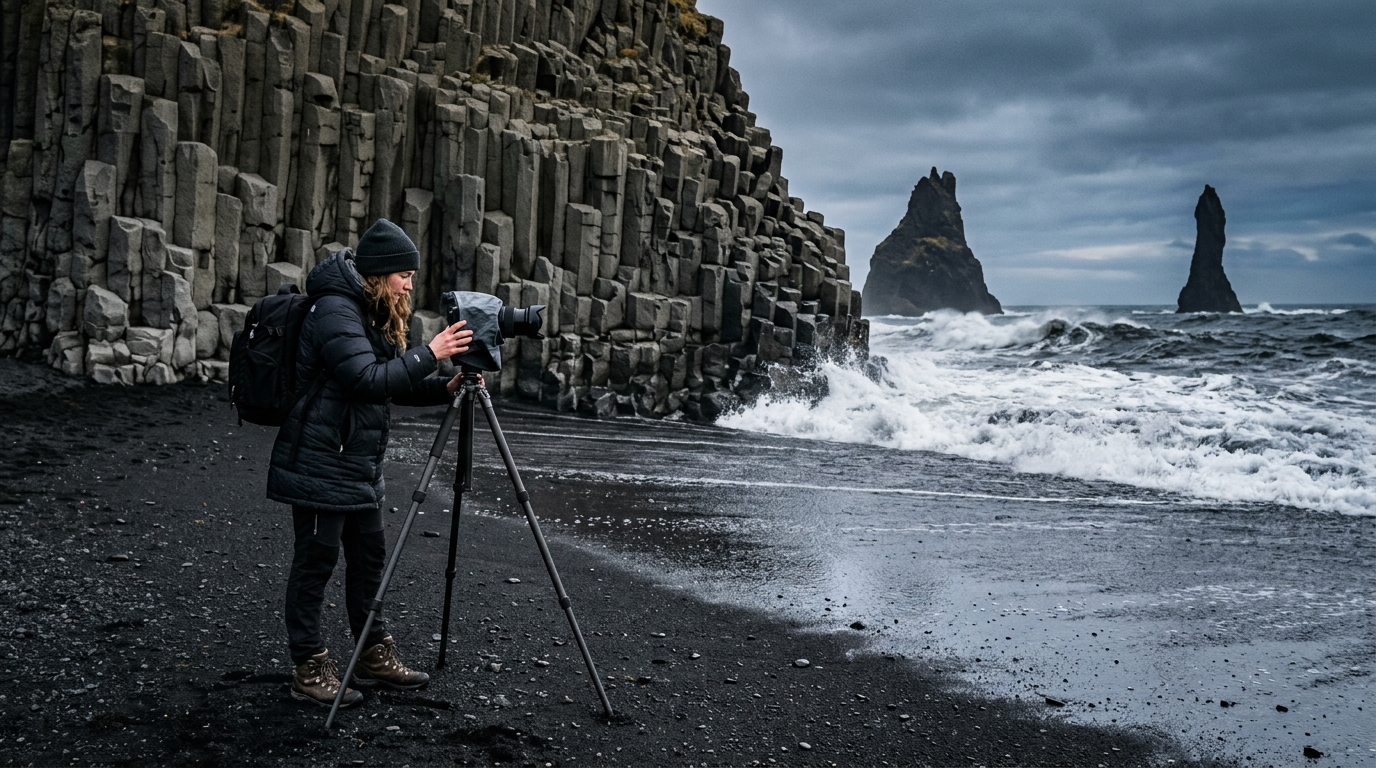
Welcome to the ultimate Reynisfjara photography guide. If you have ever dreamed of capturing the raw, untamed essence of Iceland's South Coast, Reynisfjara is likely at the top of your bucket list. With its jet-black volcanic sand, towering basalt columns, and the legendary Reynisdrangar sea stacks rising defiantly from the roaring North Atlantic, this location is a masterclass in mood and texture. However, photographing this world-famous beach is far from a simple "point-and-shoot" affair.
To walk away with portfolio-worthy images rather than a camera ruined by salt water or flat, uninspired compositions, you need a strategic approach. This guide is designed to provide professional and amateur photographers alike with the exact technical settings, composition strategies, gear recommendations, and safety protocols required to master this beautiful yet treacherous landscape.
---Why You Need a Dedicated Reynisfjara Photography Guide
Reynisfjara is not your average sandy beach. The stark contrast of brilliant white surf crashing against pitch-black volcanic sand creates an incredibly high-contrast environment. Standard camera metering systems are easily fooled here; they look at the vast expanses of dark sand and attempt to overexpose the frame, which completely blows out the details in the white waves and sky. Conversely, if you meter for the bright sky or foaming water, your foreground sand can easily devolve into a muddy, featureless black void.
Beyond the exposure challenges, the environment itself is actively hostile to camera equipment. Fine, abrasive volcanic dust can easily penetrate non-sealed lenses, while the relentless ocean breeze carries a fine mist of corrosive salt spray. Without a dedicated plan for protecting your gear and managing these high-contrast scenes, a shoot at Reynisfjara can quickly become frustrating—and costly.
At Iceland Photo Map, we have designed this guide to help you navigate these unique hurdles. By focusing on practical, real-world utility, this resource covers everything from technical exposure bracketing to the physical realities of shooting in one of Iceland’s most dynamic environments.
---Essential Gear for Reynisfjara Black Sand Beach Photography
To successfully execute high-quality reynisfjara black sand beach photography, your gear selection must prioritize durability, stability, and optical control. This is not a location where you want to rely on basic entry-level accessories.
1. Weather-Sealed Camera Bodies and Lenses
The air at Reynisfjara is constantly thick with salt spray and microscopic volcanic dust. A weather-sealed camera body paired with a weather-sealed lens is highly recommended. If your system lacks robust weather sealing, consider using a high-quality camera rain cover. Even on clear days, the wind can whip up fine sand that acts like sandpaper on exposed gear joints and lens barrels.
2. A Heavy, Sturdy Tripod
The South Coast of Iceland is famous for its fierce, unpredictable winds. A flimsy travel tripod will vibrate constantly, ruining your long exposures and tack-sharp landscape shots.
- Material: Carbon fiber is highly preferred for its dampening properties, though high-quality aluminum tripods also work well if they have sufficient weight.
- Setup Tip: Avoid extending the center column, as this acts like a sail in high winds. If your tripod has a ballast hook under the center apex, hang your camera bag from it to lower the center of gravity and anchor the setup into the sand.
- Post-Shoot Care: Volcanic sand will inevitably get into the twist locks or flip locks of your tripod legs. Be prepared to completely disassemble, rinse with fresh water, and dry your tripod legs after your shoot to prevent permanent grinding damage.
3. Lens Recommendations: Ultra-Wide to Telephoto
To capture the full spectrum of Reynisfjara's beauty, you should carry two primary lenses:
- Ultra-Wide Angle (14-24mm or 16-35mm on Full Frame): Essential for standing close to the Gardar basalt cliffs and capturing the sweeping curves of the shoreline alongside the massive Hálsanefshellir cave. It allows you to emphasize foreground textures like wet sand and basalt stones.
- Telephoto Zoom (70-200mm or 100-400mm): Crucial for compressing the distance between the shoreline and the Reynisdrangar sea stacks. A telephoto lens also allows you to tightly crop into the chaotic patterns of the crashing waves, creating abstract, high-contrast compositions while keeping you at a safe distance from the water.
4. Optical Filters: CPL and ND Filters
Filters are your secret weapon for managing the harsh dynamic range and capturing motion:
- Circular Polarizer (CPL): A CPL is indispensable here. It cuts through the glare on wet black sand, saturated basalt rocks, and water surfaces, revealing deep, rich black tones and enhancing the contrast of the white foam.
- Neutral Density (ND) Filters: To achieve silky-smooth water or to capture the movement of the receding tide, carry a 6-stop (ND64) and a 10-stop (ND1000) filter. A 6-stop filter is ideal during lower-light golden hours to drag your shutter to 1–4 seconds, while a 10-stop filter allows you to achieve long, ethereal exposures of 30 seconds or more during brighter daylight hours.
How to Photograph Reynisfjara: Composition and Framing
When learning how to photograph reynisfjara, the key is to move beyond simple snapshots and focus on the dramatic relationships between light, texture, and scale. The landscape is naturally minimalist, consisting primarily of black, white, and grey tones. Use this to your advantage to create powerful, graphic compositions.
1. Utilizing Leading Lines of White Foam
The contrast between the bright white foam of the Atlantic waves (*brim*) and the pitch-black sand provides some of the finest natural leading lines in landscape photography.
- The Technique: Set up your tripod close to the safe boundary of the wet sand. Set your camera to manual mode and a shutter speed of approximately 0.5 to 1.5 seconds.
- The Action: Wait for a wave to wash up the beach and begin to recede. Press the shutter just as the water retreats. The long exposure will capture the white trails of the foam drawing clean, graphic S-curves directly toward the Reynisdrangar sea stacks in the background.
2. Framing the Reynisdrangar Sea Stacks
The sea stacks are the focal point of the horizon, but their appearance changes dramatically depending on where you stand along the beach.
- Avoid Overlap: If you stand too close to the eastern edge of the beach, the stacks will visually merge together into a single, confusing dark mass. Walk further west along the shoreline to create separation between the individual spires, giving each stack its own distinct silhouette against the sky.
- Low-Angle Reflections: On a receding tide, the flat, wet sand acts as a giant mirror. Lower your tripod to just a foot off the ground. This extremely low perspective allows you to capture a near-perfect reflection of the sea stacks and the dramatic sky, doubling the visual impact of your frame.
3. Incorporating Human Scale
The scale of Reynisfjara is difficult to comprehend in a photograph without a point of reference. The basalt cliffs rise dozens of meters above the beach, and the waves can tower several meters high.
- The Setup: Have a companion stand near the base of the basalt columns (ensuring they are safe from any incoming waves).
- The Visual Impact: A human figure dressed in a brightly colored jacket—such as red, yellow, or orange—not only provides a sense of immense scale but also introduces a striking pop of color into an otherwise monochromatic, moody environment.
Capturing the Iconic Reynisfjara Basalt Columns Photo
Formed by the rapid cooling of basaltic lava, the cliff features near-perfect hexagonal columns stacked tightly together in a step-like formation. Capturing a striking reynisfjara basalt columns photo requires careful attention to perspective, lighting, and timing.
Finding the Best Angles and Symmetry
The columns offer highly structured, geometric patterns that contrast beautifully with the organic chaos of the ocean.
- The Straight-On Abstract: Use a medium focal length (35mm to 50mm) and position yourself directly perpendicular to a section of the columns. Frame the shot tightly to exclude the sky and the sand, focusing purely on the repeating hexagonal shapes. This creates a highly graphic, abstract pattern.
- The Step Alignment: Position your camera at a 45-degree angle to the cliff face. Use a wide-angle lens to capture the columns stepping down into the black sand, creating a strong diagonal line that leads the viewer's eye through the frame.
Managing Lighting Inside Hálsanefshellir Cave
Directly adjacent to the columns is the Hálsanefshellir cave, a massive cavern carved out by wave erosion. The interior of the cave is dark, while the opening looks out onto the bright beach and ocean.
- The Dynamic Range Challenge: To capture the texture of the basalt ceiling inside the cave while preserving the details of the sea stacks outside, you must use exposure bracketing.
- Implementation: Set your camera to bracket 3 to 5 frames at 1 or 2 EV intervals. Later, in post-processing software, merge these files into a High Dynamic Range (HDR) image to cleanly recover the deep shadows of the cave interior without blowing out the coastal highlights.
Avoiding the Crowds in 2026
Reynisfjara is one of the most visited locations in Iceland. Use a 10-Stop ND Filter: If there are people climbing on the columns, mount your camera on your sturdy tripod, attach a 10-stop ND filter, and take a long exposure of 2 to 3 minutes. Any moving tourists will disappear from the frame, leaving you with a clean, empty shot of the basalt columns. Shoot in the Off-Hours: Take advantage of the shoulder hours. Arriving at first light or late in the evening will naturally minimize the number of people in your frame.
---Understanding the Light: Best Times to Visit in 2026
Light is the defining element of any landscape photograph, and at Reynisfjara, the angle and quality of light can completely transform the mood of the beach. Depending on when you plan your shoot in 2026, you will experience very different photographic conditions.
1. Golden Hour: Sunrise and Sunset
During the golden hours, the sun hangs low on the horizon. Because Reynisfjara faces south, the rising sun in the east and the setting sun in the west strike the sea stacks and basalt cliffs at a low, side-lit angle. This side-lighting accentuates the three-dimensional textures of the basalt columns and casts long, dramatic shadows across the ripples of the black sand, adding incredible depth to your images.
2. The Advantages of Overcast Days
Do not despair if the weather forecast calls for thick clouds. Overcast days are actually highly prized by professional landscape photographers at Reynisfjara. The cloud cover acts as a massive softbox, eliminating harsh shadows and bright highlights. This diffused light is perfect for capturing moody, high-contrast black-and-white images. It emphasizes the brooding, gothic atmosphere of the black sand beach and brings out the rich, dark textures of the wet volcanic stones.
3. Seasonal Considerations: Summer Solstice vs. Winter
Your experience will vary drastically depending on the season of your visit: The 2026 Summer Solstice (June): During the summer, Iceland experiences the Midnight Sun. Around the solstice, the sun barely dips below the horizon, resulting in hours of continuous golden and pink light between 11:00 PM and 3:00 AM. Photographing Reynisfjara at 1:00 AM allows you to capture stunning, low-angle light with virtually no other tourists on the beach. Winter Photography (November to February): In winter, the beach is often dusted with pristine white snow, creating a breathtaking checkerboard of black and white.
---Safety First: Navigating the Dangerous Sneaker Waves
No Reynisfjara photography guide is complete without a serious, detailed discussion on safety. Reynisfjara is beautiful, but it is also one of the most hazardous destinations in Iceland. Several tourists have lost their lives here, dragged into the freezing, turbulent ocean by "sneaker waves." As a photographer, your focus is often split between your camera settings and your composition, making you highly vulnerable if you do not understand the mechanics of this beach.
The Science Behind Sneaker Waves
A sneaker wave is not a mythological occurrence; it is a physical phenomenon caused by the unique bathymetry (underwater topography) of the seabed surrounding Reynisfjara. No Shallow Barrier: Unlike many coastlines where shallow reefs or sandbars gradually break the incoming wave energy, the ocean floor off Reynisfjara drops off precipitously into a deep trench very close to the shore. The Surge: When these waves reach the beach, they suddenly shoal, rushing incredibly far up the flat black sand with immense speed and power. A wave that appears small from a distance can suddenly surge dozens of meters higher up the beach than the waves preceding it. The Undertow: The backwash (undertow) of these waves is incredibly strong due to the steep slope of the underwater drop-off. Once a person is swept off their feet, the retreating water pulls them rapidly into the deep, freezing ocean, where hypothermia sets in within minutes.
How to Read the Beach Safety Light System
At the entrance to Reynisfjara, before you step onto the sand, there is a prominent safety display featuring a traffic-light zoning system. This system, which is linked to the wave forecasting system of the Icelandic Road and Coastal Administration and highlighted by SafeTravel Iceland, monitors real-time ocean conditions. Always check this sign before proceeding:
- Green Light: Normal conditions, but caution is still required. Do not go near the water line.
- Yellow Light: High swell conditions. You must not enter the yellow zone marked on the beach maps. Keep a significant distance from the surf.
- Red Light: Extremely dangerous conditions. Do not go anywhere near the lower beach. The waves can reach all the way to the basalt cliffs and the cave entrance. Under a red light, stay on the upper paths.
Crucial Rules for Photographers
To ensure you return from your shoot safely with your life and your gear intact, adhere strictly to these rules:
- rarely turn your back on the ocean. As emphasized in official safety briefings from local search and rescue teams, you must rarely turn your back on the ocean. Even when looking through the viewfinder or adjusting your tripod settings, keep the water in your peripheral vision, or have a shooting partner act as a spotter.
- Keep a safe distance. As a general rule of thumb, stay at least 20 to 30 meters (65 to 100 feet) away from the wet sand line. A key safety observation shared by local guides is that if the sand beneath your feet is wet, a wave has washed over it, and another one can easily reach it again.
- Do not enter the cave during high tide. The Hálsanefshellir cave can easily become cut off by incoming waves, trapping you inside with no escape route. Always consult the official tide tables on the Icelandic Coast Guard website and marine forecasts on the Icelandic Meteorological Office website before planning your shoot, and aim to photograph during an outgoing (ebbing) tide.
- Prioritize safety over the shot. No photograph is worth your life. If a wave is approaching faster than expected, grab your tripod and run to higher ground immediately—do not stop to pack up your gear.
Expanding Your South Coast Shoot: Nearby Locations
Reynisfjara is a highlight of Iceland's South Coast, but it is best experienced as part of a broader, cohesive photography route. By combining your visit with nearby locations, you can capture a diverse range of coastal and volcanic landscapes in a single day.
Dyrhólaey Peninsula
Located just a short drive west of Reynisfjara, the Dyrhólaey peninsula offers a spectacular, elevated perspective of the entire coastline. While Reynisfjara places you down on the sand looking out at the waves, Dyrhólaey positions you atop high cliffs looking down. From this vantage point, you can photograph the massive stone arch carved by the sea, the historic lighthouse, and the endless black sand beaches stretching miles to the west. It is also an excellent spot for photographing nesting puffins during the summer months.
Designing Your South Coast Route
To maximize your time and ensure you catch the best light at each location, we recommend planning a structured journey along the South Coast region. A typical day itinerary might begin with sunrise at the dramatic waterfalls of Seljalandsfoss or Skógafoss, followed by a midday exploration of the coastal cliffs, and concluding with a late-afternoon or sunset shoot at Reynisfjara when the light on the sea stacks is at its most dramatic.
When planning your route, utilizing specialized tools is highly beneficial. An interactive tool like our landscape photography map helps you pinpoint precise parking locations, trailheads, and hidden vantage points that are easily missed when relying on standard GPS navigation.
---Frequently Asked Questions
Is it safe to photograph Reynisfjara at high tide?
Generally, photographing Reynisfjara at high tide is much more dangerous and is not recommended, especially if there is a high ocean swell. At high tide, the waves reach much further up the beach, often cutting off access to the basalt columns and the Hálsanefshellir cave entirely. If you are caught near the cliffs during high tide, you can easily be trapped by incoming waves.
What camera settings should I use to capture the white waves against the black sand?
To capture the high-contrast action of the waves, use Manual Mode with the following baseline settings: Aperture: f/8 to f/11 to ensure sharp details from the foreground sand to the distant sea stacks. ISO: Keep your ISO at its native base (typically ISO 64 or 100) to maximize dynamic range and minimize noise in the dark shadow areas of the sand. Shutter Speed: To freeze the dramatic explosion of crashing waves, use a fast shutter speed of 1/500s to 1/1000s. To capture the elegant, painterly motion of the receding foam, use a slower shutter speed of 0.5s to 1.5s on a sturdy tripod. Exposure Compensation / Metering: Use Spot Metering on the mid-tones (like the wet sand or grey basalt rocks) or set your exposure compensation to -0.7 or -1.0 EV to prevent the bright white foam from blowing out. often monitor your histogram to ensure your highlights are not clipped.
Can I fly a drone at Reynisfjara Black Sand Beach?
drone flight regulations at Reynisfjara are strictly enforced. Flying a drone is restricted directly over the beach and surrounding cliffs to protect nesting bird populations (such as puffins and fulmars) and to preserve the peace of other visitors. often check for local "No Drone" signage posted at the parking lot and beach entrance. If you do fly in permitted adjacent areas, maintain a safe distance from the cliffs and rarely harass the wildlife.
How do I protect my camera gear from the salt spray and sand at Reynisfjara?
To keep your gear safe in this harsh environment, use a high-quality optical flat or UV filter to protect your front lens element from corrosive salt spray. Keep a microfiber cloth and a bottle of lens cleaning solution in an easily accessible pocket; you will need to wipe down your lens element frequently to remove salt smudges. rarely change lenses while standing on the windy beach, as this invites fine volcanic dust directly onto your camera sensor. Finally, store your camera in a sealed camera bag when walking between shooting spots to minimize exposure to the salt-laden air.
---Conclusion: Putting Your Reynisfjara Photography Guide Into Action
Reynisfjara is a place of undeniable raw power and cinematic beauty. By understanding the unique exposure challenges of the black sand, equipping yourself with a sturdy tripod and the right optical filters, and executing thoughtful compositions that emphasize scale and leading lines, you can capture truly breathtaking images. However, the most important tool you can bring to this beach is a deep respect for the ocean. Prioritizing safety over the "perfect shot" ensures you will return home safely with a camera full of stunning images.
At Iceland Photo Map, we are dedicated to helping you navigate these incredible landscapes safely and successfully. Our goal is to provide clear, actionable insights so you can focus on what matters most: capturing the breathtaking beauty of Iceland.
Ready to capture the raw beauty of Iceland's South Coast? Don't miss a single epic viewpoint. Get our comprehensive Iceland Photo Map today to unlock exact GPS coordinates, parking details, and shooting tips for Reynisfjara and hundreds of other stunning locations!