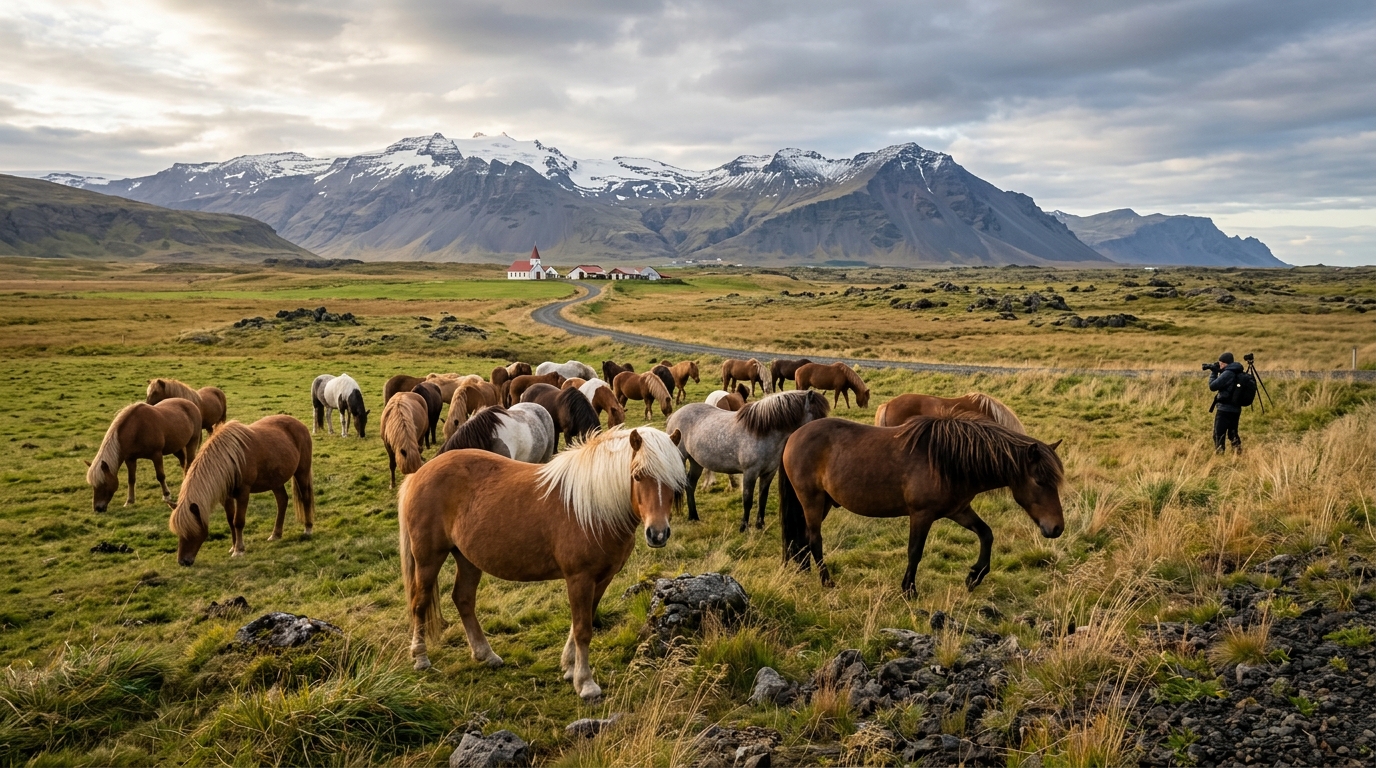
Introduction: Capturing Iceland's Most Iconic Animal
Few subjects embody the rugged spirit of the land of fire and ice quite like its native equine residents. With their thick manes, sturdy builds, and exceptionally calm temperaments, these creatures are a dream subject for wildlife and landscape photographers alike. If you are planning a photography trip in 2026, knowing exactly where to photograph Icelandic horses will undoubtedly be at the top of your itinerary. They provide a vital sense of scale and a living, breathing foreground element against the dramatic backdrops of volcanic craters, towering waterfalls, and sweeping glacial valleys.
However, capturing stunning portraits of these animals requires more than just pulling over on the side of the road and pointing your camera. Because they are deeply embedded in the local agricultural framework, photographing them demands a specific blend of location scouting, technical camera proficiency, and ethical considerations.
Exactly Where to Photograph Icelandic Horses by Region
While you might spot horses from the window of your rental car almost as soon as you leave Keflavík Airport, finding the perfect combination of a cooperative herd, a safe place to park, and a stunning background takes a bit of planning. Here is a breakdown of exactly where to photograph Icelandic horses across the country's most photogenic regions.
The South Coast: Abundant Roadside Farms
The stretch of Route 1 (the Ring Road) between the towns of Selfoss and Vík is arguably one of the most accessible areas for equine photography. Because this region is heavily agricultural, the flat coastal plains are dotted with expansive horse farms. When photographing along the South Coast, look for designated gravel pull-offs near Hvolsvöllur and Hella. Here, fences often run parallel to the road, and the horses are frequently curious enough to approach the fence line. On a clear day, you can frame these portraits with the looming stratovolcanoes of Eyjafjallajökull or Hekla in the background.
The Golden Circle: Dramatic Valleys and Geothermal Backdrops
If you are exploring the Golden Circle, the agricultural lands surrounding Skálholt and the valleys near Geysir offer incredible photographic opportunities. The topography here is more undulating than the South Coast, allowing you to position yourself lower than the horses to shoot upward, silhouetting their iconic manes against the dynamic Icelandic sky. Keep an eye out for farms that offer horseback riding tours; these properties often have large, accessible pastures with spectacular views of the surrounding geothermal landscapes.
North Iceland: The Historical Heartland
For the true equine enthusiast, the region of Skagafjörður in North Iceland is widely considered the historical heartland of the Icelandic horse. The valleys here are steep and dramatic, carved by ancient glaciers, providing a majestic, moody backdrop that is perfect for fine-art wildlife photography. Because the North sees slightly less tourist traffic than the South, the herds here often graze in vast, uninterrupted pastures that make for incredibly clean, distraction-free compositions.
To pinpoint the exact coordinates of safe parking areas and scenic pastures, we highly recommend using our interactive maps to find nearby pull-offs that have been vetted by other photographers.
Best Places to See Horses in Iceland: Free-Roaming vs. Farmed
When searching for the best places to see horses in Iceland, it is helpful to understand that there are generally no truly "wild" horses in Iceland. The horses you see belong to local farmers or breeders. However, the way these animals are kept varies drastically depending on the season and the region, which directly impacts how you photograph them.
During the long winter months, many horses are kept in fenced pastures near farmhouses in the lowlands, where they can be easily fed and monitored. Photographing them during this time means dealing with fences. To minimize the visual impact of a fence in your shot, you will need to rely on specific lens choices and depth-of-field techniques.
Summer, however, brings a centuries-old tradition that completely changes the photographic landscape. Starting in June, many farmers release their non-riding horses (young foals, pregnant mares, and resting horses) into the unfenced highlands to graze freely on the rich vegetation. If you are traveling through the highlands via F-roads (such as the Kjölur route or Landmannalaugar) between late June and early September, you may encounter these free-roaming herds. Photographing free-roaming horses offers a distinct advantage: no fences, no power lines, and a completely wild aesthetic. This summer grazing period culminates in September with the réttir, the annual horse round-up, which is a spectacularly photogenic cultural event if you are lucky enough to attend.
How to Interact with Icelandic Horses Safely and Ethically
Knowing how to interact with Icelandic horses safely is a critical aspect of your photography trip. Because these animals are a vital part of Iceland's agricultural economy and cultural heritage, tourists should adhere to ethical guidelines to help ensure the safety of both the animals and themselves.
Rule #1: Do Not Feed the Horses
This is a frequently broken rule by tourists, and it can carry severe consequences. It is highly recommended that you do not feed horses you encounter on the side of the road. According to the Icelandic Food and Veterinary Authority (MAST), feeding horses unfamiliar snacks like bread, apples, or foreign horse treats can cause deadly cases of colic or choking. Furthermore, because Iceland has strict biosecurity laws to protect its isolated horse population from foreign diseases, pathogens transferred from a tourist's hands or imported treats can devastate a herd. If you want to photograph them, let their natural curiosity bring them to the fence; do not bribe them with food.
Rule #2: Respect Fences and Private Property
It is strongly advised to avoid climbing over, crawling under, or opening a closed gate to enter a horse pasture. These are private agricultural lands. Entering a field can risk startling the herd, potentially causing injuries to the animals or yourself. It is best practice to shoot from the public side of the fence line.
Rule #3: Park Safely and Legally
The quest for the perfect photo should never compromise road safety. Current guidelines published by Visit Iceland explicitly state that stopping your vehicle on the shoulder or in the middle of the Ring Road is illegal and highly dangerous due to blind crests and fast-moving traffic. Always drive until you find a designated gravel pull-out or a safe farm approach road before exiting your vehicle to photograph.
Reading Equine Body Language
To help ensure a stress-free encounter, approach the fence line slowly and calmly. Avoid sudden movements or loud noises. If a horse pins its ears flat against its neck, turns its hindquarters toward you, or swishes its tail aggressively, it may be agitated—step back and give it space. Conversely, ears pricked forward and a relaxed, lowered head often indicate curiosity and comfort, making for the perfect portrait moment.
Essential Icelandic Horse Portrait Settings
To elevate your images from simple snapshots to professional-grade wildlife portraits, you need to master your Icelandic horse portrait settings. The dynamic environment of Iceland, combined with the movement of the animals, requires a deliberate approach to the exposure triangle.
Aperture: Isolating Your Subject
Because you will often be shooting from behind a fence line, controlling your depth of field is paramount. We recommend using a wide aperture, ideally between f/2.8 and f/4. A wide aperture creates a shallow depth of field, which beautifully blurs out distracting background elements like farmhouses or distant power lines. More importantly, if you position your lens close to the fence wire (without touching it or crossing the property line) and shoot at f/2.8, the wire closest to your lens will often blur out entirely, rendering it less visible in the final image.
Shutter Speed: Freezing the Action
For static portraits where the horse is simply standing or grazing, a shutter speed of 1/500s is generally sufficient to eliminate camera shake and micro-movements. However, the Icelandic horse is world-renowned for its unique gaits. According to the official breed association, Horses of Iceland, this breed is capable of performing five distinct gaits, including the famous tölt—a smooth, four-beat ambling gait. If you are trying to capture a horse in motion, especially demonstrating the energy of the tölt or a full gallop, you may need to bump your shutter speed to at least 1/1000s or 1/1250s to freeze the flying hooves and flowing manes.
Focus and Focal Length
Modern mirrorless cameras equipped with animal eye-tracking autofocus are incredibly useful here. Set your camera to Continuous Autofocus (AF-C or AI Servo) to track the horse's eye as it moves around the pasture.
Regarding lenses, a 70-200mm telephoto lens is often considered an excellent choice for equine photography in Iceland. Shooting at the 200mm end allows you to maintain a respectful, safe distance while tightly framing the horse's face. Additionally, the telephoto compression flattens the perspective, pulling those dramatic distant mountains or glaciers right up behind the horse for a truly epic composition.
Icelandic Horse Photography Tips for All Seasons
Iceland's wildly fluctuating seasons dramatically alter both the landscape and the appearance of the horses, meaning your Icelandic horse photography tips need to adapt to the time of year.
Winter (November to March)
Winter photography in Iceland is magical. To survive the sub-zero temperatures, Icelandic horses grow an incredibly thick, fluffy double coat, making them look exceptionally rugged. When photographing them against a snowy landscape, your camera's light meter will often be tricked by the bright white snow, resulting in underexposed, gray-looking images. To compensate, manually dial in +1 to +1.5 stops of Exposure Compensation. Keep an eye out for dark-colored horses (blacks, dark bays, or chestnuts), as their coats provide stunning, high-contrast subjects against the white winter backdrop.
Summer (June to August)
By early summer, the horses shed their winter fuzz, revealing sleek, shiny summer coats. The landscape explodes into vibrant greens, with fields of purple Alaskan lupine dominating the lowlands. Use these lupine fields as foreground elements to frame your horse portraits. The summer months also bring the phenomenon of the midnight sun. In June and July, the golden hour lasts for several hours throughout the night, providing incredibly soft, warm, directional light that is perfect for backlit portraits highlighting their manes.
Planning Your Route: Where to Photograph Icelandic Horses on the Ring Road
Integrating horse photography into a broader Icelandic road trip requires good time management. You rarely need to plan a whole day around finding horses; instead, you can build spontaneous stops into your transit times between major landmarks.
For example, if you are planning to photograph the iconic waterfalls of the South Coast like Seljalandsfoss and Skógafoss, allocate an extra 45 minutes of driving time. The stretch of Route 1 connecting these two waterfalls is heavily populated with horse farms. Similarly, when scouting dramatic landscapes in the East Fjords, keep your telephoto lens easily accessible in the passenger seat. You will frequently round a corner to find a small herd grazing perfectly positioned beneath a towering basalt mountain.
A pro tip for road-trippers: Do not feel obligated to stop at the very first horse farm you see upon leaving Reykjavík. Those closest to the city are often crowded with other tourists. If you drive just an hour further into the countryside, you will often find equally beautiful horses with fewer crowds, allowing you the time and space to compose your shots thoughtfully.
Conclusion: Respecting the Landscape and Its Inhabitants
Photographing the Icelandic horse is an immensely rewarding experience that captures the very soul of Iceland's agricultural heritage. By understanding exactly where to find them, respecting the ethical guidelines regarding feeding and private property, and dialing in the correct camera settings, you can walk away with portfolio-worthy images.
Remember that excellent wildlife photography often stems from patience and respect. Let the horses approach you on their own terms, stay safely behind the fence lines, and use your telephoto lens to do the heavy lifting. The rugged beauty of these animals is a privilege to witness, and capturing it responsibly helps ensure that future generations of photographers can enjoy the same incredible encounters.
Frequently Asked Questions
Are there wild horses in Iceland?
It is widely noted that there are no truly wild horses in Iceland. The horses you see are generally owned by a farmer or breeder. However, during the summer months, many farmers release their herds into the remote highlands to graze freely, which can give them the appearance of being wild. They are later rounded up in the autumn during a traditional event known as the réttir.
Can I feed the Icelandic horses I see on the side of the road?
It is highly advised against. Feeding horses on the side of the road can be dangerous for the animals. Foreign foods can cause severe digestive issues like colic, or result in choking. Additionally, touching and feeding horses can introduce foreign pathogens to the isolated Icelandic horse population. It is widely recommended to observe and photograph them without offering food.
What is the best lens for photographing horses in Iceland?
A 70-200mm telephoto lens is often considered an excellent choice for photographing horses in Iceland. The long focal length allows you to capture intimate portraits from a safe, respectful distance without crossing fence lines. Furthermore, shooting at 200mm compresses the background, making distant mountains and glaciers appear larger and closer behind your subject.
What time of year is best for Icelandic horse photography?
The ideal time depends entirely on the aesthetic you prefer. Winter (November to March) is great for capturing their incredibly thick, fluffy winter coats against dramatic snowy landscapes. Summer (June to August) is fantastic for photographing their sleek summer coats against vibrant green pastures and fields of purple lupines, with the added benefit of the midnight sun providing hours of perfect golden-hour lighting.
Ready to find the perfect backdrop for your horse portraits? Explore our interactive Iceland Photo Map to discover the best scenic pull-offs and photography locations across the country.