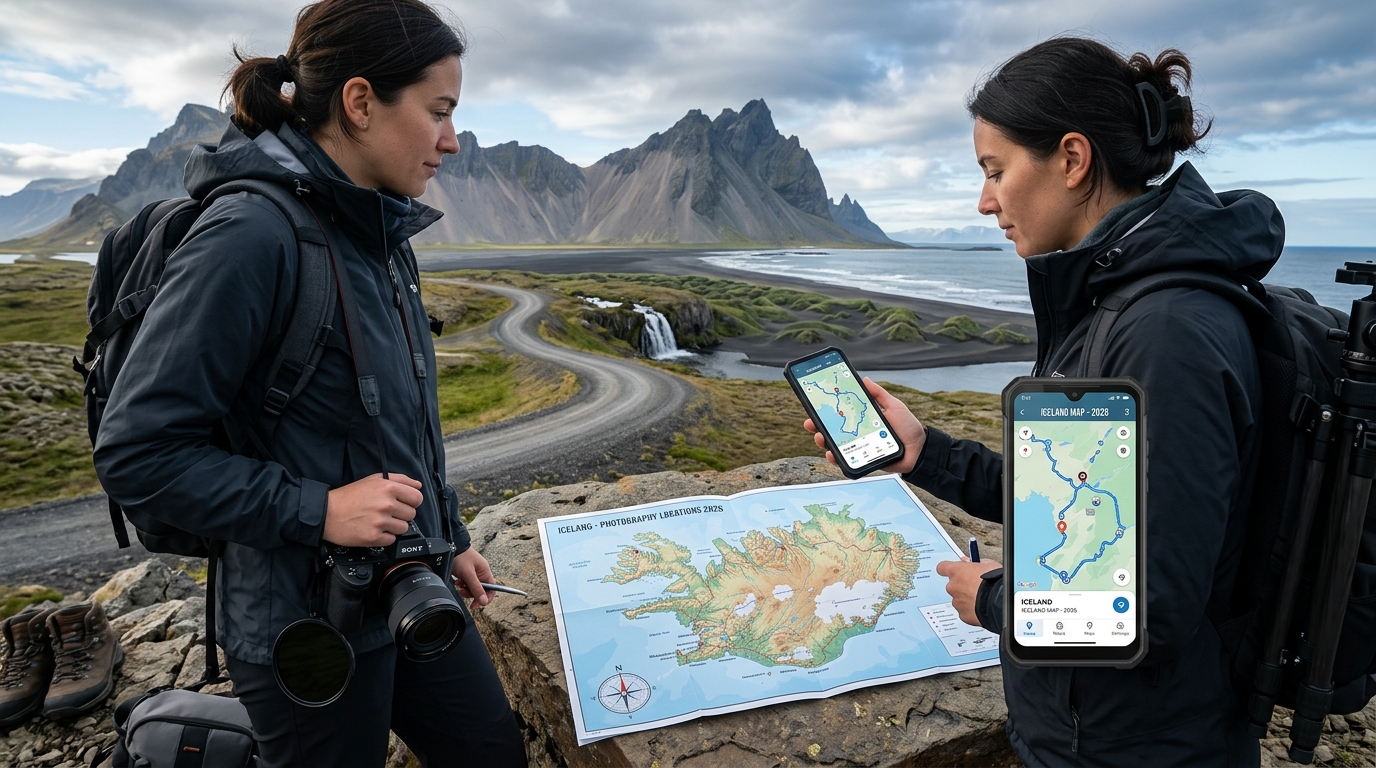
Short answer: For 2026, make a dedicated digital photography map with offline GPS your primary tool — it pinpoints exact coordinates, parking, and access for each photo spot, which general navigation apps and paper maps cannot. Keep a physical topographic paper map as a battery-free backup for the Highlands and deep fjords where devices fail and signal drops. The best setup is a hybrid: digital for precision, paper for redundancy.
Introduction: Navigating the Land of Fire and Ice in 2026
Planning a photography expedition to Iceland in 2026 requires far more than just packing your camera body, a sturdy carbon-fiber tripod, and a selection of neutral density filters. Navigating the dramatic, volatile, and highly unpredictable landscapes of the Land of Fire and Ice demands absolute geographic precision. For landscape photographers, finding the best iceland photography map is not just a matter of convenience—it is the foundation of a successful, safe, and productive shoot.
While standard turn-by-turn navigation apps like Google Maps or Apple Maps are excellent for driving from Keflavík International Airport to a hotel in Reykjavík, they fall dangerously short when it comes to specialized photography planning. These mainstream consumer apps are designed to find the fastest paved route between two points. They do not understand the nuance of photographic scouting. They cannot tell you where a hidden trailhead begins, which gravel pull-off offers the safest parking, whether a specific F-road requires a high-clearance 4x4 with a snorkel, or how the light will hit a basalt sea stack during astronomical twilight.
As you plan your 2026 itinerary, you will inevitably face a critical toolset debate: should you rely on traditional, tactile paper maps, or should you embrace modern, interactive digital solutions? Both mediums possess distinct advantages and critical limitations. To help you maximize your time behind the lens and navigate safely through Iceland's remote regions, this guide provides an in-depth comparison of physical and digital mapping strategies, outlining how to build the ultimate navigation system for your upcoming expedition.
Why You Need a Dedicated Iceland Photo Spots Map
A standard tourist map is designed to highlight commercial infrastructure: gas stations, hotels, supermarkets, and heavily trafficked geosite parking lots. In contrast, a dedicated iceland photo spots map is engineered specifically for the visual creator. It translates geographical data into creative opportunity, saving you hours of aimless driving and helping you avoid the frustration of arriving at a world-class location only to find the light is completely unusable.
The primary advantage of a specialized photography map lies in its micro-level precision. When photographing complex geological features, a difference of fifty meters can completely alter your composition. A dedicated map does not just point to a landmark; it identifies:
- Exact Composition Coordinates: The precise GPS coordinates where you should set up your tripod to capture iconic perspectives or lesser-known angles.
- Safe Parking and Trailheads: Iceland's environmental regulations are strict, and off-road parking is illegal. A photo map highlights designated parking areas and the exact paths leading to the shoot location, preventing costly fines and protecting fragile ecosystems.
- Seasonal Accessibility: Many of Iceland's most dramatic locations are inaccessible for large portions of the year. A photo-focused map provides clear indications of which routes are impassable during the winter months.
Furthermore, understanding light behavior is critical in high-latitude environments. In Iceland, the sun's angle changes dramatically throughout the year. During the summer midnight sun, the sun skims the horizon for hours, casting long, soft shadows and creating an extended golden hour that transitions directly into sunrise. Conversely, in the depths of winter, the sun rises only a few degrees above the horizon, offering brief, low-angle light.
By utilizing a specialized map, such as our curated list of waterfall photography locations, you can determine which canyon walls will block the light at specific hours, allowing you to time your arrival perfectly to capture pristine reflections or dramatic mist-lit rainbows.
The Case for Paper Maps: Reliability in Remote Landscapes
In an era dominated by digital screens, the traditional paper map remains an indispensable asset for serious explorers. Physical maps—particularly those produced at scales of 1:100,000 or 1:50,000 by local cartographic authorities or the National Land Survey of Iceland—offer unique advantages that digital devices simply cannot replicate.
First, paper maps provide an unparalleled tactile benefit for broad-scale route planning. Spreading a large physical map across a table allows you to visualize the grand topography of an entire region, such as the Snæfellsnes Peninsula or the East Fjords, in a single glance. This macro-level perspective is vital for understanding the relationship between mountain ranges, fjords, and coastal plains, helping you plan logical driving routes that maximize your shooting time.
Second, physical maps have zero dependency on technology. Physical paper maps do not require cellular network coverage, are unaffected by software glitches, and are completely immune to battery drain. This last point is particularly critical in Iceland's cold climate. Sub-zero temperatures—common during the autumn, winter, and spring shooting seasons—can severely degrade lithium-ion battery performance, causing smartphones and camera batteries to lose charge rapidly in cold environments, as noted in Apple's official device temperature guidelines. A paper map protected inside a waterproof sleeve remains functional regardless of how low the temperature drops.
However, the limitations of paper maps are significant and can pose serious risks if relied upon exclusively:
- Lack of Real-Time Updates: Iceland's geological and meteorological landscapes are incredibly dynamic. Volcanic activity, glacial floods (jökulhlaups), and severe windstorms can alter roads and access points overnight. A paper map printed even a few months prior cannot reflect these sudden changes.
- Physical Wear and Tear: High winds, torrential rain, and blowing volcanic ash can quickly destroy paper, rendering it unreadable if not handled with extreme care.
- No Active GPS Positioning: A paper map cannot tell you exactly where you are in a whiteout blizzard or thick fog. You must possess advanced map-and-compass navigation skills to determine your position when visibility drops to near zero.
For up-to-the-minute safety information, road closures, and weather alerts, photographers must cross-reference their physical planning tools with official real-time resources such as SafeTravel Iceland.
The Power of an Interactive Iceland Photography Map
For the modern photographer, an interactive iceland photography map represents a massive leap forward in scouting efficiency. By leveraging digital databases, these maps transform static geographic lines into dynamic, searchable, and highly customizable planning tools.
One of the most powerful features of an interactive map is the ability to filter locations by highly specific criteria. Instead of scanning a crowded map for points of interest, you can instantly filter the view to display only the categories relevant to your current creative goals. For example, if you are planning a moody, minimalist shoot, you can filter for historic coastal structures, such as the iconic Búðakirkja black church on the Snæfellsnes Peninsula. If your focus is on dramatic long exposures, you can isolate waterfalls, sea stacks, or glacial lagoons with a single tap.
Additionally, interactive maps excel at integrating live data feeds. Many modern digital photography maps feature real-time weather overlays and cloud cover models from the Icelandic Meteorological Office (essential for aurora borealis forecasting), and direct links to road condition databases maintained by the Icelandic Road and Coastal Administration. This integration allows you to pivot your plans on the fly. If a sudden storm system moves over the South Coast, your interactive map can help you quickly identify clear skies and viable alternative locations in the West or North.
Visualizing your compositions before you even step foot in the country is another game-changing benefit. High-quality digital maps embed reference images, focal length recommendations, and detailed user notes directly into each location pin. Knowing whether a waterfall requires a 14mm ultra-wide lens to capture its scale, or a 70-200mm telephoto lens to isolate details from a distant viewpoint, ensures that you pack the correct gear in your daypack before starting a long hike.
Offline Navigation: The Importance of an Iceland GPS Photo Map
Once you leave the paved comfort of the Ring Road (Route 1) and venture into remote areas like the Highlands or the deep fjords, cellular network coverage becomes highly spotty or non-existent. In these vast, uninhabited expanses, relying on an active internet connection to load map data is a recipe for disaster. This is where an offline-enabled iceland gps photo map becomes a critical safety and navigation tool.
To understand how GPS technology works, your smartphone or dedicated GPS receiver communicates directly with overhead satellites to determine your coordinates; this system does not require cellular data or Wi-Fi. However, without pre-downloaded map files, your device will display your position as a lonely blue dot on an empty, gray screen. By downloading comprehensive offline vector maps and satellite imagery cache files before you depart, you ensure that your device can render detailed topographic lines, roads, trails, and your custom photography pins even in the most remote cellular dead zones.
This is particularly vital when exploring regions like the remote Westfjords region, where winding gravel roads cling to steep cliffs and weather conditions can deteriorate with terrifying speed. A reliable GPS map allows you to track your progress in real-time, ensuring you do not miss critical turn-offs or wander off marked trails during sudden fog roll-ins.
To ensure continuous, uninterrupted navigation in the field, follow these best practices for managing offline digital maps:
- Pre-Download Large Map Areas: Before leaving your accommodation or the airport, download the offline map packages for the entire country. Ensure you download both topographic vector maps (for trail navigation) and satellite layers (for identifying terrain features and parking surfaces).
- Verify Offline Functionality: Put your device into "Airplane Mode" while still in a high-connectivity area and attempt to search for locations, zoom in on remote trails, and view your pinned photo spots. If the details blur or fail to load, your offline cache is incomplete.
- Use a Dedicated GPS App: Utilize robust mapping platforms that allow you to import custom GPX or KML files. For a seamless experience, our comprehensive Iceland Photo Map offers fully compatible, downloadable datasets designed to integrate directly with professional offline navigation apps.
How to Choose the Best Iceland Photography Map for Your Trip
With numerous mapping options available, selecting the best iceland photography map for your 2026 expedition depends heavily on your specific travel style, vehicle choice, and photographic objectives. A photographer spending a week in a campervan driving the Ring Road has vastly different navigation needs than an adventurous explorer heading deep into the interior Highlands.
To evaluate and select the right mapping tool, use the following decision matrix based on your travel profile:
| Travel Style | Primary Terrain | Key Map Features Required | Recommended Map Type |
|---|---|---|---|
| The Ring Road Explorer | Paved highways, popular coastal spots, well-marked trails. | Detailed parking coordinates, crowd-avoidance timing tips, clean UI. | Interactive digital map with real-time weather integration. |
| The Highlands Adventurer | Unpaved F-roads, deep river crossings, remote mountain tracks. | Topographic contour lines, F-road classifications, offline satellite imagery, river crossing safety notes. | Offline GPS photo map paired with a high-quality physical topographic paper map. |
| The Winter Aurora Hunter | Snowy coastal roads, icy viewpoints, night photography locations. | Real-time cloud cover overlays, winter road closure indicators, safe night-parking locations. | Interactive digital map with live meteorological data feeds. |
Regardless of your travel style, the best iceland photography map must successfully balance comprehensive coverage with ease of use. Avoid maps that overwhelm you with thousands of uncurated, generic tourist pins. Instead, look for maps that prioritize quality over quantity—offering highly curated, verified locations with accurate metadata, clear safety warnings, and practical photographic advice written by experienced professionals who understand the unique conditions of Iceland.
Combining Digital and Physical Maps: The Ultimate 2026 Strategy
Rather than viewing the digital versus paper debate as an either-or scenario, the most successful professional photographers operating in Iceland utilize a hybrid strategy that combines the strengths of both mediums. By integrating physical and digital tools, you create a redundant, highly versatile navigation system that maximizes both creative efficiency and personal safety.
The Hybrid Workflow: Step-by-Step
To implement this highly effective approach on your 2026 trip, structure your daily workflow as follows:
- Phase 1: Evening Macro-Planning (Physical): Each evening, spread your physical paper map out on a table in your accommodation or campervan. Use this broad perspective to visualize the next day's travel distance, analyze the overall topography of the mountain passes you must cross, and discuss the route options with your travel companions.
- Phase 2: Tactical Route Importing (Digital): Once the general route is decided, open your interactive digital map. Pin your target locations, study the embedded composition notes, check the sunrise/sunset angles, and review the exact coordinates of the trailheads and parking areas.
- Phase 3: In-Field Execution (GPS): While driving and hiking, rely on your offline GPS photo map for precise, real-time navigation. Keep your mobile device mounted securely on your vehicle's dashboard, and use your offline GPS tracking to navigate safely to the exact tripod setup spots.
- Phase 4: Continuous Safety Monitoring: Throughout the day, keep a web browser tab open to SafeTravel Iceland to monitor sudden weather alerts, high wind warnings, and road closures, adjusting your digital itinerary as conditions dictate.
Protecting and Powering Your Navigation Tools
Operating in Iceland's harsh, wet, and cold environments requires taking proactive steps to protect your mapping hardware. often carry a rugged, high-capacity power bank with USB-C Power Delivery to keep your devices charged while in the field. Keep your smartphone in an inner jacket pocket close to your body heat when not in use, as cold temperatures rapidly degrade battery performance. Finally, ensure all physical maps are kept inside heavy-duty, clear plastic waterproof map cases, and protect your digital devices with rugged, shockproof, and water-resistant enclosures.
Conclusion: Elevate Your Photography with the Best Iceland Photography Map
Successfully capturing the ethereal beauty of Iceland's landscapes requires a delicate balance of artistic vision, technical skill, and meticulous preparation. While traditional paper maps remain invaluable for broad-scale geographic orientation and reliable, battery-free backup navigation, they lack the real-time flexibility, dynamic filtering, and precise composition data offered by modern digital solutions. Conversely, relying solely on digital maps without proper offline preparation can leave you stranded in remote regions without a signal.
The key to a successful 2026 photography expedition lies in choosing the best iceland photography map that fits your travel style, downloading all critical data for offline use, and combining it with a reliable physical map for ultimate redundancy. By prioritizing safety, respecting the country's fragile natural environment, and utilizing the right navigation tools, you can focus entirely on what matters most: capturing breathtaking, world-class images of this extraordinary volcanic wilderness.
Frequently Asked Questions
Can I rely solely on Google Maps for photography in Iceland?
No, relying solely on Google Maps is highly discouraged for serious photography planning. While Google Maps is excellent for standard highway navigation between towns, it does not identify specific photographic compositions, trailheads, or safe parking areas. Furthermore, Google Maps often suggests routes over impassable Highland F-roads to unsuspecting tourists and does not work reliably offline unless you have manually cached specific areas in advance. It also lacks essential photographic metadata such as optimal lighting angles and seasonal accessibility details.
Do digital photography maps work offline in the Icelandic Highlands?
Yes, provided you use a dedicated GPS mapping application and have fully downloaded the offline vector maps and satellite imagery datasets prior to your departure. Your device's internal GPS receiver operates independently of cellular network coverage, allowing you to track your exact location on pre-downloaded map layers even in the most remote areas of the Highlands where cell signals are completely unavailable.
What makes a photography map different from a standard travel map?
A standard travel map focuses on commercial infrastructure, major highways, and highly commercialized tourist attractions. A photography map is specifically curated for visual creators. It highlights precise GPS coordinates for tripod setups, identifies scenic parking pull-offs, outlines walking paths to viewpoints, and provides critical photographic metadata—such as focal length recommendations, optimal times of day or seasons to shoot, and drone regulations for each location.
Are paper maps still useful for tourists in Iceland in 2026?
Yes, paper maps remain highly useful as a reliable, battery-free backup and as an excellent tool for high-level, macro route planning. Iceland's cold climate can drain digital device batteries rapidly, and cellular coverage can be non-existent in deep fjords and the Highlands. Having a physical, topographic paper map provides a reliable backup to ensure you can navigate safely even if your digital devices fail due to cold, water damage, or power loss.
Ready to capture the breathtaking landscapes of Iceland? Explore our interactive Iceland Photo Map today and plan your perfect photography route with offline GPS support.