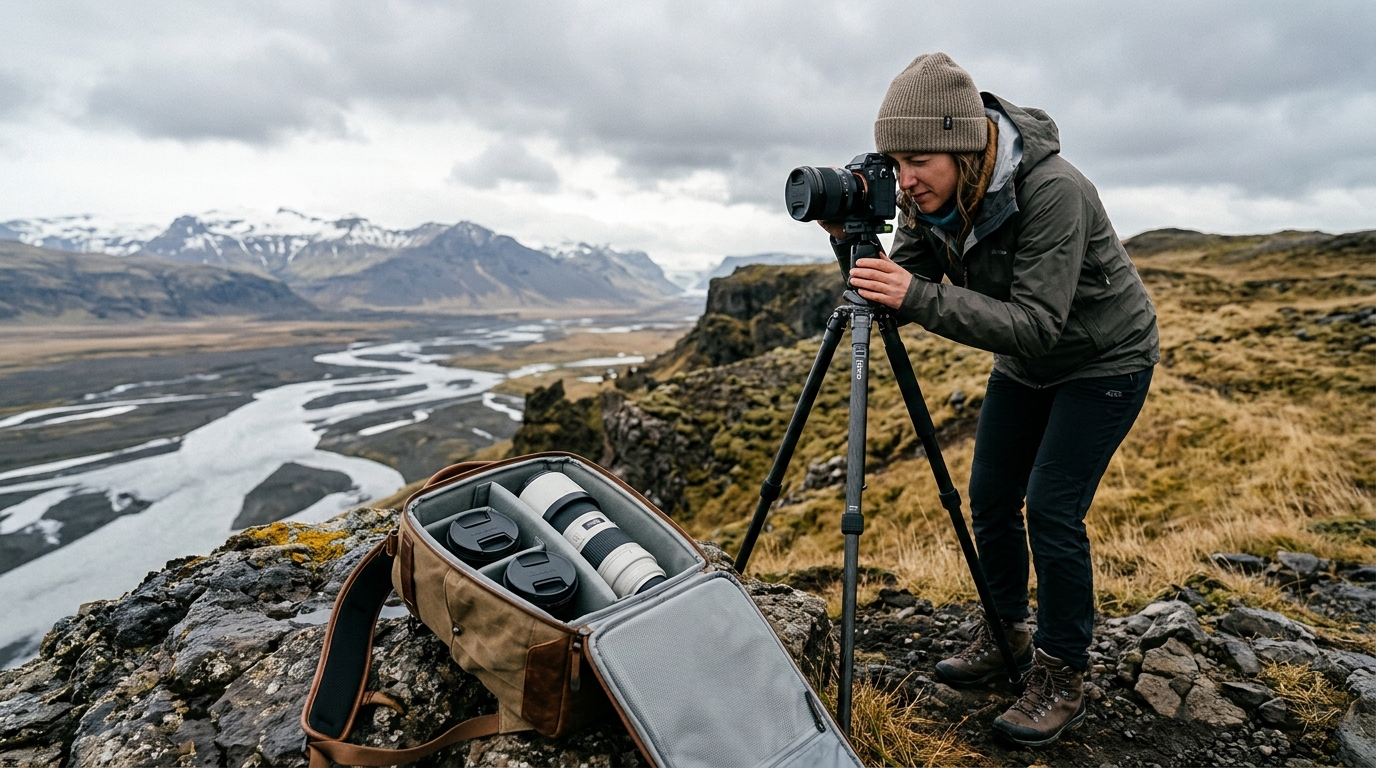
Introduction: Why Lens Choice Matters in the Land of Fire and Ice
When planning a trip to the Land of Fire and Ice, choosing the best lenses for Iceland photography is one of the most critical decisions you will make. Iceland is a landscape of extreme contrasts and grand proportions. In a single afternoon, you might find yourself standing before a colossal glacier tongue that stretches to the horizon, and shortly after, focusing on the intricate, hexagonal geometry of ancient basalt columns. Capturing these diverse subjects requires a thoughtful, strategic approach to your camera gear.
The challenge of photographing Iceland lies not only in its diverse scale but also in its notoriously unpredictable weather. According to historical weather data compiled by the Icelandic Meteorological Office, the island's climate is characterized by sudden gale-force winds, horizontal rain, and abrasive volcanic dust storm events. In these harsh environments, changing lenses frequently in the field is more than just an inconvenience—it is a direct threat to your camera's sensor. Volcanic grit can easily find its way into your camera body, resulting in costly repairs or hours spent cloning out sensor dust in post-processing. To translate this epic scale onto a camera sensor successfully, you must understand how different focal lengths behave in the field and construct a kit that balances versatility, image quality, and physical protection.
What Lenses to Bring to Iceland: The Ultimate Three-Lens Setup
If you ask professional landscape photographers what lenses to bring to iceland, the overwhelming consensus points to the "Holy Trinity" of zoom lenses. This classic trio consists of an ultra-wide zoom (typically 16-35mm), a standard workhorse zoom (24-70mm), and a telephoto zoom (70-200mm). Together, these three lenses cover the vast majority of shooting scenarios you will encounter along the Ring Road and deep into the Highlands.
- The Ultra-Wide-Angle Zoom (16-35mm f/4 or f/2.8): This lens is your primary tool for capturing expansive vistas, towering waterfalls from up close, and the interior of cavernous ice caves.
- The Standard Zoom (24-70mm f/4 or f/2.8): Serving as your default walk-around lens, this focal range is ideal for environmental portraits, coastal cliffs, and general travel photography where you need to transition quickly from wide landscapes to tighter compositions.
- The Telephoto Zoom (70-200mm f/4 or f/2.8, or 100-400mm): A powerful telephoto lens iceland setup is your secret weapon for compressing vast volcanic landscapes, isolating distant mountain peaks, and photographing wildlife safely.
While some purists advocate for the superior sharpness of prime lenses, zoom lenses are highly preferred in Iceland's windy, dusty, or wet environments. The ability to adjust your focal length with a simple twist of a zoom ring—rather than physically swapping lenses—protects your camera's delicate internal components from moisture and abrasive silica dust.
Furthermore, weight and packing considerations are paramount. With international airlines enforcing strict carry-on weight limits (often capped at 10kg for overhead baggage), carrying multiple heavy f/2.8 zoom lenses can quickly push you over the limit. If you plan on hiking long distances to reach remote locations, opting for lighter f/4 zooms can save you several pounds of pack weight without sacrificing professional image quality.
The Wide Angle Lens in Iceland: Capturing Scale and Drama
An ultra-wide angle lens iceland kit is indispensable for capturing the sheer drama of the country's geology. When you are standing inside an active ice cave beneath the Vatnajökull glacier, or looking up at a towering 60-meter waterfall, standard focal lengths simply cannot capture the immense sense of scale. An ultra-wide-angle lens (such as a 14-24mm or 16-35mm) allows you to pull the viewer directly into the scene, creating an immersive, three-dimensional feel.
However, shooting with an ultra-wide lens requires careful compositional planning. The most common mistake photographers make is tilting the camera up to fit a massive subject in the frame, which results in "empty" middle ground and makes grand mountains look small and distant. To avoid this, use strong foreground elements to lead the eye through the frame. For example, on Diamond Beach (Breiðamerkursandur), get down low and place a glistening chunk of glacial ice just inches from your lens. The ultra-wide perspective will exaggerate the size of the ice in the foreground while keeping the crashing waves and distant horizon beautifully in context.
Another technical challenge of wide-angle photography in Iceland is managing perspective distortion. When shooting towering cliffs, sea stacks, or steep canyon walls, tilting your lens upward causes vertical lines to converge, making the cliffs look as though they are falling backward. To mitigate this, try to keep your camera perfectly level with the horizon. If you must tilt the camera, ensure you leave enough safety margin around the edges of your frame to correct the perspective distortion during post-processing without cropping out critical elements of your composition.
Why a Telephoto Lens in Iceland is Your Secret Weapon
While beginners often pack only wide-angle glass, experienced shooters know that a high-quality telephoto lens iceland is the real key to creating unique, compelling imagery. In a landscape as vast as Iceland's, wide-angle lenses can sometimes capture too much clutter, diluting the impact of your subject. A telephoto zoom allows you to simplify your compositions, isolating the most powerful elements of the scene.
The primary artistic power of a telephoto lens is lens compression. By shooting a distant subject from far away with a focal length of 150mm to 300mm, you visually compress the distance between the foreground and background. This technique makes distant volcanic peaks, massive glaciers, or jagged ridges look incredibly imposing behind closer subjects, such as a solitary wooden church, a winding dirt road, or a small hiker. It transforms a vast, empty space into a dense, dramatic layer cake of geological textures.
Additionally, a telephoto lens is essential for isolating fine details in the landscape. You can zoom in on the abstract, smoky patterns of steam rising from geothermal vents in the north, capture the deep blue, cracked textures of a distant glacier tongue, or isolate the delicate spray of water catching the light at the crest of a high waterfall.
Finally, a telephoto lens is mandatory for ethical wildlife photography. Whether you are photographing Atlantic puffins nesting on the sheer cliffs of Látrabjarg or capturing the iconic Icelandic horses grazing in roadside pastures, maintaining a safe, respectful distance is vital. A focal length of at least 200mm (and ideally up to 400mm) allows you to fill the frame with these beautiful animals without disturbing their natural behavior or encroaching on private property.
Are Prime Lenses for Iceland Worth the Weight?
Given the versatility and environmental protection offered by modern zoom lenses, are fast prime lenses for iceland worth adding to your camera bag? The answer depends largely on whether you plan to photograph the night sky.
The primary use case for packing fast prime lenses (with maximum apertures of f/1.4 to f/1.8) is capturing the Northern Lights (Aurora Borealis). The aurora is a dynamic, fast-moving phenomenon. To capture the distinct, curtain-like pillars of light without them blurring into a soft green wash, you need to keep your shutter speed relatively fast—ideally between 1 and 6 seconds. Achieving this in the pitch black of an Icelandic winter night requires a lens that can gather massive amounts of light. A fast prime lens allows you to keep your ISO at a reasonable level (such as ISO 1600 or 3200) while maintaining sharp, noise-free images.
For night sky photography, a 20mm or 24mm wide-angle prime lens is considered the absolute sweet spot. It is wide enough to capture a dramatic landscape foreground along with a sweeping expanse of the green aurora overhead, while the fast f/1.8 aperture ensures clean, bright exposures.
However, during daylight hours, using prime lenses carries significant physical risks. Swapping prime lenses in the middle of a windstorm on a black sand beach exposes your camera's sensor to highly abrasive volcanic dust and moisture. If a single grain of volcanic sand gets lodged inside your lens's focus motor or on your sensor, it can ruin your entire gear setup. Therefore, if you do bring prime lenses for night shooting, it is best to mount them in the safety of your vehicle or accommodation before heading out into the dark, rather than changing them in the open air.
How to Choose the Best Lenses for Iceland Photography Based on Your Style
When selecting the best lenses for Iceland photography, there is no one-size-fits-all solution. Your final gear list should be tailored to your specific shooting style, physical stamina, and budget.
If you are a landscape purist who shoots primarily from a sturdy tripod, you will likely be stopping your lenses down to f/8 or f/11 to maximize depth of field. In this case, expensive and heavy f/2.8 zoom lenses are rarely necessary. High-quality f/4 zoom lenses are lighter, more compact, and often just as sharp (if not sharper) than their f/2.8 counterparts when stopped down. This weight savings is a massive advantage when hiking up steep volcanic craters or packing your gear into a single carry-on bag.
Conversely, if you are an adventure, lifestyle, or documentary photographer who prefers shooting hand-held, you will benefit greatly from the faster f/2.8 apertures. These lenses allow you to maintain fast shutter speeds in low light—such as during the moody, overcast days common to Iceland—and provide beautiful background separation (bokeh) for environmental portraits of your travel companions against dramatic backdrops.
For photographers using crop-sensor cameras (APS-C or Micro Four Thirds), it is crucial to calculate the crop factor when planning your focal lengths to match the recommended full-frame perspectives:
| Full-Frame Equivalent | APS-C Equivalent (1.5x Crop) | Micro Four Thirds Equivalent (2.0x Crop) |
|---|---|---|
| 16-35mm (Ultra-Wide) | 10-24mm | 8-18mm |
| 24-70mm (Standard) | 16-50mm / 18-55mm | 12-35mm / 12-40mm |
| 70-200mm (Telephoto) | 50-140mm / 55-200mm | 35-100mm |
Matching Your Lenses to Iconic Locations
To truly understand how to deploy your gear, let us look at how different lenses perform at some of the most iconic locations across the country, which you can easily locate and explore through our interactive Iceland Photo Map.
Waterfalls: Wide-Angle Drama vs. Telephoto Isolation
Iceland's waterfalls are legendary, but they require very different photographic approaches. To capture the immense, raw power of the Dettifoss waterfall in the north, an ultra-wide-angle lens is fantastic for getting close to the edge of the canyon, allowing you to frame the roaring water alongside the sheer basalt cliffs. However, the spray from Dettifoss is intense; you will need to wipe your lens element constantly.
Alternatively, standing further back on the canyon rim and using a telephoto zoom allows you to shoot dryly and safely. A telephoto lens lets you isolate the massive, cascading curtains of water against the dark rock, capturing the fine mist rising from the canyon in exquisite detail.
Black Sand Beaches: Staying Safe with Mid-Range and Telephoto Zooms
When exploring the stunning South Coast of Iceland, you will undoubtedly visit the famous black sand beach of Reynisfjara. While the temptation to use an ultra-wide lens near the shoreline is strong, Reynisfjara is notorious for its extremely dangerous "sneaker waves" that can sweep unsuspecting tourists out to sea. As detailed in the safety alerts provided by SafeTravel Iceland, these sudden, powerful waves can pull individuals into the freezing ocean without warning.
To photograph this area safely, keep a respectful distance from the water and use a standard or telephoto zoom. A focal length of 70-200mm is perfect for capturing the dramatic Reynisdrangar sea stacks rising out of the roaring North Atlantic waves, keeping you dry and your expensive camera equipment safe from saltwater damage.
The Highlands: Compressing the Rhyolite Ridges
If you venture into the remote interior of the Icelandic Highlands, such as Landmannalaugar, a telephoto zoom is an absolute necessity. The Highlands are characterized by vast, layered ridges of colorful rhyolite mountains, painted in shades of mustard yellow, red, and blue-grey. A telephoto lens compresses these distant, rolling ridges, transforming the vast landscape into a stunning, abstract tapestry of color and texture. For more inspiration on capturing these unique geological formations, explore our curated gallery of Icelandic landscapes.
Essential Lens Features for Harsh Icelandic Weather
In Iceland, the technical specifications of your glass are only half the battle; the physical build quality of your lenses is what determines whether they will survive the trip.
Professional-grade weather sealing is not a luxury in Iceland—it is an absolute necessity. A truly weather-sealed lens features rubber gaskets at the mount, around the control rings, and at every joint to prevent rain, waterfall spray, and fine volcanic sand from penetrating the internal barrel. If your lenses lack robust weather sealing, investing in high-quality, reusable rain sleeves is a smart and affordable way to protect your gear while shooting in wet conditions.
Additionally, using high-quality protective front filters (such as a clear protector or UV filter) is highly recommended. The wind in Iceland can carry abrasive volcanic grit that acts like sandpaper. A single strong gust of wind can permanently scratch the front element of an expensive lens. It is far better to scratch a replaceable protective filter than to ruin your primary lens on day one of your trip.
Finally, do not forget to pack a Circular Polarizing Filter (CPL). A CPL is incredibly useful in Iceland for several reasons:
- It cuts through the glare on wet rocks, saturated moss, and black sand, revealing deep, rich colors.
- It reduces reflections on water surfaces, allowing you to capture the crystal-clear depths of glacial rivers.
- It enhances the deep, electric blues of glacial ice by removing surface reflections that would otherwise wash out the color.
Summary Checklist: Selecting the Best Lenses for Iceland Photography
Before you pack your bags and head to the airport, use this quick-reference checklist to ensure your camera kit is fully prepared for the demanding Icelandic environment:
- Ultra-Wide Zoom (14-24mm or 16-35mm): For ice caves, grand waterfalls, and expansive coastal vistas.
- Standard Zoom (24-70mm): Your versatile, go-to walk-around lens for daily exploration.
- Telephoto Zoom (70-200mm or 100-400mm): For landscape compression, abstract textures, and safe wildlife shooting.
- Fast Wide Prime (20mm or 24mm f/1.8): Specifically for clean, sharp Northern Lights photography.
- High-Quality Filters: UV/Protector filters for every lens, a Circular Polarizer (CPL), and Solid Neutral Density (ND) filters for long-exposure water effects.
- Weather Protection: Microfiber cloths (pack at least 10), a rocket blower, lens cleaning solution, and camera rain covers.
If you do not own some of these specialized lenses, consider renting them. High-end camera rental services are available locally in Reykjavik, allowing you to secure professional-grade, weather-sealed glass without the financial burden of purchasing it outright or flying with excessive weight.
To maximize your time in the field and avoid unnecessary lens changes in harsh weather, we highly recommend using interactive photography maps to plan your compositions in advance. By knowing the exact scale and perspective of a location before you arrive, you can mount the perfect lens in the safety of your rental car, keeping your camera sensor completely protected from the elements.
Frequently Asked Questions
What is the single best lens to bring to Iceland if I can only pack one?
If you must limit yourself to a single lens, a high-quality 24-105mm f/4 or 24-70mm f/2.8 zoom is the ultimate choice. This focal range offers incredible versatility, allowing you to capture decently wide landscapes at 24mm while still having enough reach at the long end to isolate distant subjects or compress layers in the landscape. Opting for a weather-sealed version of this lens ensures you can handle most of Iceland's diverse environments without ever needing to expose your sensor to the elements.
Is an f/4 lens fast enough for shooting the Northern Lights in Iceland?
Yes, an f/4 lens is capable of capturing the Northern Lights, but it is not ideal. Because an f/4 lens lets in half as much light as an f/2.8 lens (and a quarter of the light of an f/2.0 lens), you will need to compensate by raising your ISO significantly (often to ISO 3200 or 6400) and lengthening your exposure time. This can result in noisier images and cause fast-moving auroral curtains to appear as a soft, blurry green glow rather than sharp, distinct bands. If you only have f/4 lenses, wait for a night with a strong aurora forecast (KP 3 or higher) to ensure there is enough ambient light for a successful exposure.
How do I protect my camera lenses from waterfall spray and wind-blown sand?
To protect your lenses, many photographers choose to keep a high-quality UV or protector filter mounted on their glass as a physical barrier. Keep your lens hood attached at all times; not only does it prevent stray light from causing flare, but it also acts as a physical shield against blowing rain and sand. Carry a plentiful supply of clean, dry microfiber cloths in a sealed Ziploc bag. When shooting near waterfalls, keep your lens cap on until the exact moment you are ready to take the shot, wipe away any spray immediately, and use a rocket blower to remove dry volcanic grit before wiping to avoid scratching the glass.
Do I need a macro lens for photography in Iceland?
A dedicated macro lens is not strictly necessary for most photographers visiting Iceland. While there are beautiful details to capture, such as Arctic wildflowers, interesting volcanic rock textures, and tiny patterns in glacial ice, most of these can be photographed effectively using the close-focus capabilities of a high-quality standard zoom or a telephoto lens. Unless you specialize in extreme close-up photography of flora or mineral structures, you can safely leave the heavy macro lens at home and save valuable pack weight.
About Our Content Standards
At Iceland Photo Map, we are committed to providing the most accurate, practical, and accessible information for traveling photographers. In designing this guide, we have adhered to the highest industry benchmarks, aligning our advice with Google's helpful content guidelines to ensure our recommendations are based on real-world, first-hand experience. Furthermore, we optimize our digital resources following Google's SEO Starter Guide and build our platforms in accordance with W3C accessibility fundamentals, making our guides and interactive maps easy to navigate for every photographer preparing to explore the incredible landscapes of Iceland.
Ready to put your lenses to the test? Download our comprehensive Iceland Photo Map to discover exact GPS coordinates, composition tips, and the best times of day to shoot over 100 spectacular locations.