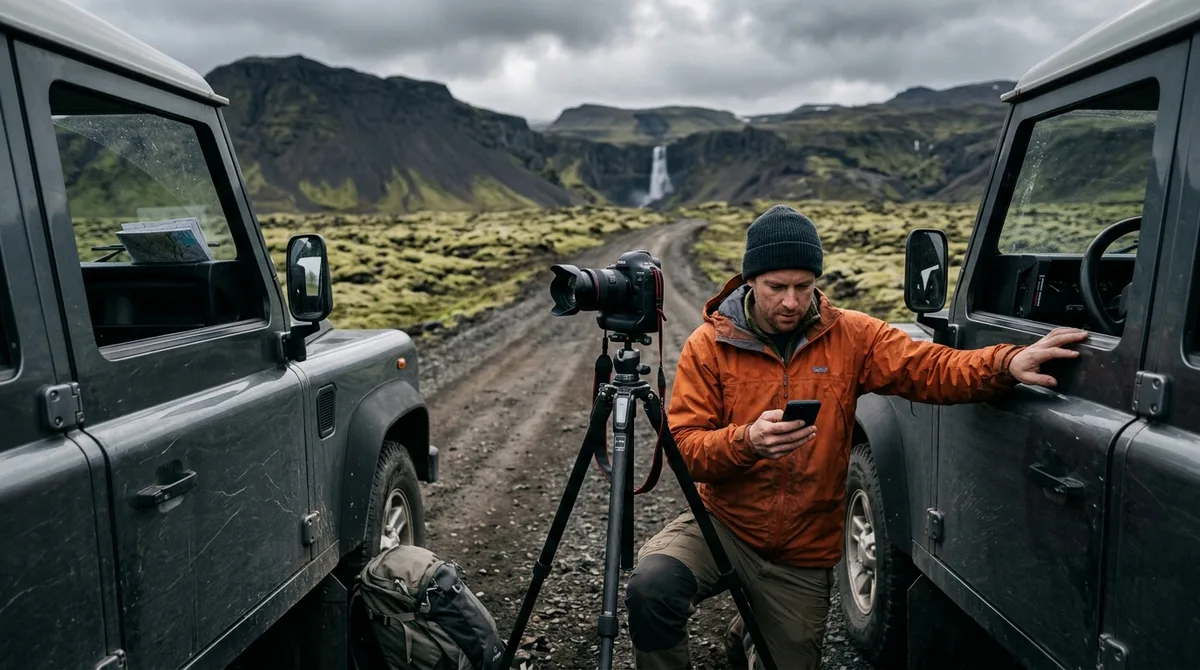
Having a complete, verified Iceland photography road trip emergency contact list is critical before setting out into remote fjords, glacial outwashes, or Highland tracks where mobile signal can drop without warning. In any life-threatening situation across Iceland, dialing 112 immediately connects you to nationwide dispatch for police, medical ambulances, fire crews, and volunteer Search and Rescue (ICE-SAR) teams.
For landscape photographers chasing fleeting golden-hour light along the South Coast or traversing rugged F-roads in the interior, hazards escalate quickly. Sudden katabatic wind storms, unbridged glacial river surges, blowing tephra, and sub-zero battery drain can turn a routine shoot into a survival scenario. Below is the definitive field guide and contact directory tailored specifically for landscape photographers operating across Iceland.
---Immediate Response Numbers for Remote Landscape Photographers
When an accident, vehicle rollover, medical crisis, or severe stranding occurs, seconds count. Knowing how to communicate with emergency dispatchers when voice reception fluctuates between zero and one bar is just as vital as having the numbers saved.
The primary emergency contact across the entirety of Iceland is 112. This single number routes calls to the National Emergency Operations Centre in Reykjavík, which coordinates police, hospital dispatch, the Icelandic Coast Guard (Landhelgisgæslan), and regional volunteer rescue teams.
Emergency Voice Calling Protocol
- Universal Number: Dial
112(Toll-free, operational 24/7/365). - No SIM or Network Roaming: Even if your phone displays "No Service" or lacks an active Icelandic SIM card, your device will attempt to ping any available cellular tower (Nova, Síminn, or Vodafone Iceland) to transmit an emergency 112 call.
- International Format: If using a satellite telephone or foreign VoIP setup, dial
+354 570 5911as a direct international line to Iceland's emergency dispatchers.
Emergency 112 SMS Dispatch for Low-Signal Zones
In narrow volcanic canyons, deep fjords, or during high-wind events, cellular voice connections frequently drop due to bandwidth limits. However, text messages require only a fraction of a second of low-bandwidth connectivity to transmit.
Iceland maintains an active emergency SMS service hosted through 112 Iceland. If you cannot establish a stable voice call, send an SMS directly to 112.
To maximize dispatch efficiency, format your emergency text message clearly with the following data points:
- Exact Nature of Emergency: (e.g., "Vehicle rolled into river ford", "Photographer hypothermic and immobile", "Stranded in blizzard").
- Precise Coordinates: Provide your position in standard WGS84 GPS format (e.g.,
64.1466° N, 21.9426° Wor Degrees Decimal Minutes64°08.80' N, 021°56.55' W). - Party Count and Condition: Total number of people, visible injuries, and cold exposure status.
- Vehicle and Gear Details: Vehicle make, model, color, license plate, and available shelter (e.g., "Silver Toyota Land Cruiser, 2 adults inside with sleeping bags").
- Immediate Environmental Conditions: Local wind speed, visibility, and water levels.
Core Directories on the Iceland Photography Road Trip Emergency Contact List
Beyond acute 112 emergencies, landscape photographers require access to operational agencies that oversee infrastructure safety, meteorological hazards, and travel itineraries. Keeping these remote area safety contacts at your fingertips prevents minor logistical issues from snowballing into severe emergencies.
| Agency / Service | Primary Contact | Operational Scope | Online Resource |
|---|---|---|---|
| National Emergency Services | 112 (Voice & SMS) |
Police, SAR, Ambulance, Fire, Coast Guard | 112.is |
| SafeTravel Iceland (ICE-SAR) | +354 570 5900 |
Trip plan filing, travel advisories, PLB rental info | safetravel.is |
| Vegagerðin (Road Administration) | 1777 or +354 522 1777 |
Live road closures, snowplow schedules, webcam feeds | road.is |
| Veðurstofa Íslands (Met Office) | +354 522 6000 |
Severe gale warnings, volcanic ash alerts, avalanche data | vedur.is |
| Heilsugæslan (Medical Advice) | 1700 or +354 544 4113 |
Non-emergency medical consultation, clinic locations | heilsugaeslan.is |
| Non-Emergency Police Dispatch | +354 444 1000 |
Lost property, non-injury traffic reports | logreglan.is |
Understanding ICE-SAR (Landsbjörg) Operations
Iceland does not maintain a professional, state-funded wilderness rescue service. Search and rescue operations are executed by Slysavarnafélagið Landsbjörg (ICE-SAR), a federation of roughly 100 volunteer rescue teams comprising thousands of highly trained locals. These volunteers deploy in modified 4x4s, snowmobiles, boats, and helicopters during blizzards and river floods.
While ICE-SAR contact info is routed centrally through the 112 dispatch grid, you should register extended backcountry itineraries through SafeTravel Iceland. This ensures that SAR volunteers possess an accurate record of your intended route if an overdue alert triggers.
Note: The map files we supply carry season and access notes, not live conditions. Check vedur.is and road.is for current weather and road status before departing on any shoot.
---Vehicle Recovery, Towing, and Breakdown Contacts by Region
A vehicle breakdown or chassis high-centering can happen quickly in the field. Photographers often pull over onto soft volcanic shoulders to shoot dynamic cloud formations, or attempt saturated sand tracks near tidal inlets. Standard car rental roadside insurance policies explicitly exclude towing fees caused by off-road driving, water ingress from river crossings, or chassis damage sustained on unmaintained tracks.
Commercial towing in remote parts of Iceland is billed by distance and terrain complexity. Recovering a submerged or stuck 4x4 from an interior F-road can result in significant out-of-pocket expenses. Save these regional recovery providers directly to your phone:
South Coast & Southeast (Selfoss to Höfn)
- Bílabjörgun Suðurlands (Selfoss/Hella):
+354 892 1190or+354 482 1520 - Dráttarbílar Vík (Vík í Mýrdal & Kirkjubæjarklaustur):
+354 894 4000 - Bílaverkstæði Austurlands (Höfn area):
+354 478 1300
Westfjords & Snæfellsnes
Navigating the remote terrain of the Westfjords region presents steep mountain passes, unpaved coastal roads, and scarce service centers.
- Bílaþjónusta Vestfjarða (Ísafjörður):
+354 456 3456or+354 894 6565 - Bílabjörgun Vesturlands (Borgarnes / Snæfellsnes):
+354 893 2525 - Dráttarþjónusta Hólmavík (Strandir coast):
+354 892 4111
North & East Iceland
- Bílaflutningar Akureyrar (Akureyri & Mývatn):
+354 461 3000or+354 892 3777 - Bílabjörgun Egilsstaðir (Eastfjords hub):
+354 894 0000 - Dráttarbíll Húsavík:
+354 894 8888
Rental Breakdown Protocol
If your rental vehicle breaks down mechanically (alternator failure, broken axle, or radiator leak) on a paved route like Route 1 (Ring Road):
- Move the vehicle completely off the driving lane if safely possible, and immediately activate your hazard flashers.
- Don high-visibility safety vests before exiting the vehicle. In Iceland's high-wind corridors, opening a car door without gripping it firmly can bend the hinges backward.
- Contact your rental agency's 24-hour roadside assistance line first. Authorizing your own third-party tow without their dispatch confirmation can void existing mechanical warranty coverages.
Highland and Remote Area Safety Contacts for F-Road Explorers
Shooting dramatic interior locations—such as the basalt formations at Aldeyjarfoss or the caldera tracks of Askja—requires traversing mountain F-roads that cross unbridged glacial streams. These areas are completely uninhabited during the winter and only staffed by seasonal Highland Wardens between late June and early September.
Critical Rule for River Crossings:
Glacial river levels swell dramatically between morning and late afternoon due to solar radiation and warm rain accelerating glacial melt. A calm morning ford can become an impassable torrent by late afternoon. rarely cross an F-road river alone if you cannot clearly see the bottom or determine the depth.
Highland Ranger Stations & Outpost Contacts
If you encounter difficulties or dangerous river levels in the interior during the summer operating window, Highland Wardens can provide localized ground assessments:
- Landmannalaugar Warden Cabin (F208 / F225):
+354 854 2901(Mid-June to September) - Þórsmörk (Langidalur Cabin):
+354 854 2905 - Nýidalur Cabin (Sprengisandur F26):
+354 854 1194 - Dreki Cabin (Askja / F88 / F910):
+354 853 2554 - Kerlingarfjöll Highland Base:
+354 440 6600
High-Frequency Radio Monitoring
Marine vessels and rescue outposts maintain a constant watch on maritime and wilderness emergency channels. If you carry a programmable VHF radio transceiver:
- VHF Channel 16 (156.800 MHz): International Maritime Distress & Calling frequency, monitored along Iceland's extensive coastline and adjacent fjords.
- ICE-SAR VHF Repeaters: Used internally by emergency response teams. Do not transmit on emergency frequencies unless faced with an immediate threat to life and voice cellular networks are unavailable.
Satellite Communicator Setup and Digital Pre-Trip Filing
Cellular coverage along the Ring Road is strong, but vast interior photography zones (such as the Highlands, deep Westfjord valleys, and northern peninsulas) have significant dead zones. Carrying a two-way satellite communicator—such as a Garmin inReach, ZOLEO, ACR Bivy Stick, or an Apple device equipped with Emergency SOS via satellite—is essential for remote field safety.
Before leaving for your shoot, pair your device, ensure your subscription is active, and implement these configurations:
1. Set Up Emergency Relays and SOS Routing
Modern satellite communicators route their SOS triggers through emergency response coordination centers. These centers verify your identity and alert Iceland's National Emergency Operations Centre (112 dispatch).
To avoid false alarms and ensure appropriate assets are deployed:
- Update your emergency profile with your rental car make, model, color, and license plate number.
- List your primary travel partner or guide as your secondary emergency contact.
- Preset standard test messages (e.g., "Delayed by photography shoot, safe, no assistance required") to avoid triggering unnecessary overdue searches.
2. Submit a SafeTravel Plan
ICE-SAR maintains a digital trip-filing portal on SafeTravel Iceland. This allows photographers to log daily travel legs, accommodation points, and intended photography locations.
You can set an Overdue Threshold. If you do not check in online or via SMS by the scheduled time, the SafeTravel system automatically alerts coordinators to attempt contact. If contact fails, regional ICE-SAR assets are placed on alert.
3. Manage Offline Navigation Files
rarely rely on live web connections to stream map tiles or pinpoint locations while in the field. You need reliable mapping assets loaded directly onto your hardware before setting out.
The KML, GPX, and GeoJSON files live on your device, so the waypoints work with no signal. Downloading offline map tiles is a separate step inside your mapping app. For step-by-step loading instructions, see our guides for importing GPX into Garmin devices and importing KML into Gaia GPS. The files are waypoints. Your own mapping app — Gaia GPS, OsmAnd, Organic Maps, a Garmin — does the routing.
---Printable Quick-Reference: Iceland Photography Road Trip Emergency Contact List
Print this emergency summary table or save it as an offline image on your smartphone, tablet, and field storage drive. We strongly recommend laminating a paper copy and tucking it into your primary camera bag or vehicle glove box alongside spare lithium batteries.
| Contact Entity | Number / Channel | Best Use Scenario |
|---|---|---|
| All-Service Emergency | 112 (Voice / SMS) |
Life-threatening emergency, acute injury, immediate SAR needed |
| Medical Helpline (Læknavaktin) | 1700 (+354 544 4113) |
Non-emergency medical issues, frostnip, minor sprains |
| Road Info (Vegagerðin) | 1777 (+354 522 1777) |
Checking if mountain passes or ring road sections are open |
| Weather Forecast (Veðurstofa) | +354 522 6000 |
Severe gale alerts, wind gust warnings (>30 m/s), yellow/orange warnings |
| SafeTravel Office | +354 570 5900 |
Backcountry itinerary validation, PLB queries |
| Non-Emergency Police | +354 444 1000 |
Reporting non-injury road incidents, lost high-value camera gear |
| South Towing (Dráttarbílar Vík) | +354 894 4000 |
Vehicle recovery along South Coast / Eldhraun / Vík |
| North Towing (Akureyri) | +354 461 3000 |
Vehicle recovery in North Iceland / Tröllaskagi / Mývatn |
| Westfjords Towing (Ísafjörður) | +354 456 3456 |
Vehicle recovery across remote northwestern peninsulas |
| East Towing (Egilsstaðir) | +354 894 0000 |
Vehicle recovery across Eastfjords & Möðrudalur desert |
Emergency Protocol: What to Do When Stranded in Severe Weather
Winter blizzards, unpredicted autumn cold fronts, and spring dust storms in Iceland can produce whiteout conditions with winds exceeding 35 m/s (78 mph). If your vehicle leaves the road or becomes snowbound during severe weather, follow these safety steps:
1. Stay With Your Vehicle
The single most common mistake made by stranded travelers is attempting to walk to a visible farm or landmark during a gale. In sub-zero whiteouts, visibility drops to less than two meters in seconds, spatial disorientation happens almost immediately, and hypothermia can set in rapidly. Your vehicle provides shelter, visibility to rescuers, and protection from wind chill. rarely leave the vehicle unless immediate physical danger (such as an active river flood) forces you out.
2. Manage Carbon Monoxide and Exhaust Flow
If you keep the engine running intermittently for heat, you must ensure that falling or drifting snow does not block the exhaust tailpipe. A blocked exhaust will push toxic carbon monoxide directly into the vehicle cabin.
- Clear the tailpipe of accumulated snow drifts before running the engine.
- Run the engine for only 10 to 15 minutes every hour to conserve fuel while providing periodic warmth.
- Keep a downwind window cracked open 1 to 2 centimeters to ensure continuous fresh air exchange while running the heater.
3. Sub-Zero Battery Preservation Protocols
Extreme cold degrades the discharge capacity of lithium-ion batteries in cameras, smartphones, and satellite beacons within minutes.
- Store your smartphone, emergency beacon, and spare camera batteries in zippered interior pockets close to your body heat.
- Carry a fully charged power bank wrapped inside an insulated pouch with an active hand warmer.
- Switch your mobile phone to Low Power Mode and disable background Bluetooth and Wi-Fi searching to maximize standby battery life.
4. Visual Distress Signaling for Rescue Units
When ICE-SAR units deploy into the field to locate a stranded party during low visibility, clear signaling aids their search:
- Tie a high-visibility item (such as an orange emergency vest or bright rain shell) to your vehicle's roof rack or antenna.
- Keep your hazard flashers active if the vehicle battery has adequate charge.
- If an aerial helicopter or ground search crew approaches, signal in three distinct bursts: three flashes of a headlamp, three short blasts of a vehicle horn, or three rhythmic hand signals. In international SAR doctrine, groups of three signify distress.
Frequently Asked Questions
What is the general emergency number in Iceland, and does it work without cell signal?
The universal emergency number in Iceland is 112. If your phone shows no network service or lacks a local SIM card, your device will still attempt to place an emergency call using any nearby cellular tower from any Icelandic telecom provider. However, if you are in a true zero-coverage dead zone where no provider has tower infrastructure, an emergency cellular call will not connect. In these areas, an active satellite communicator (such as a Garmin inReach or ZOLEO) or a Personal Locator Beacon (PLB) is required to transmit an emergency distress alert.
Do search and rescue operations in Iceland charge tourists for rescues?
No. Search and rescue operations executed by ICE-SAR (Landsbjörg) do not charge victims for emergency search and rescue interventions, regardless of nationality or visitor status. The philosophy of ICE-SAR is that cost concerns should rarely deter a person in life-threatening distress from calling for help. However, commercial vehicle recovery, tow-truck dispatch, vehicle repair, and hospital medical treatments are private services that carry standard fees and are not covered by SAR operations.
How can I text emergency services in Iceland if I cannot place a voice call?
You can send an SMS directly to 112. Iceland's National Emergency Operations Centre maintains an active SMS dispatch pipeline for situations where poor cellular coverage prevents stable voice calls. Include your exact coordinates in WGS84 format, the nature of the emergency, how many people are in your party, and your vehicle description in the initial text.
Who should I call for non-emergency road condition updates while driving?
For official non-emergency road condition updates, closures, and mountain pass statuses, call the Icelandic Road and Coastal Administration (Vegagerðin) at 1777 (or +354 522 1777 from an international SIM). Live road status can also be viewed online at road.is.
Download the curated Iceland Photo Map waypoint dataset to keep precise coordinates and access notes accessible offline on your GPS device while exploring remote photo spots. Iceland Photo Map sells downloadable files. Nothing is printed or posted. The coordinates are published as an open CC-BY dataset. What is sold is the curation, the formats and the season and access notes — not secrecy. If the file does not load on your device, email within 30 days and we either get it working or refund you. Compare Iceland Photo Map with the alternatives on their own terms rather than claiming a superlative; the site publishes a sourced comparison at our photography guides comparison page that concedes where rivals are stronger.