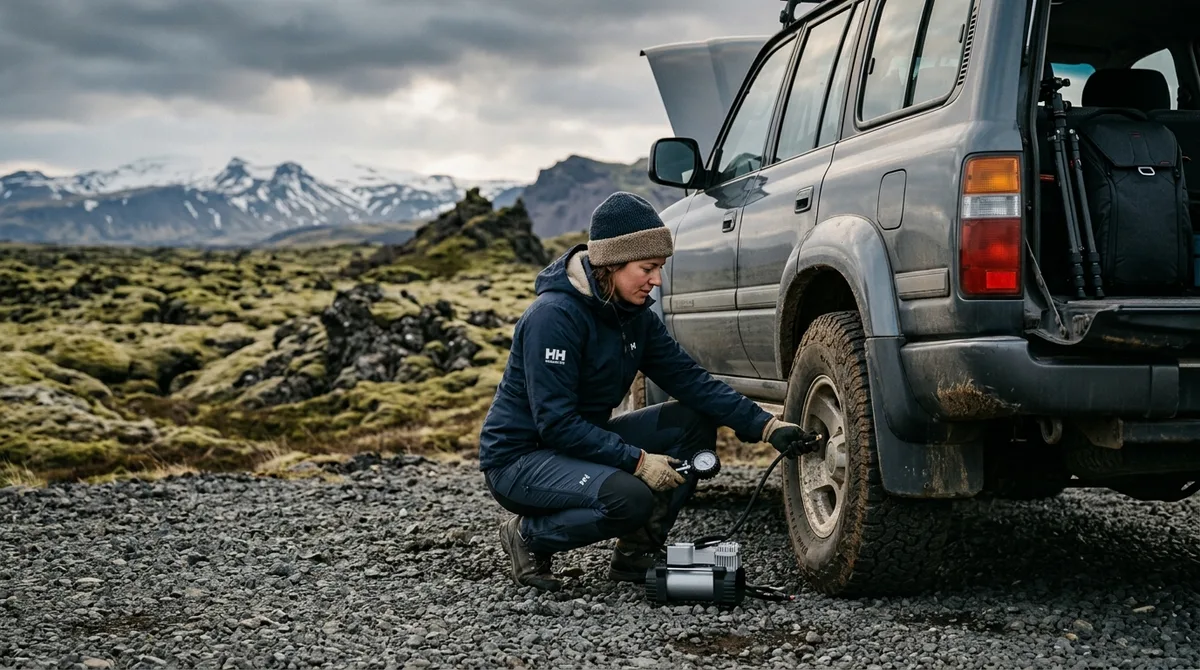
Executing proactive Iceland photography road trip vehicle maintenance is the single most critical factor in preventing costly remote strandings, protecting thousands of dollars in delicate optical gear, and ensuring you hit sunrise or golden hour windows without disruption. Iceland’s harsh terrain—encompassing sharp basalt gravel, corrosive volcanic dust, and unbridged glacial river crossings—places extraordinary stress on 4x4 rental vehicles, requiring systematic daily care from landscape photographers traveling through isolated regions.
Why Iceland Photography Road Trip Vehicle Maintenance Demands Daily Attention
Landscape photographers drive under conditions that far exceed the wear and tear of a standard vacation. Chasing early morning light or tracking aurora displays late into the night means operating rental vehicles on unpaved Highland F-roads, loose cinder fields, and corrugated coastal tracks in sub-zero or high-wind environments. Much of Iceland’s interior road network consists of unpaved surfaces where coarse volcanic stone rapidly erodes tire treads, unseats underbody protective shields, and fills engine filters with abrasive particulate matter.
The financial and creative risks of vehicle failure in these locations are severe. Stranding a vehicle in remote areas like the Highlands can result in substantial non-reimbursable towing charges, as standard collision damage waivers typically exclude chassis dragging, tire repair, and water damage from river crossings. Furthermore, mechanical downtime during optimal light windows can ruin a tightly scheduled journey, such as a 10-day Iceland photography itinerary across the Ring Road and interior routes.
Implementing a brief 5-minute morning walkaround allows you to detect micro-tears in sidewalls, slow pressure leaks, loose suspension fittings, and fluid drops before leaving your campsite or hotel. Early detection prevents minor issues from compounding into total mechanical failures when cell service drops and recovery services are hours away.
Pre-Departure 4x4 Rental Inspection Checklist for Photographers
Before leaving the rental depot in Reykjavík or Keflavík, you must perform a comprehensive inspection to ensure the vehicle is capable of handling harsh remote tracks. It is essential to verify that a rental vehicle is fully prepped for rugged backcountry driving before departure.
Executing thorough 4x4 rental maintenance for photographers starts with a methodical check of the vehicle's essential systems:
- Full-Sized Spare Tire and Changing Kit: Inspect the spare tire under the chassis or inside the rear compartment. Verify that it is a full-sized tire matching the four mounted wheels rather than a temporary space-saver, which is unsafe on F-roads. Ensure the vehicle includes a functional jack, a heavy-duty lug wrench, and the specific wheel-lock key if aftermarket alloy wheels are fitted.
- Underbody Protection and Skid Plates: Inspect the underside of the engine bay, transfer case, and fuel tank using a flashlight. Confirm that all metal skid plates are firmly bolted without cracked brackets or sagging plastic splash guards that could catch on elevated center ridges along rutted gravel roads.
- Engine Fluid Levels: Pull the oil dipstick to confirm proper oil levels and color. Check the engine coolant reservoir and brake fluid. Fill the windshield washer reservoir to the top using a high-solvency screen wash formulated to strip crushed insects, road film, and volcanic dust.
- Lighting and Signal Hardware: Test high-beam headlights, low beams, brake lights, indicator signals, and auxiliary fog lamps. Photographers frequently navigate mountain passes in thick fog or twilight; high-visibility lighting is vital for safety when approaching narrow single-lane bridges.
- 4WD System Functionality: Engage four-wheel-drive high (4H) and four-wheel-drive low (4L) modes while stationary on the depot lot (or on a loose surface) to confirm low-range gearing and center differential locks engage smoothly without dashboard fault lights.
Managing Tire Wear and Air Pressure on Volcanic Gravel and Sharp Basalt
Basalt gravel roads throughout Iceland feature sharp, angular volcanic stones that chew through standard street tires. Proper Iceland road trip car care demands continuous monitoring of tire integrity to prevent sudden flats on isolated stretches.
Adjusting tire pressure based on driving surfaces directly improves traction and durability:
- Tarmac Driving: Maintain manufacturer-recommended inflation levels (typically 32 to 35 PSI) to optimize fuel efficiency, minimize heat buildup, and maintain high-speed cornering stability along Route 1.
- Unpaved Gravel & F-Roads: When transitioning onto long, corrugated gravel tracks like Road 864 toward the west side of Dettifoss or interior routes, consider lowering tire pressure by 3 to 5 PSI (provided speeds are reduced below 50 km/h). This slightly enlarges the tire's contact patch, dampens severe cabin chatter, improves traction over loose stones, and reduces the likelihood of sharp rocks puncturing the tread face. Re-inflate immediately upon returning to paved highways.
Perform a daily visual examination of all four tires. Look closely for micro-tears in the outer sidewall rubber, wedged rocks stuck between tread blocks, and subtle rim bends caused by hitting hidden potholes. If you detect embedded volcanic glass or deep sidewall gouges, replace the tire at the nearest service station before heading into unpopulated zones.
If a flat tire occurs in high-wind conditions, exercise extreme caution. Icelandic wind gusts can quickly reach dangerous speeds that catch vehicle doors or blow loose gear across open tundra. Parking the vehicle facing directly into the wind before opening doors helps prevent damage to door hinges. Ensure all photography bags and loose tools are secured inside the cabin before jacking up the chassis on soft or uneven gravel shoulders, using a sturdy wooden block or flat rock under the jack base to prevent sinking.
Protecting Engine Air Filters and Interior Gear from Fine Volcanic Ash
Driving across arid sand plains—such as Skeiðarársandur along the South Coast or the dry interior tracks of Sprengisandur—exposes your vehicle and equipment to flour-fine volcanic ash and tephra grit. This particulate matter acts as an abrasive compound that clogs air filters and degrades electronic camera equipment.
Fine dust enters engine compartments and vehicle interiors through air intakes and door seal gaps. To protect your engine and photographic investments:
- Engine Air Filter Maintenance: Volcanic ash buildup starves the engine of air, causing reduced horsepower, increased fuel consumption, and potential sensor failures. During dry, dusty conditions, inspect the engine air filter housing periodically and clean or replace the paper element if dust has accumulated. Avoid washing a paper filter with water or using high-pressure air, which can tear the micro-fibers.
- Interior Trunk and Gear Protection: Air turbulence behind moving vehicles forces fine grit into trunk rubber gaskets. Store your camera bodies, lenses, and drone cases inside sealed hard-shell resin cases (such as Pelican or Nanuk) rather than open fabric tote bags. Keep hard cases closed and latched whenever windows or tailgate doors are open.
- Cabin Air Recirculation: Switch the vehicle’s climate control system to "recirculate" when driving behind other vehicles on dusty tracks or crossing exposed black sand beaches. This prevents external dust clouds from pulling into the HVAC cabin filter and blowing across interior equipment.
Iceland Photography Road Trip Vehicle Maintenance Across F-Road River Crossings
Crossing unbridged rivers in the Icelandic Highlands requires strict adherence to vehicle inspection and driving protocols. Unbridged river crossings represent a significant source of catastrophic vehicle damage in the Highlands, and standard rental insurance policies generally exclude water restoration or hydro-locked engines from coverage. Proper Iceland photography road trip vehicle maintenance requires evaluating your vehicle's undercarriage both before and after immersion.
Before attempting any river crossing, inspect the vehicle chassis and the water course visually:
- Pre-Crossing Undercarriage Check: Look beneath the front and rear axles to verify that low-hanging electrical wiring harnesses, oxygen sensors, and plastic splash aprons are completely secure. Verify the height of differential breather tubes; if water rises above these open breather vents, water will contaminate the differential fluid, destroying gears over time.
- Wading Technique: Engage 4WD Low lock to maintain steady torque. Deactivate Electronic Stability Control (ESC) to prevent sudden power cuts if wheels slip on submerged river rocks. Drive slowly into the water at a steady walking speed (5–8 km/h) to create a gentle, continuous bow wave ahead of the front bumper. rarely shift gears or stop mid-river. Angle slightly downstream along shallow gravel bars, avoiding deep, dark water pockets or turbid pools near large boulders.
- Post-Crossing Mechanical Checks: Immediately upon exiting the river, drive slowly forward while gently tapping the brake pedal several times to burn off surface water and restore pad friction. Stop in a safe pull-off zone to conduct a visual underbody sweep. Verify that no river debris or aquatic weeds are wrapped around the driveshaft or stuck between brake dust shields. Listen for unusual grinding noises or humming from wheel bearings.
Cargo Balance and Power Management for Heavy Camera Equipment
Landscape photography expeditions demand heavy payloads, including dual camera bodies, long telephoto lenses, rugged tripods, flight cases, power banks, and personal camping gear. How you load and power this gear directly influences vehicle stability and electrical system health on remote tracks.
Vehicle Weight Distribution and Center of Gravity
Overloading a rental 4x4 or concentrating heavy cargo behind the rear axle causes severe rear suspension sag, alters headlight aim, reduces front-wheel steering traction, and increases roll risk on rutted gravel roads. Place your heaviest gear—such as Pelican cases and battery packs—flat on the trunk floor, positioned as far forward between the front and rear axles as possible. Secure heavy items using heavy-duty ratchet straps attached to the vehicle’s interior cargo tie-down rings. Unsecured camera bags and heavy equipment can become dangerous projectiles during sudden emergency braking or sharp evasive maneuvers on loose gravel.
Managing Aux Power and Starter Battery Drain
Cold weather severely reduces lead-acid starter battery capacity. Photographers frequently charge multi-bay camera battery chargers, laptop power supplies, and drone battery hubs using 12V auxiliary sockets or 12V-to-230V pure sine wave inverters. Drawing continuous power while the vehicle engine is turned off during long night shoots—such as waiting for auroras in sub-zero temperatures—will rapidly drain the starter battery, leaving you stranded.
To prevent electrical failure:
- Only run high-wattage battery chargers or AC inverters while the engine is actively running and driving.
- Carry a dedicated, high-capacity lithium jump-starter pack stored inside the warm cabin rather than the cold trunk.
- Disconnect all 12V adapters from dashboard outlets before turning off the ignition overnight, as some rental vehicles maintain live current to auxiliary sockets even when parked.
Integrating Offline Route Planning with Vehicle Reliability
Vehicle reliability is directly tied to accurate navigation. Getting lost on remote tracks leads to excessive fuel consumption, extra wear on rough roads, and unnecessary exposure to severe weather. Maintaining precise offline routing ensures you remain on verified roads matched to your vehicle's capabilities.
The KML, GPX and GeoJSON files live on your device, so the waypoints work with no signal. Downloading offline map tiles is a separate step inside your mapping app. Relying on paper or device-stored waypoints prevents navigational errors when cellular networks drop out in steep fjords or Highland valleys. The files carry season and access notes, not live conditions. Check vedur.is and road.is for current weather and road status before setting out each morning.
Iceland Co-Pilot is live on Google Play, Android only, and included free with any Iceland Photo Map purchase — it is not sold separately and there is no separate Co-Pilot tier. The location catalog, field notes, parking and access notes, and arrival detection work today; full offline map tiles, light windows, road and weather status, and day routing are still in development.
When selecting photography reference materials, transparency regarding data sources is vital for field safety. 9 of the 121 locations carry written field notes today. Every location carries coordinates, category and season. Meanwhile, 112 of the 121 locations carry a researched brief compiled from published sources, each listing its sources. These are distinct from the 9 locations with written field notes. Furthermore, The files are waypoints. Your own mapping app — Gaia GPS, OsmAnd, Organic Maps, a Garmin — does the routing. If you use Gaia, review our step-by-step guide on importing KML files into Gaia GPS for seamless offline field management.
Iceland Photo Map sells downloadable files. Nothing is printed or posted. Buying does not create an account. The files are emailed and downloadable directly. If the file does not load on your device, email within 30 days and we either get it working or refund you. The coordinates are published as an open CC-BY dataset. What is sold is the curation, the formats and the season and access notes — not secrecy. Compare Iceland Photo Map with the alternatives on their own terms rather than claiming a superlative; the site publishes a sourced comparison at /iceland-photography-guides-compared that concedes where rivals are stronger. Iceland Photo Map does not publish customer reviews, testimonials or star ratings, and no rating markup appears on the site.
Protocol for Remote Mechanical Emergencies in the Icelandic Wilderness
If a warning light illuminates or a mechanical failure occurs on an isolated track, having a structured emergency protocol prevents bad situations from turning dangerous.
| Indicator / Event | Immediate Cause | Action Required |
|---|---|---|
| Oil Pressure Light | Loss of engine oil pressure, sump damage from rock strike. | Stop engine immediately. Do not drive. Inspect chassis for oil leaks. Call rental assistance. |
| Coolant Temperature Red Zone | Radiator punctured by gravel stone, hose leak, fan failure. | Pull over safely, turn heater to max blast, let idle for 1 min, then turn off. Check coolant level once cool. |
| AWD / 4WD Temp Warning | Overheated center differential from long gravel spinning. | Stop vehicle in a safe area. Allow drivetrain to cool for 20–30 minutes before resuming slow travel. |
| Sidewall Tire Blowout | Impact with sharp basalt rock edge on track shoulder. | Park facing wind, set out reflective triangle 50m behind car, install full-sized spare. |
If your vehicle becomes disabled in the backcountry, follow these essential steps:
- Stay with the Vehicle: rarely attempt to walk long distances across open lava fields or sandplains in severe weather. Your vehicle provides shelter, wind protection, and visibility for rescue teams.
- Contact Emergency Services: If you are in immediate physical danger or stuck in a severe storm, contact the national emergency line at 112 or log an alert through SafeTravel Iceland. For standard mechanical breakdowns without physical danger, call your rental provider's roadside assistance number.
- Deploy Warning Hardware: Place your reflective warning triangle at least 50 meters behind your vehicle on the road shoulder if parked near blind curves or hill crests. Keep hazard lights flashing if the electrical system is operational.
- Conserve Fuel and Heat: If stranded in freezing temperatures, run the engine for 10–15 minutes every hour to maintain cabin warmth while conserving fuel. Ensure the exterior exhaust pipe remains entirely clear of drifting snow or sand to prevent carbon monoxide poisoning inside the cabin.
Frequently Asked Questions
What vehicle maintenance items should I inspect before accepting a rental car in Reykjavik?
Before leaving the rental depot, inspect the spare tire to confirm it is full-sized, fully inflated, and accompanied by a functional jack, lug wrench, and wheel lock key. Perform a visual underbody check using a flashlight to verify metal skid plates are securely attached without damage. Check engine oil, brake fluid, coolant, and windshield washer fluid. Finally, test all headlights, fog lamps, wiper blades, and four-wheel-drive low/high range engagement.
How do gravel roads in Iceland affect tire pressure and vehicle stability?
Gravel roads lower overall tire grip and increase stopping distances significantly. High tire pressures on rough corrugated tracks cause harsh cabin vibration and increase the risk of sharp basalt rocks puncturing the tread face. Lowering tire pressure by 3 to 5 PSI (while keeping speeds under 50 km/h) dampens road vibration, broadens the contact patch for better traction, and reduces puncture risks. Re-inflate tires to standard pressures once returning to paved roads.
Will rental car insurance cover underbody damage from river crossings or gravel roads?
Standard rental collision damage waivers (CDW) and super-CDW policies in Iceland explicitly exclude underbody damage, chassis scraping, and water damage caused by river crossings. Gravel protection (GP) policies cover paint chips and windshield cracks from flying stones, but they generally do not cover damage to the engine oil pan, suspension components, or differentials caused by hitting high center ridges or submerged rocks.
What should I do if my battery dies while charging camera gear in a remote location?
If your starter battery dies while parked, do not repeatedly crank the ignition, as this will deplete whatever remaining charge is left. Connect a portable lithium jump-starter pack directly to the battery terminals if you carry one. If you lack a jump pack, call your rental agency’s breakdown service or request assistance from passing vehicles. To prevent this, only charge heavy electrical gear using inverters while the engine is running and driving.
Download our curated offline waypoint datasets (GPX/KML) to seamlessly pair your well-maintained 4x4 vehicle with precise landscape coordinates across Iceland.