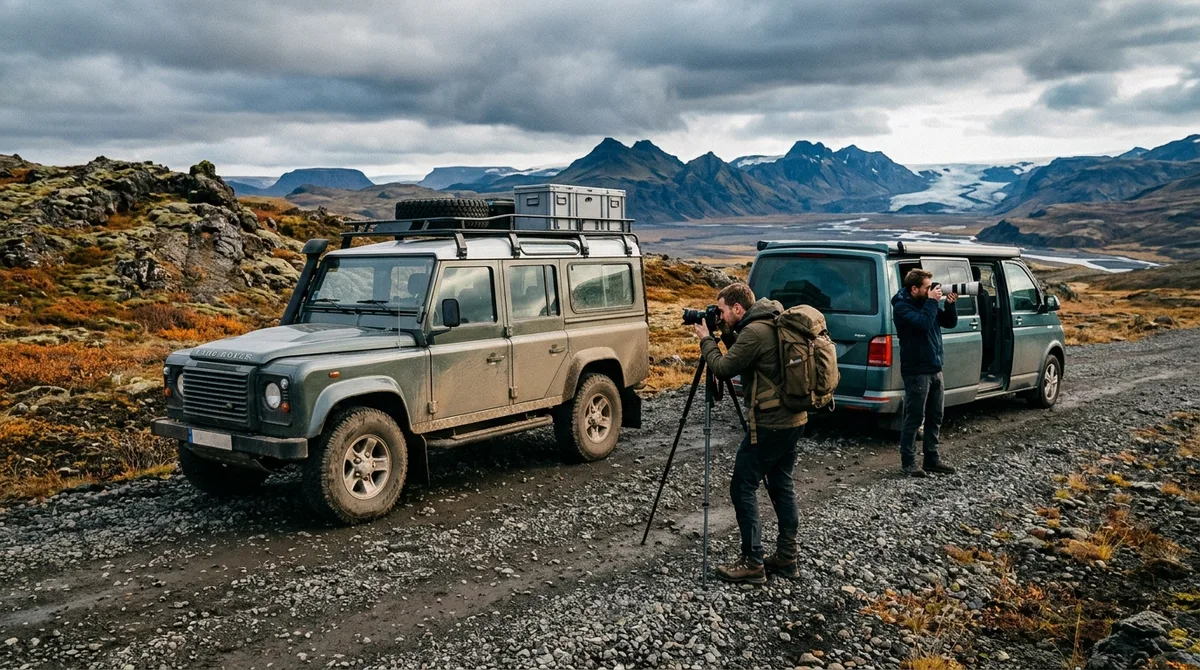
Choosing between Iceland photography road trip vehicle rental types comes down to a direct tradeoff between interior sleeping flexibility for chasing midnight sun light and ground clearance for traversing rough highland tracks. Selecting the wrong category risks invalidating your insurance on unpaved mountain routes, draining camera and drone batteries in sub-zero weather, or leaving expensive optical gear exposed in high-traffic parking areas.
Whether you need a specialized 4x4 rental Iceland for photographers heading into the Central Highlands or a climate-controlled campervan to catch golden hour at 3:00 AM without hotel commutes, your vehicle serves as your mobile production studio, shelter, and transport hub across unpredictable subarctic terrain.
Fast Decision Guide: Iceland Photography Road Trip Vehicle Rental Types at a Glance
Every vehicle class available from Icelandic rental outfits presents a distinct balance of passenger room, cargo security, cold-weather comfort, and legal road access. Evaluating these classes against your planned shooting itinerary ensures you do not overspend on clearance you will not use or strand yourself outside remote interior locations.
| Vehicle Category | Legal F-Road Access | Power & Charging Capacity | Gear Storage Security | Best Photographic Use Case |
|---|---|---|---|---|
| 2WD Economy / Compact Sedan | No (Strictly Prohibited) | 1x 12V DC accessory port (active only with engine running) | Enclosed locking trunk (high security out of sight) | Summer Ring Road, Golden Circle, paved coastal day-trips from hotels. |
| Compact 4x4 Crossover (e.g., Dacia Duster) | Yes (Mild F-roads without deep river crossings) | 1–2x 12V DC ports, limited inverter compatibility | Hatchback cargo area with pull-cover (moderate security) | Shoulder-season Ring Road, gravel pass detours, budget highland access. |
| Mid-to-Full Size 4x4 SUV (e.g., Toyota Land Cruiser) | Yes (Moderate-to-rough F-roads and standard river crossings) | Multiple 12V DC ports, factory 100W–220V inverter options on some trims | Spacious rear cargo with dark tint and parcel shelf | Deep highland expeditions, winter aurora chasing in gale-force winds, Westfjords gravel passes. |
| 2WD Campervan | No (Strictly Prohibited) | Auxiliary leisure battery, USB-A/C ports, optional 12V fridge | Under-bed enclosed bins, visible living area | Summer Ring Road flexibility, camping on-site for midnight sun golden hour. |
| 4x4 Campervan (Lifted Van or Truck Camper) | Yes (Specific approved F-roads depending on operator rules) | Dedicated AGM/Lithium house battery, pure sine wave inverter, parking heater | Built-in cabinetry, under-bench lockboxes | Multi-week autonomous landscape expeditions, Highland basecamp shooting. |
| Modified Superjeep (33”–38”+ Tires) | Yes (Extreme F-roads, winter highland tracks, unbridged rivers) | High-output dual battery systems, heavy-duty inverters | Custom rear drawers and secure internal racking | Winter glacial exploration, extreme highland river crossings, professional production shoots. |
To narrow your choice among Iceland photography road trip vehicle rental types, apply these operational decision rules:
- Choose a compact or mid-size 4x4 SUV if your trip runs between October and April, when sudden blizzards, black ice, and crosswinds render high-roof campervans hazardous.
- Choose a 4x4 campervan if you are shooting from late May through August and want to pivot your waking hours entirely around the midnight sun without being locked into rigid hotel check-in windows.
- Choose a standard 2WD economy car only if you are visiting in peak summer, sticking strictly to the paved Route 1 corridor, and staying in pre-booked guesthouses along the South Coast and Golden Circle.
4x4 SUV vs Campervan for Landscape Photographers: Mobility, Comfort, and Sleep Logistics
The debate over a campervan vs SUV for Iceland photography fundamentally shapes your daily workflow. Landscape photography in Iceland demands extreme responsiveness to changing light and weather systems. Your choice of platform dictates how close you can position yourself to a composition before civil twilight begins.
Campervans function as fully mobile basecamps. During the peak summer months, when the sun dips barely below the horizon around 1:00 AM and rises again before 3:30 AM, normal circadian schedules become obsolete. A campervan allows you to sleep from midday until 8:00 PM, prepare hot meals inside the cabin, and begin shooting during the best four-hour light window of the day. Many designated campsites in Iceland sit adjacent to iconic landmarks—such as Skógafoss, Hamragarðar (near Seljalandsfoss), and Skaftafell—allowing you to step out of bed directly into your composition with your tripod over your shoulder.
Conversely, 4x4 SUVs provide superior structural agility, off-road clearance, and aerodynamic stability. Icelandic weather is notorious for sustained storm systems producing wind gusts exceeding 35 m/s (78 mph). High-profile campervans act like sails during these wind events, often forcing drivers off the road or causing rental agencies to issue travel bans. A low-profile, heavy 4x4 SUV like a Toyota Land Cruiser or Nissan Patrol cuts through crosswinds, handles unpaved washboard surfaces with significantly less interior vibration, and offers true low-range 4WD gearing for steep mountain ascents.
When considering sleeping logistics, photographers must understand the legal framework governing overnight stays. Under the Icelandic Nature Conservation Act, wild camping in any motor vehicle—including campervans, motorhomes, and cars—is strictly prohibited across the entire country. You cannot pull over into a scenic turnout, gravel quarry, or coastal viewpoint to sleep overnight in your vehicle. Campervans must spend the night at a registered, designated campground. While this limits spontaneous roadside sleeping, Iceland maintains a dense network of over 170 registered campsites across the island, many of which remain open from May through September, with a select number operating year-round.
Mobile Power Management: Inverters, Aux Batteries, and Drone Charging on the Road
A successful photography expedition requires substantial electrical throughput. A single photographer running two mirrorless bodies, a drone hub charging three flight packs simultaneously, a laptop for daily offloading, and 12V lens warmers can easily consume 400 to 800 watt-hours per day. Selecting the appropriate vehicle electrical setup prevents catastrophic battery failures in the field.
Standard rental SUVs feature 12V accessory sockets wired directly into the vehicle's single 12V starter battery. These circuits typically support a maximum current of 10 to 15 amps (120W to 180W). If you connect a cheap modified-sine-wave cigarette-lighter inverter while the engine is idling, you risk blowing the accessory fuse or failing to charge high-draw smart chargers such as DJI drone hubs or MacBook USB-C Power Delivery bricks. More critically, running electronics through the accessory socket while the engine is turned off will drain your starter battery within a few hours, leaving you stranded in remote terrain without cell reception.
Equipping your vehicle for serious electrical demand requires understanding auxiliary power systems:
- Campervan House Batteries: Dedicated campervans feature a secondary deep-cycle AGM or Lithium (LiFePO4) leisure battery isolated from the engine starter. This secondary bank is recharged via the vehicle alternator while driving and, in premium setups, assisted by rooftop solar panels.
- Pure Sine Wave Inverters: Sensitive camera batteries and computing equipment require clean alternating current. Ensure your campervan or portable power station features a pure sine wave inverter to avoid frying smart battery management circuits.
- Portable Power Stations (e.g., EcoFlow, Jackery): If renting a standard 4x4 SUV, renting or bringing a 500Wh–1000Wh portable power station is the most reliable strategy. Charge the station from the 12V socket exclusively while driving at highway speeds, then charge your camera batteries, drone packs, and laptop from the power station while parked overnight.
- Battery Warming Bags: Sub-zero winter temperatures drastically increase internal resistance in lithium-ion cells. Keep camera and drone batteries inside insulated thermal cases or close to the vehicle's interior diesel parking heater to prevent sudden voltage drop-offs when shooting the aurora borealis.
Gear Security and Thermal Protection Across Iceland Photography Road Trip Vehicle Rental Types
Managing high-value camera bodies, super-telephoto lenses, and drone cases requires both physical security against opportunist theft and environmental protection against severe condensation and thermal shock.
While Iceland ranks among the safest nations globally, high-traffic tourist hubs along the Golden Circle, Thingvellir, and Seljalandsfoss have experienced occasional smash-and-grab thefts from rental cars. The physical layout of your rental vehicle directly impacts risk:
- Sedans and Wagons: Offer completely enclosed, metal-covered trunks that hide Pelican cases and backpacks entirely from view. This represents the highest level of gear security when leaving the vehicle unattended during long hikes.
- Standard 4x4 SUVs: Usually feature open cargo bays with rollable fabric parcel covers. Ensure your rental includes a working cargo cover, or bring a dark, non-reflective blanket to drape over your hard cases and tripod bags.
- Campervans: Have large rear windows and open living quarters. Premium camper builds include under-bed storage compartments or lockable bench boxes. rarely leave camera bodies sitting on top of the mattress or kitchen counters when leaving the vehicle parked at major trailheads.
Beyond human risks, thermal shock poses a major threat to optical equipment in Iceland's subarctic climate. Moving a camera body and telephoto lens directly from a heated 22°C (72°F) vehicle interior into a -10°C (14°F) blizzard can cause immediate mechanical sluggishness and rapid battery drain. However, the reverse transition is far more dangerous: bringing freezing cold gear back into a warm, humid vehicle cabin causes instant water condensation across internal lens elements and electronic sensor glass.
To prevent internal moisture damage, place your camera body and lenses back inside your sealed backpack before entering the vehicle. Allow the sealed bag to warm up slowly in the cooler footwell or cargo area for 45 to 60 minutes before opening the zippers. In winter campervans, monitor humidity levels closely. Respiration and cooking inside a closed van generate substantial moisture; operating the dry-air diesel parking heater (such as a Webasto or Eberspächer system) with a roof vent cracked open ensures the living environment remains dry, protecting delicate electronics.
F-Road Clearance and River Crossing Capabilities by Vehicle Category
Iceland's interior Central Highlands are traversed by mountain tracks designated with the prefix "F" (such as F208 to Landmannalaugar or F910 to Askja). Doing so triggers severe police fines and completely invalidates all rental insurance policies, leaving the driver personally liable for mechanical damage, chassis scraping, and thousands of dollars in towing fees.
To legally and safely navigate F-roads, rental companies require a certified four-wheel-drive vehicle. However, not all 4x4 rentals offer the same mechanical capabilities:
Compact crossovers and small 4x4s (such as the Dacia Duster, Suzuki Jimny, or Toyota RAV4 AWD) feature generous ground clearance to help navigate uneven terrain. These vehicles are capable on well-maintained gravel mountain roads like the Kaldidalur corridor (Road 550) or the north entrance to Landmannalaugar (Road F208 North via Hrauneyjar, which features no unbridged river crossings). They are not built for deep ruts, sharp basalt boulder fields, or wading across moving water.
True mid-size and large 4x4 SUVs (such as the Toyota Land Cruiser, Toyota Hilux, or Land Rover Defender) offer ground clearance exceeding 220mm–250mm, heavy-duty ladder-frame chassis, low-range transfer cases, and factory wading depths of 600mm–700mm. These platforms are essential if your photographic targets include remote highland waterfalls such as Aldeyjarfoss via unpaved approaches or the southern approach through Eldgjá.
When executing river crossings, photographic route planning must account for strict mechanical boundaries:
- Air Intake Location: Most standard rental 4x4s draw engine air from inside the front wheel arch. Water splashing above the headlight line can get sucked into the engine intake, causing immediate catastrophic hydrostatic lock.
- Water Depth & Current: Never cross glacial rivers where the water level exceeds the top of the vehicle's wheel hubs (axle height) unless driving a modified Superjeep. Glacial melt increases significantly on warm summer afternoons and after heavy rainfall. Always check road accessibility updates on road.is before departing paved highways.
- Insurance Realities: Standard and premium rental insurance packages across virtually all Icelandic car rental companies strictly exclude water damage caused by river crossings. If you flood an engine or get swept downstream, you are many financially responsible for the vehicle replacement and rescue costs.
Mandatory Rental Insurance Add-ons for Harsh Icelandic Terrain
Renting a vehicle for landscape photography in Iceland requires specialized insurance coverage that differs markedly from standard travel policies used in North America or continental Europe. The volcanic geology and severe weather patterns create unique hazards that easily inflict thousands of dollars in cosmetic and structural damage.
When securing your 4x4 rental Iceland for photographers, evaluate these specific waiver policies:
- Sand and Ash Protection (SADP / SAAP): High winds along the southern coastal plains (particularly near Vík, Kirkjubæjarklaustur, and the black sand outwashes of Skeiðarársandur) can whip up abrasive volcanic sand, basalt grit, and ash. A single sandstorm can strip paint down to the bare metal and completely frost automotive glass within minutes. Standard Collision Damage Waivers (CDW) explicitly exclude sand and ash scouring. often add SADP if traveling along the South Coast or Central Highlands between spring and autumn.
- Gravel Protection (GP): Even if you do not plan on driving F-roads, many scenic routes to trailheads, lighthouses, and coastal cliffs are unpaved gravel roads. Passing commercial trucks and opposing traffic routinely kick up sharp crushed basalt rocks. Gravel Protection covers chip damage to the front bumper, cracked headlights, and shattered windscreens.
- Super Collision Damage Waiver (SCDW) / Zero-Excess Packages: Reduces your deductible from typical baseline amounts of €2,000–€3,500 down to €0–€250. Given the high cost of mechanical labor and bodywork in Iceland, zero-excess coverage provides essential peace of mind when maneuvering tight tracks.
One critical exception to all rental insurance policies is wind damage to vehicle doors . Gale-force gusts can catch an unlatched car door as you exit to grab your tripod, bending the door hinges forward against the chassis or tearing the sheet metal completely off the frame. This type of damage is universally excluded from all standard insurance waivers. When stopping at exposed coastal viewpoints, often park the vehicle facing directly into the oncoming wind, hold the interior door handle with both hands when opening, and exit with extreme caution.
Seasonality Considerations: Midnight Sun Flexibility vs Winter Storm Stability
The optimal vehicle type changes dramatically depending on the month of your expedition. Road conditions, daylight availability, and weather extremes require matching your automotive platform to seasonal challenges.
During the Summer Season (June through August), road conditions on the Ring Road and coastal peninsulas are clear, and mountain F-roads gradually open to traffic starting in mid-to-late June. The primary photographic advantage of summer is the midnight sun, providing 20 to 24 hours of usable daylight. For this season, a 4x4 campervan or comfortable 4x4 crossover provides unparalleled operational freedom, allowing you to chase transient cloud breaks across regions and sleep during dull midday light.
During the Winter Season (November through March) , conditions shift toward heavy snowfall, sheet ice, blowing blizzards, and severe crosswinds. Winter landscape photography revolves around low-angle southern light during the short 4-to-5 hour day, ice cave explorations, and long nights dedicated to tracking the aurora borealis. Campervans are far more challenging to operate safely in mid-winter due to their high center of gravity and vulnerability to wind shear. Winter road trips benefit from a capable 4x4 SUV equipped with heated seats, robust drivetrains, and winter tires, with studded tires permitted under Icelandic law from November through mid-April to help maintain traction across icy mountain passes.
The Shoulder Seasons (May and September–October) present a dynamic mix. September is widely regarded by landscape photographers as an exceptional month, offering autumn tundra colors, opening aurora activity, manageable tourist crowds, and functioning campgrounds. However, early snowstorms in late September can shut down highland F-roads with little notice. Always check daily weather forecasts and severe gale warnings via vedur.is and verify road safety advisories at safetravel.is before heading out each morning.
Matching Vehicle Classes to Regional Photography Itineraries
Your photographic itinerary should directly determine your vehicle class. Over-engineering your rental choice wastes budget, while under-engineering limits your compositional opportunities.
For a detailed breakdown of routing and daily drive times, review our 7-day Iceland photography itinerary or the expanded 10-day Iceland photography itinerary to see how vehicle requirements align with specific regions.
Paved Classic Routes: South Coast, Snæfellsnes, and Golden Circle
If your expedition focuses entirely on accessible iconic locations—such as Seljalandsfoss, Skógafoss, Reynisfjara, Jökulsárlón Glacier Lagoon, and the Kirkjufell mountain loop on the Snæfellsnes Peninsula—the roads are paved with two lanes throughout. A standard 2WD campervan (in summer) or a compact 4x4 crossover (in shoulder or winter seasons) is completely adequate. You do not need expensive high-clearance 4x4 platforms for these routes, provided you stay on primary tarmac roads.
Rugged Coastal Regions: The Westfjords and Northeast Detours
Venturing into the Westfjords region, the Tröllaskagi Peninsula, or coastal tracks near Bíldudalur involves steep gravel passes, unpaved switchbacks, potholes, and loose coastal washboard surfaces. While not officially classified as F-roads, these routes place substantial stress on vehicle suspensions. A sturdy mid-size 4x4 SUV (such as a Subaru Outback, Toyota RAV4, or Dacia Duster) provides the higher clearance, tire durability, and all-wheel stability required to navigate these long gravel sections comfortably without risking tire sidewall punctures.
The Central Highlands: Interior Deserts and Canyons
If your photographic goal includes deep interior locations such as Kerlingarfjöll, Landmannalaugar, Askja, or the moss-covered volcanic cones of the interior, a heavy-duty 4x4 SUV with true low-range gearing and elevated clearance is mandatory. If you plan to camp autonomously in highland campgrounds to capture early morning light over rhyolite mountains, choose a purpose-built 4x4 truck camper or elevated 4x4 van with an integrated parking heater and commercial-grade off-road tires.
Frequently Asked Questions
Is a 4x4 vehicle strictly mandatory for photographing Iceland's Ring Road?
A 4x4 is not legally required for driving the paved Ring Road (Route 1) during the summer months (June through August), when a standard 2WD car or campervan is sufficient. Winter road trips benefit from a capable 4x4 SUV equipped with heated seats, robust drivetrains, and winter tires, with studded tires permitted under Icelandic law from November through mid-April to help maintain traction across icy mountain passes.
Can I legally sleep in my rental campervan anywhere along the road in Iceland?
No. Under Icelandic law, wild camping in any motorized vehicle is strictly illegal. You cannot park overnight in roadside turnouts, scenic lookouts, private land, or parking areas. Campervans and roof-tent vehicles must spend the night at officially designated campgrounds, which are located throughout the island and offer electrical hookups, waste disposal, and sanitary facilities.
Does rental car insurance cover water damage from highland river crossings?
No. Virtually all car rental insurance packages in Iceland—including comprehensive zero-excess and Super Collision Damage Waivers—explicitly exclude water damage caused by driving into rivers, lakes, or coastal surf.
Which vehicle type is best for charging multiple camera and drone batteries simultaneously?
Campervans equipped with secondary auxiliary leisure batteries (AGM or Lithium) and pure sine wave inverters are the best vehicle type for simultaneous charging. They allow you to charge multi-bay drone hubs, camera batteries, and laptops without risking draining the vehicle's engine starter battery. For standard SUV rentals, carrying a standalone portable power station charged from the 12V port while driving is the safest alternative.
Pair your chosen vehicle with precise GPS location data. Download Iceland Photo Map waypoints directly into your favorite navigation app (Gaia GPS, OsmAnd, or Garmin) to reliably find parking turnouts and scenic viewpoints without relying on cellular data.