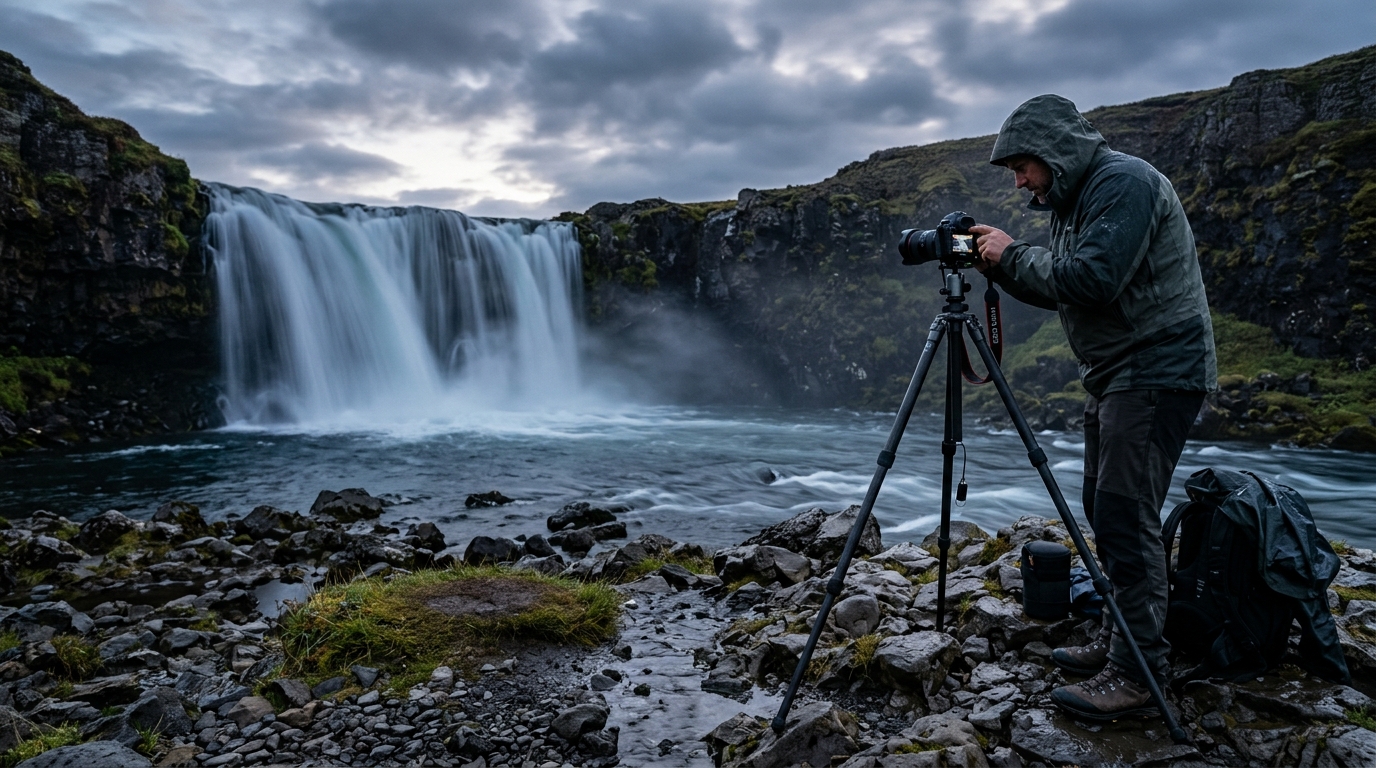
Iceland, a land forged by fire and ice, offers a photographic playground unlike any other. Its dramatic landscapes, from thundering waterfalls to serene glacial lagoons and windswept coastlines, beckon photographers to capture their raw beauty. But to truly convey the dynamic essence of this island, many turn to a powerful technique: long exposure photography. This method transforms the ordinary into the ethereal, blurring motion into painterly strokes and revealing a hidden dimension of time within a single frame.
It allows you to smooth turbulent waters into silky cascades, render crashing waves into misty veils, and streak clouds across vast skies, creating images that resonate with tranquility and drama. This comprehensive guide will deep dive into everything you need to know, from essential gear and specific camera settings to navigating Iceland's unique challenges and discovering the best locations. Prepare to unlock the secrets to capturing Iceland's landscapes transformed, creating truly unforgettable photographs that stand the test of time.
The Allure of Time: Why Long Exposure in Iceland?
Long exposure photography is an artistic technique that uses an extended shutter speed to capture elements of motion within a static frame. The result is a mesmerizing blend of sharp, stationary subjects and beautifully blurred moving elements. This technique allows photographers to transcend a single moment, instead compressing a segment of time into one captivating image. The artistic impact is profound, evoking a sense of calm, mystery, and often, an otherworldly beauty that conventional photography simply cannot achieve.
Iceland’s unique and diverse landscapes are, quite simply, a dream canvas for long exposure. Imagine the raw power of its countless waterfalls, where raging torrents can be transformed into soft, milky flows that appear to pour directly from the heavens. Consider the rugged coastlines, where crashing Atlantic waves blur into an ethereal mist, revealing the ancient character of black sand beaches and basalt columns. Then there are the serene glacial lagoons, where icebergs drift slowly, their movement beautifully softened against the still reflections of the sky. Even the ever-present Icelandic wind, often a photographer's bane, can become an ally, streaking clouds across a dramatic sky to add dynamic interest.
From this comprehensive guide, you, the discerning photographer, will gain practical, actionable insights. We’ll equip you with the knowledge to choose the right gear, understand the nuances of camera settings, master the art of composition, and overcome the specific environmental challenges Iceland presents. Our goal is to empower you to create stunning long exposure images that not only capture Iceland’s beauty but also tell a story of time and motion, reflecting your unique artistic vision.
The Art of Long Exposure: What It Is and Why Iceland is Its Canvas
At its core, long exposure photography involves keeping the camera's shutter open for an extended period, ranging from a fraction of a second to several minutes, or even hours. During this time, any stationary elements in the scene remain sharp, while moving elements—such as water, clouds, or even people—are rendered as blurs or streaks. This technique is fundamentally about capturing the passage of time and motion, making the invisible visible.
The creative effects achievable with long exposure are diverse and visually striking. Waterfalls, for instance, are transformed from choppy, turbulent flows into smooth, silky cascades that seem to melt over the rocks. Seascapes, with their relentless waves, become glassy, serene surfaces or dramatic misty veils, depending on the shutter speed chosen. Clouds, often a dynamic element in Iceland's famously changeable skies, can be stretched into painterly streaks, adding a sense of speed and drama to an otherwise still landscape. The result is often an ethereal, dreamlike quality that elevates a photograph beyond a simple snapshot.
The sheer abundance of dramatic subjects—from the raw power of Seljalandsfoss to the serene beauty of Jökulsárlón—means endless opportunities. However, Iceland's notoriously unpredictable weather, characterized by strong winds, sudden rain, and rapidly shifting light, demands resilience and preparedness. The reward, however, is immense: the chance to capture truly distinctive images that harness the raw, untamed spirit of Iceland, presenting its iconic landscapes in a uniquely artistic light.
Essential Gear for Captivating Long Exposure Photography in Iceland
While the magic of long exposure photography lies in technique and vision, having the right equipment is non-negotiable, especially when facing Iceland's often challenging conditions. Investing in quality gear will not only protect your equipment but also significantly improve the quality and consistency of your long exposure shots.
- Sturdy Tripod: Absolute Necessity for Stability in Windy Conditions
This is arguably the most critical piece of equipment. In long exposure photography, any camera movement, no matter how slight, will result in a blurred image. Iceland is renowned for its powerful, often relentless winds, especially along the coastlines and near waterfalls. A flimsy tripod will simply not suffice. Look for a tripod made from carbon fiber or aluminum that offers excellent stability, even when fully extended. Features like a hook at the bottom of the center column to hang your camera bag for added weight can be incredibly beneficial. Ensure the leg locks are robust and easy to operate, even with cold hands. - Neutral Density (ND) Filters: Understanding Strengths and Types
ND filters are sunglasses for your camera lens. They reduce the amount of light entering the lens without affecting color, allowing you to use longer shutter speeds even in bright conditions. For ND filters Iceland photography, you'll likely need a range of strengths:- Light ND filters (e.g., 3-stop, 6-stop): Useful for subtly blurring water or clouds in overcast conditions or during golden hour.
- Strong ND filters (e.g., 10-stop, 15-stop): Essential for achieving very long exposures (several seconds to minutes) in bright daylight, turning turbulent water into mist or making clouds streak dramatically.
- Solid ND filters: These darken the entire frame uniformly. Ideal for scenes with consistent light across the frame.
- Graduated ND (GND) filters: These are darker at the top and gradually clear towards the bottom. Useful for balancing bright skies with darker foregrounds, though less commonly used for pure long exposure effects where a solid ND is often preferred.
- Remote Shutter Release or Self-Timer to Prevent Camera Shake
Pressing the camera's shutter button, even gently, can introduce enough vibration to blur a long exposure shot. A remote shutter release (wired or wireless) allows you to trigger the shutter without touching the camera. If you don't have one, use your camera's 2-second self-timer. This slight delay allows any vibrations from pressing the shutter button to dissipate before the exposure begins. - Wide-Angle Lenses for Expansive Icelandic Vistas
Iceland's landscapes are vast and epic. A wide-angle lens (e.g., 14-24mm on full-frame, 10-18mm on crop-sensor) will help you capture the grandeur of these scenes, allowing you to include sweeping foregrounds, dramatic skies, and the immense scale of waterfalls and coastlines. Ensure your lens is weather-sealed if possible, given the likely exposure to the elements. - Weather Protection: Rain Covers, Lens Cloths, and Appropriate Clothing
Icelandic weather is notoriously fickle. Rain, mist, and sea spray are common, especially near waterfalls and coastlines.- Camera Rain Cover: A simple, inexpensive cover can save your camera from a sudden downpour.
- Microfiber Lens Cloths: Carry several. You'll constantly be wiping spray off your lens, particularly near powerful waterfalls like Skógafoss or Seljalandsfoss.
- Appropriate Clothing: Dress in layers, with waterproof and windproof outer shells. Warm gloves are essential for operating camera controls in cold conditions.
Mastering Daytime Long Exposure in Iceland: Harnessing the Light with ND Filters
Daytime long exposure presents a unique set of challenges compared to shooting at dawn, dusk, or night. The abundance of light means that achieving shutter speeds long enough to blur motion requires significant light reduction. Iceland, with its long summer daylight hours (especially around the June 2026 publication date), makes this even more pertinent. The intense, often harsh, midday sun can easily overexpose your images if not properly managed.
The key to successful daytime long exposure is the judicious use of Neutral Density (ND) filters. These filters reduce the amount of light reaching your camera's sensor, effectively allowing you to extend your shutter speed without overexposing the image. For bright Icelandic daylight, you'll typically need strong ND filters, often in the 10-stop to 15-stop range. A 10-stop ND filter, for example, allows you to turn a 1/60th of a second exposure into an exposure of approximately 17 seconds, dramatically smoothing water and streaking clouds. Source: Digital Photography School source.
Choosing the right ND filter strength depends on several factors: the ambient light conditions, the desired shutter speed, and the effect you want to achieve.
- For subtle water smoothing (e.g., a gentle river): A 3-stop or 6-stop ND filter might suffice on an overcast day.
- For silky waterfalls or moderately blurring waves: A 6-stop or 10-stop ND filter is usually ideal.
- For extremely glassy water or dramatic cloud streaks in bright sun: A 10-stop or even 15-stop ND filter will be necessary.
Calculating exposure times with ND filters requires a bit of math, but thankfully, there are excellent tools available. Many smartphone apps (e.g., PhotoPills, ND Filter Calculator) can do the calculations for you. You simply meter your scene without the ND filter, note the shutter speed, input the strength of your ND filter, and the app will provide the new, longer shutter speed. Manually, if your base exposure is 1/125th of a second and you apply a 10-stop ND filter, you would multiply the denominator by 2 ten times (2^10 = 1024), resulting in an exposure of approximately 8 seconds (125 * 1024 = 128000, 1/125s * 1024 = 1024/125s = 8.19s). It's crucial to perform this calculation accurately to avoid under or overexposure.
Composition tips for daytime scenes are just as vital as technical settings. With the vastness of Iceland, strong composition helps to guide the viewer's eye.
- Leading Lines: Utilize natural elements like rivers, paths, or rock formations to draw the eye towards your main subject.
- Foreground Interest: Place interesting rocks, flowers, or ice chunks in the foreground to add depth and context to the scene.
- Rule of Thirds: Position your main subject or horizon line along the intersecting points or lines of a tic-tac-toe grid superimposed on your frame for a balanced and engaging composition.
- Negative Space: Don't be afraid to include large areas of blurred water or streaked sky to emphasize the scale and tranquility of the scene.
Iconic Icelandic Waterfalls: Perfecting Your Long Exposure Shots
Iceland is synonymous with waterfalls, and they are arguably the most popular subjects for waterfall long exposure Iceland. The sheer volume and variety, from towering cascades to hidden gems, offer endless photographic opportunities. To locate some of the most stunning spots, consider exploring our Iceland Photo Maps, which pinpoint these natural wonders.
Among the best waterfall locations for long exposure are:
- Seljalandsfoss: Famous for the path that allows you to walk behind the cascade. A long exposure from behind the fall can create an incredible ethereal curtain of water, framing the landscape beyond. Be prepared for extreme spray!
- Skógafoss: A majestic, powerful waterfall. Its wide curtain of water is perfect for long exposure, turning the torrent into a silky sheet. The sheer volume of water means significant spray, so plan accordingly.
- Kvernufoss: A lesser-known gem, also walkable behind, but often less crowded. Its sheltered canyon offers unique perspectives for long exposure.
- Kirkjufellsfoss: While smaller, its iconic backdrop of Kirkjufell mountain makes it incredibly photogenic. Long exposures here can smooth the multiple small cascades, creating a serene foreground for the dramatic peak.
- Godafoss: The "Waterfall of the Gods" is wide and horseshoe-shaped, offering multiple angles to capture its powerful flow as a silky expanse.
Composition strategies for waterfalls are crucial for conveying their power and beauty:
- Capturing Flow: Experiment with shutter speeds. A 1/2 second might show some texture in the water, while a 10-second exposure will render it completely smooth. The "sweet spot" often lies between 1 and 5 seconds for a good balance of silkiness and flow.
- Framing: Use surrounding rocks, trees, or the canyon walls to frame the waterfall. This adds depth and draws the viewer's eye to the main subject.
- Scale: Include a person (if safe and ethical) or recognizable objects in the frame to give a sense of the waterfall's immense scale.
- Foreground Interest: Utilize mossy rocks, flowing streams, or wildflowers in the foreground to add texture and depth to your composition.
Dealing with spray and mist is an inevitable part of waterfall photography in Iceland. The sheer force of water creates a constant fine mist that quickly coats lenses. Here’s how to manage it:
- Lens Cleaning: Carry multiple clean microfiber cloths. Wipe your lens and filters frequently, ideally between every shot. A small blower can help remove larger water droplets before wiping.
- Protective Gear: Use a rain cover for your camera body. A lens hood can offer some protection, but for heavy spray, you might need to shield the lens with an umbrella or even your body between shots.
- Shooting Angles: Sometimes, simply changing your angle by a few feet can significantly reduce the amount of spray hitting your lens. Look for vantage points slightly upwind or further away.
- Quick Shots: Set up your shot, clean your lens, take the picture quickly, and then clean the lens again.
Safety considerations around powerful waterfalls cannot be overstated. The ground can be extremely slippery due to moss and constant moisture. Strong currents are present in the rivers above and below the falls. Always stay on marked paths and respect warning signs. Never get too close to the edge of a cliff or a powerful torrent. The wind can also be a factor, making footing precarious. Your safety, and the preservation of these natural wonders, must always take precedence over the perfect shot. The Environment Agency of Iceland provides valuable guidelines on responsible travel and minimizing impact in sensitive natural areas.
Beyond Waterfalls: Long Exposure for Iceland's Coasts, Ice, and Aurora
While waterfalls are a prime subject, Iceland offers a wealth of other incredible opportunities for long exposure photography. Expanding your horizons beyond cascades will lead to truly unique and compelling images.
Capturing the Drama of Black Sand Beaches and Crashing Waves
Iceland's black sand beaches, such as Reynisfjara near Vík, are iconic. Here, the powerful Atlantic waves crash against dark volcanic sand and basalt columns. Long exposure can transform these turbulent scenes into dramatic, ethereal compositions.
- Shutter Speed: Experiment with speeds from 0.5 seconds to 2 seconds to capture the motion of receding waves, creating a smooth, glassy effect on the wet sand. Longer exposures (5-15 seconds) will turn crashing waves into a misty, ghost-like veil around the basalt columns or sea stacks like Reynisdrangar.
- Composition: Focus on the interaction between the water and the unique rock formations. Use the patterns left by receding waves as leading lines. Be mindful of the "sneaker waves" – unpredictable large waves that can appear without warning. It is crucial to always keep a safe distance from the water's edge. For general safety guidelines in Iceland, consult Safetravel.is.
Long Exposure at Jökulsárlón Glacier Lagoon: Icebergs and Reflections
Jökulsárlón, the famous glacial lagoon, is a mesmerizing location for long exposure. Here, icebergs calved from the Breiðamerkurjökull glacier drift slowly towards the sea.
- Reflections: On calm days, the reflections of icebergs and the sky on the still water are breathtaking. A long exposure (10-30 seconds) can smooth out any ripples, enhancing the mirror-like quality of the water and intensifying the reflections.
- Ice Movement: While icebergs move slowly, very long exposures (several minutes) can subtly blur their edges, giving them an even more ethereal appearance against the incredibly still water.
- Diamond Beach: Just across the road, ice chunks wash ashore on the black sand. Long exposures here can create beautiful streaks as waves wash over the glittering ice, contrasting the sharp ice with the blurred water.
Creative Uses for Long Exposure with Glacial Rivers and Geothermal Areas
Iceland's braided glacial rivers, with their intricate patterns and often milky-blue waters, offer abstract long exposure possibilities when shot from an elevated perspective (e.g., from a drone or a hilltop). Long exposures can smooth the individual braids into a flowing, organic tapestry. In geothermal areas like Námaskarð or Hverir, while steam vents are often fast-moving, a long exposure can transform the billowing steam into soft, painterly clouds, enhancing the otherworldly feel of these volcanic landscapes. Be cautious of hazardous ground and strong sulfur smells in these areas.
Brief Mention of Long Exposure for Aurora Borealis (Though a Separate Topic)
While a dedicated aurora photography guide would delve deeper, it's worth noting that capturing the Northern Lights inherently involves a form of long exposure. Shutter speeds typically range from 5 to 30 seconds (depending on aurora activity and lens aperture) to gather enough light to reveal the aurora's colors and movement. For more detailed guidance on chasing and photographing this incredible phenomenon, our Iceland Photo Maps for Northern Lights can guide you to prime viewing locations.
Technical Deep Dive: Camera Settings and Composition for Long Exposure Success
Mastering the technical aspects of your camera is paramount for consistent and high-quality long exposure photography. Understanding the interplay of aperture, ISO, and shutter speed, especially when using ND filters, is key.
Aperture Priority vs. Manual Mode for Long Exposures
- Aperture Priority (Av/A): This mode allows you to set your desired aperture (which controls depth of field) and ISO, and the camera will automatically select the shutter speed. This can be useful for initial metering without an ND filter. However, once you attach a strong ND filter, the camera's meter might struggle or give an extremely long shutter speed that you can't manually set (e.g., beyond 30 seconds).
- Manual Mode (M): This is the preferred mode for long exposure. It gives you full control over aperture, ISO, and shutter speed. Here’s the typical workflow:
- Compose your shot and set your desired aperture (e.g., f/8 to f/11 for sharpness and good depth of field).
- Set your ISO (typically 100 or 200 for minimal noise).
- Meter the scene without the ND filter in manual mode to get a correct exposure (e.g., 1/60th sec).
- Attach your ND filter.
- Calculate the new shutter speed based on the filter's strength (e.g., 1/60th sec with a 10-stop filter becomes ~16 seconds).
- Set your camera to this calculated shutter speed.
Optimal ISO Settings for Minimal Noise
For long exposure photography, especially in daylight or twilight, it is generally recommended to use the lowest possible ISO setting (typically ISO 100 or 200). Long exposures inherently generate more digital noise, particularly in the shadow areas. Keeping the ISO low minimizes this noise, resulting in cleaner, higher-quality images. Only increase ISO if absolutely necessary (e.g., for very faint aurora, where a compromise is needed between capturing the light and managing noise).
Understanding Shutter Speed and Bulb Mode for Extended Exposures
Shutter speed is the core of long exposure. As discussed, you'll be using speeds ranging from fractions of a second to several minutes. Most cameras have a maximum standard shutter speed of 30 seconds. For any exposure longer than 30 seconds, you'll need to use Bulb mode.
- Bulb Mode: In Bulb mode, the shutter remains open for as long as the shutter button (or remote release button) is held down. This is essential for very long exposures (e.g., 2-5 minutes for extremely glassy water or heavily streaked clouds in bright daylight). You'll need a remote shutter release with a locking mechanism or an intervalometer to time these exposures accurately.
Achieving Sharp Focus in Low Light or with ND Filters
Focusing with an ND filter attached can be challenging, as the filter darkens the viewfinder or live view significantly.
- Focus First, then Filter: The best method is to compose and focus your shot before attaching the ND filter.
- Set your camera to autofocus (AF).
- Focus on your desired subject (e.g., a rock in the foreground, the horizon).
- Switch your lens (or camera) to manual focus (MF) to lock the focus. This prevents the camera from trying to refocus when the filter is attached.
- Attach your ND filter.
- Take your long exposure shot.
- Live View Magnification: If it's too dark to autofocus, or if you prefer manual focusing, use your camera's Live View mode and zoom in to 5x or 10x magnification to precisely adjust focus on a bright point in your scene before attaching the filter.
- Hyperfocal Distance: For landscape shots where you want everything from foreground to background sharp, consider focusing at the hyperfocal distance for your chosen aperture.
Post-Processing Considerations for Long Exposure Images
Post-processing is an integral part of long exposure photography.
- RAW Format: It is highly recommended to shoot in RAW. This preserves the maximum amount of image data, giving you much more flexibility for adjustments in post-processing, especially for recovering highlights or shadows and managing color.
- Color Correction: ND filters, especially cheaper ones, can sometimes introduce a color cast (often magenta or green). You'll need to correct this in software like Lightroom or Photoshop using the white balance or tint sliders.
- Sharpening: While your static elements should be sharp, a slight amount of sharpening can enhance detail. Be careful not to overdo it, as it can introduce artifacts.
- Noise Reduction: Even at low ISOs, long exposures can have some noise. Apply noise reduction judiciously, as too much can soften details.
- Contrast and Clarity: Enhance the drama and texture of the static elements.
- Dodging and Burning: Use these techniques to subtly lighten or darken specific areas, guiding the viewer's eye and adding depth.
Navigating Iceland's Elements: Tips for Challenging Conditions
Iceland's captivating beauty often comes hand-in-hand with challenging weather. As photographers, we often seek out dramatic conditions, but it's crucial to be prepared and safe. The Icelandic Met Office (Vedur.is) is an invaluable resource for checking forecasts, especially for wind speeds and precipitation, which are critical for planning long exposure shoots.
Strategies for Shooting in Strong Winds: Tripod Weighting, Body as a Shield
Wind is perhaps the most common adversary for long exposure photographers in Iceland. Even a slight tremor can ruin a multi-second exposure.
- Tripod Weighting: