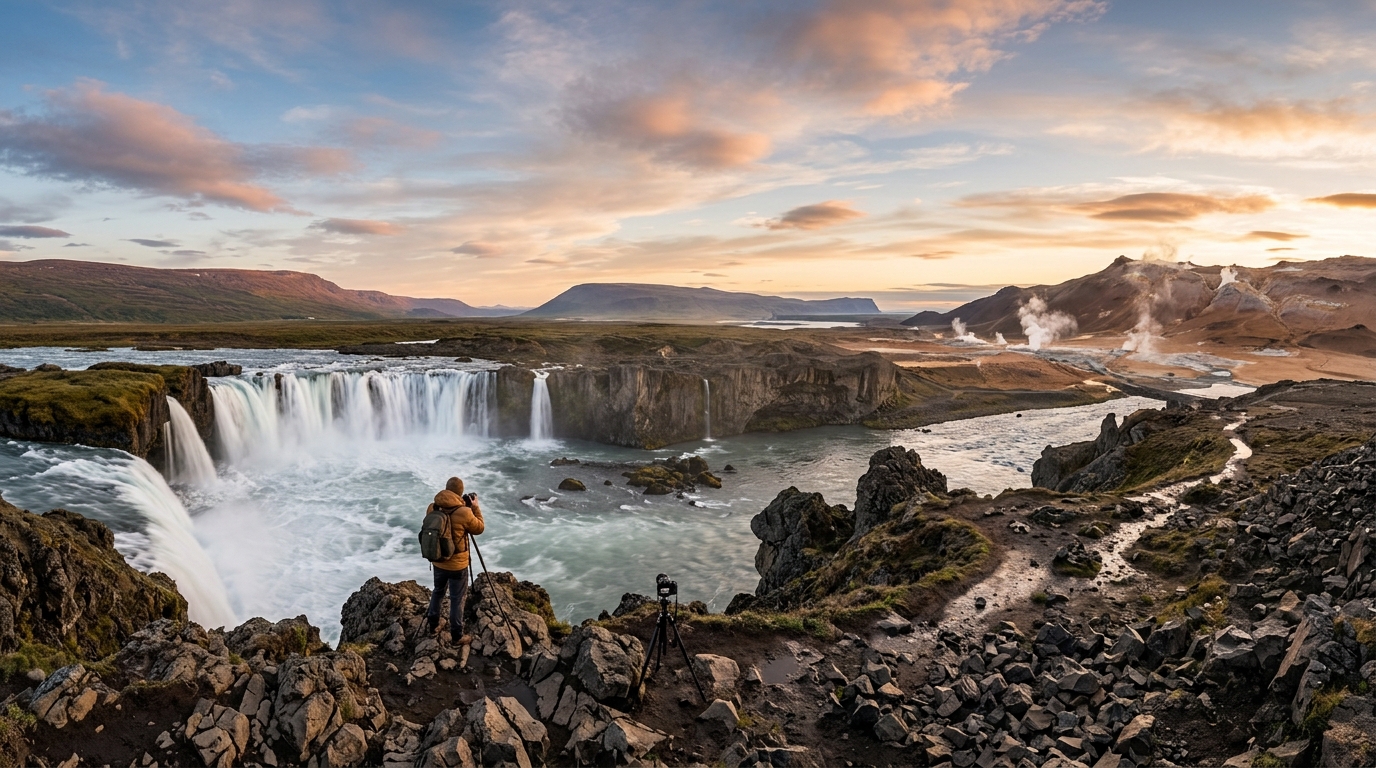
Introduction to Photographing North Iceland
When planning a landscape photography expedition to the Arctic, finding the best North Iceland photography spots is key to capturing a side of the country that many tourists completely miss. While the South Coast draws massive crowds to its iconic black sand beaches and waterfalls, North Iceland offers a quieter, more dramatic alternative characterized by raw volcanic geology, massive glacial canyons, and geothermal anomalies. It is a region where the earth still feels active, and the sheer variety of subjects—from thundering cascades to steaming fumaroles—provides endless creative opportunities for photographers of all skill levels.
The landscape of the North is defined by its stark contrasts. Here, ancient basalt columns frame milky-white glacial rivers, and stark volcanic craters sit adjacent to tranquil, bird-rich lakes. Because this region is situated just below the Arctic Circle, the quality of light is uniquely ethereal. In the summer months, the midnight sun skims the northern horizon, casting a golden glow that lasts for hours. In the winter, the snow-covered valleys and dark basalt structures create a high-contrast minimalist playground, topped off by the frequent dance of the Aurora Borealis across the northern sky.
To maximize your time and ensure you do not miss the fleeting light at these remote locations, planning your route is essential. Utilizing the interactive Iceland Photo Map allows you to plot your journey efficiently, providing precise GPS coordinates, parking information, and real-time accessibility updates. Whether you are chasing the perfect sunrise at a roaring waterfall or seeking out a forgotten turf church, having a dedicated visual guide ensures you spend less time navigating and more time behind the lens.
In this guide, we will explore the premier North Iceland photography spots, detailing how to shoot the famous Diamond Circle, capture hidden coastal gems, and choose the right gear to withstand the unpredictable Arctic environment in 2026.
The Diamond Circle Photography Guide: Route and Planning
The Diamond Circle is North Iceland’s premier touring route, spanning approximately 250 kilometers of jaw-dropping landscapes. Acting as the northern counterpart to the South's Golden Circle, this circuit connects some of the most geologically active and visually stunning locations on the island. The five key pillars of the loop are the historic town of Húsavík, the lush canyon of Ásbyrgi, the thunderous waterfall of Dettifoss, the geothermal wonderland of Lake Mývatn, and the historic Goðafoss waterfall.
To capture the Diamond Circle effectively, a well-thought-out North Iceland photography spots itinerary is critical. In 2026, the entire loop is fully paved, making it highly accessible during the summer and shoulder seasons, though you should always verify current road conditions on Road.is. However, the direction you choose to drive can significantly impact your photographic success. We recommend driving the loop counter-clockwise starting from Akureyri. This approach allows you to photograph Goðafoss in the soft morning light, proceed to the dramatic depths of Ásbyrgi when the sun is higher in the sky (which helps illuminate the canyon floor), and reach the geothermal fields of Mývatn just in time for late afternoon and golden hour shooting.
Seasonal considerations are paramount when planning your Diamond Circle photography guide itinerary:
- Summer (June to August): The midnight sun offers 24-hour shooting windows. Popular spots like Dettifoss and Goðafoss can be completely empty of tourists if you shoot between 11:00 PM and 3:00 AM. The light during these hours is soft, warm, and low on the horizon, minimizing harsh shadows.
- Shoulder Seasons (May and September): These months offer a beautiful balance of golden hours, civil twilight, and dark nights suitable for astrophotography. September also brings the first autumn snow dustings on the mountain peaks, adding beautiful contrast to your frames.
- Winter (October to April): While incredibly beautiful, winter requires flexible planning. Mountain passes can close rapidly due to heavy snow and high winds. Always monitor real-time weather alerts on the official Icelandic Meteorological Office website to ensure safe travel.
Balancing the highly popular sights with lesser-known viewpoints along the route is the secret to a unique portfolio. While you will certainly want to capture the classic angles of Dettifoss, allocating time to explore the coastal cliffs near Húsavík or the quiet birch forests of Ásbyrgi will give your work a distinct, narrative-driven edge.
Mastering Godafoss Photography: Angles, Light, and Composition
Goðafoss, or the "Waterfall of the Gods," is one of the most elegant and historically significant waterfalls in Iceland. According to a popular legend detailed by Perlan, around the year 1000 AD, the lawspeaker Þorgeir Ljósvetningagoði threw his pagan Norse idols into the waterfall to symbolize Iceland's conversion to Christianity. Beyond its historical weight, the waterfall is a dream for composition, featuring a symmetrical 30-meter-wide semi-circular horseshoe shape where the Skjálfandafljót river drops 12 meters over curved basalt cliffs. Source: Perlan source. Source: Perlan source. Source: Perlan source. Source: Guidetoiceland source.
To capture successful Goðafoss photography, you must understand the distinct advantages of shooting from the East Bank versus the West Bank:
The East Bank
The East Bank provides a closer, more intimate perspective of the lower basin. From here, you can hike down safely to the water’s edge (careful of wet, mossy rocks) and use the rushing river rapids in the foreground to lead the viewer’s eye toward the main falls. This bank is ideal for wide-angle compositions (16-35mm lens) that emphasize the scale of the canyon. However, because of the prevailing wind patterns, the East Bank is highly susceptible to mist and spray, requiring constant lens cleaning.
The West Bank
The West Bank features elevated, paved viewing platforms that offer a panoramic view of the entire horseshoe. This is the best side for capturing clean, graphic compositions that showcase the symmetry of the falls. It is also the most accessible side, making it ideal for quick setups or shooting during challenging winter weather. The West Bank is highly recommended for sunset photography, as the sun sets behind the canyon, casting dramatic colors across the sky directly behind the waterfall.
To master your compositions here, employ long exposure techniques. Using a 6-stop or 10-stop Neutral Density (ND) filter allows you to slow your shutter speed down to between 0.5 and 2 seconds. This sweet spot softens the churning water into a silky texture while retaining the defined lines and power of the flow. A circular polarizer is also essential to cut glare from the wet basalt rocks and enhance the deep turquoise hues of the glacial water.
For those chasing the Aurora Borealis, Goðafoss is an exceptional foreground. Because the falls face north-northeast, a strong auroral display will stretch directly over the semi-circular crest. Set your camera on a sturdy tripod, open your aperture to f/2.8, adjust your ISO between 1600 and 3200, and use a shutter speed of 4 to 8 seconds to capture the green curtains reflecting in the swirling pool below.
The Dramatic Basalt Columns: Aldeyjarfoss Photo Guide
For professional landscape photographers, Aldeyjarfoss is often considered the crown jewel of the North. Located further upstream along the Skjálfandafljót river, this waterfall is far less visited than Goðafoss but infinitely more dramatic. Here, the river plunges 20 meters into a basin surrounded by an amphitheater of symmetrical, twisted, and vertical basalt columns, as detailed by Perlan. The stark contrast between the roaring, milky-white glacial water and the dark, intricate volcanic stone creates an almost architectural masterpiece of nature. Source: En Wikipedia source.
Reaching this remote location requires careful planning. Our Aldeyjarfoss location guide emphasizes that the waterfall is located at the start of the Sprengisandur highland route (Road F-26). To reach the parking lot safely, you must drive a 4x4 vehicle, as the final stretch of the road is unpaved, heavily rutted, and rocky. During the winter and spring months, this F-road is completely impassable to standard rental cars due to deep snow drifts and mud, requiring a specialized superjeep tour or a long, arduous hike on snowshoes.
When you arrive, focus on compositions that highlight the tension between the fluid water and the rigid basalt columns. Here are three highly effective framing strategies:
- The Wide Amphitheater: Position yourself on the rocky plateau on the north side of the canyon. Use a wide-angle lens (around 20mm) to capture the entire semi-circle of basalt columns, showing how they curve and twist under the immense pressure of ancient lava flows.
- The Tight Crop: Use a mid-range zoom lens (24-70mm) to isolate the point where the white water meets the black basalt. The graphic contrast of the foaming water against the geometric columns makes for a powerful, high-contrast black-and-white conversion.
- The Low-Angle Reflection: If you safely scramble down into the canyon basin (only recommended in dry, calm summer conditions), look for small rock pools left behind by the spray. Position your camera close to the water to capture the reflection of the columns and the waterfall in the still pool.
Safety is a critical caveat at Aldeyjarfoss. There are no safety barriers, ropes, or guardrails along the cliff edges. The spray from the waterfall can freeze instantly in autumn and winter, turning the smooth basalt ledges into treacherous ice sheets. Always maintain a safe distance from the edge, keep your camera strap secured around your neck or wrist, and use a weighted tripod to combat the strong gusts of wind that funnel down the river valley. For up-to-date safety guidelines and travel alerts in these rugged areas, consult SafeTravel Iceland.
Geothermal Wonders: Lake Myvatn Photo Spots
The Lake Mývatn region is a sprawling geothermal playground that looks more like the surface of the moon than Earth. Formed by a series of massive basaltic volcanic eruptions thousands of years ago, the area is packed with unique geological features, steaming vents, and rich biodiversity. For photographers, the sheer variety of subjects within a 15-minute drive of one another makes this one of the most productive North Iceland photography spots on your itinerary.
Begin your shoot at the Skútustaðagígar pseudo-craters on the southern shore of the lake. These unique landforms were created when boiling lava flowed over the wetlands, trapping water underneath. The resulting steam explosions formed perfect, grass-covered craters. To photograph them, use a wide-angle lens during the golden hour when the low sun casts long, dramatic shadows that define the circular rims of the craters. If you shoot with a drone, ensure you comply with local regulations, as the aerial perspective of these nested craters reflecting in the surrounding water is truly spectacular.
Next, venture into Dimmuborgir, the "Dark Castles." This is a vast area of unusually shaped lava fields, home to massive volcanic caves, towering rock pillars, and natural arches. The key to capturing Dimmuborgir is finding natural frames. Look for the famous "Kirkjan" (The Church) cave, or use the natural basalt arches to frame the distant volcanic peak of Hverfjall. Shoot during early morning or late afternoon to avoid the flat, harsh midday light that can turn these dark lava formations into a chaotic, messy silhouette.
For a complete shift in color palette, head to the Hverir (Námaskarð) geothermal area. Here, the earth is painted in vibrant shades of ochre, orange, yellow, and deep grey. Steaming fumaroles vent high-pressure sulfur gas into the air, and boiling mud pots bubble violently. To capture the surreal atmosphere of Hverir:
- Use an overcast sky to your advantage. The flat light prevents harsh shadows and allows the saturated yellows and reds of the mineral deposits to pop.
- Use a telephoto lens (70-200mm) to zoom in on the textures of the bubbling mud pots, capturing the abstract shapes of the mud as it bursts.
- Climb the trail up Námafjall ridge for a breathtaking, wide-angle view of the entire steaming valley below, which looks particularly dramatic at sunrise.
Finally, do not overlook the shores of Lake Mývatn itself. The lake is a world-renowned sanctuary for waterfowl. If you are interested in bird photography, bring a long telephoto lens (at least 400mm) to capture species like the rare Harlequin Duck and Barrow’s Goldeneye. On calm mornings, the lake's glassy surface provides perfect, mirror-like reflections of the surrounding volcanic peaks, offering serene, minimalist landscape compositions.
The Roar of Dettifoss: Europe's Most Powerful Waterfall
Dettifoss is a force of nature that must be experienced to be believed. Plunging 44 meters down into the Jökulsárgljúfur canyon with a width of 100 meters, it discharges an average of 193 cubic meters of water per second, making it one of the most powerful waterfalls in Europe according to regional geographical data from Visit North Iceland. The water is a thick, sediment-rich grey, colored by the pulverized rock carried from the Vatnajökull glacier. Photographing Dettifoss is a thrilling challenge, requiring you to convey its immense scale, volume, and raw violence through a static image.
The first major decision you must make is choosing which side of the canyon to photograph from, as the viewpoints are separated by a long drive and offer completely different perspectives:
| Feature | West Side (Road 862) | East Side (Road 864) |
|---|---|---|
| Road Condition | Fully paved, easy access, open longer in the season. | Rough, unpaved gravel road; closed in winter/spring. |
| Perspective | Elevated viewpoints with safety railings; look down into the roaring chasm. | Get right up to the wet rocky edge; stand level with the crest of the falls. |
| Composition | Great for capturing the wide canyon and the sheer drop of the water. | Incredibly intimate, raw, and powerful; perfect for dramatic wide-angle shots. |
| Spray/Mist | Can be heavy if the wind blows from the east, but generally manageable. | Extremely heavy spray; you and your gear will get soaked. Heavy lens protection needed. |
To capture the scale of our Dettifoss profile, try to include a human element in your frame. On the East Side, safely positioned tourists standing on the rocky slabs across the canyon provide a perfect sense of scale, highlighting the massive size of the waterfall. Use a fast shutter speed (1/1000s or faster) to freeze the individual droplets of water and the violent plumes of mist rising from the depths. Conversely, a long exposure (using a heavy ND filter) will turn the chaotic, muddy water into a ghostly, smooth fog, creating a surreal and eerie atmosphere.
Protecting your gear is paramount at Dettifoss. The mist generated by the falls is highly charged with fine glacial silt, which can act like sandpaper on your lens elements if not wiped off carefully. To protect your equipment, it is highly recommended to use a high-quality lens hood to keep spray off the front glass, wrap your camera body in a dedicated rain sleeve, and carry several clean microfiber cloths. Wipe the lens element gently in a circular motion only after blowing away any loose grit with a rocket blower.
While visiting Dettifoss, do not make the mistake of leaving immediately after. Take the short, 1.5-kilometer trail walking upstream to discover Selfoss. Though much shorter than Dettifoss, Selfoss is incredibly elegant, consisting of a wide, horseshoe-shaped series of orderly cascades that wrap around the canyon. It offers a beautiful, peaceful contrast to the chaotic roar of its downstream neighbor.
Off the Beaten Path: Hidden North Iceland Photography Spots
While the Diamond Circle captures the majority of tourist attention, venturing off the beaten path reveals some of the most unique and evocative North Iceland photography spots. These hidden gems allow you to slow down, compose your shots without a crowd, and capture the quiet, melancholic beauty of the Icelandic coast.
One such location is Hvítserkur, located on the eastern shore of the Vatnsnes Peninsula. Rising 15 meters out of the sea, this bizarrely shaped basalt sea stack resembles a dragon or a mammoth drinking from the ocean. According to local folklore documented by Visit North Iceland, the stack is a troll that forgot to hide from the sun and was turned to stone. To photograph Hvítserkur:
- Check the Tides: At low tide, you can hike down the steep trail to the black sand beach and capture the sea stack reflecting in the wet, shimmering sand. At high tide, use a 10-stop ND filter to smooth out the ocean waves, creating a minimalist shot where the "dragon" rises out of a calm, misty sea.
- Lighting: Because the stack sits off the east coast of the peninsula, it is beautifully backlit during sunrise, casting a dramatic silhouette against the colorful morning sky.
Further east lies the Tröllaskagi (Troll) Peninsula, a mountainous region characterized by deep fjords and towering peaks. Nestled at the northern tip of the peninsula is the quiet fishing village of Siglufjörður. Once the herring capital of the Atlantic, Siglufjörður features beautifully restored, colorful historic buildings clustered around a quiet harbor. The reflections of the brightly painted houses and the surrounding snow-capped mountains in the still fjord water are exceptionally photogenic, especially during the blue hour.
North Iceland is also rich in traditional Icelandic architecture, particularly historic turf churches and houses. Unlike modern structures, these buildings blend seamlessly into the landscape, with their roofs covered in vibrant green grass. A prime example is the Víðimýrarkirkja (Vidimyri Church) near Varmahlíð. Built in 1834, it is one of the few remaining turf churches in the country, preserved as a historic site by the National Museum of Iceland (as detailed on Visit Iceland). To photograph these delicate structures, use a polarising filter to enrich the green of the turf roof and the deep blue of the sky, and shoot from a low angle to emphasize how the building rises organically from the earth.
Finding these lesser-known, crowd-free vantage points can be challenging without local knowledge. Utilizing specialized regional guides, such as our North Iceland region directory, ensures you have the exact coordinates and access details for these architectural and coastal treasures.
Essential Gear and Seasonal Tips for North Iceland Photography Spots
To successfully capture the stunning variety of North Iceland photography spots, you must be prepared for some of the most volatile weather conditions on the planet. The Arctic environment demands robust, weather-sealed equipment and a highly disciplined approach to safety and environmental conservation.
Must-Have Camera Gear
First and foremost, a rock-solid, heavy-duty tripod is non-negotiable. The wind in North Iceland can easily exceed 40 knots, which will cause lightweight travel tripods to shake, ruining your long exposures. Look for a carbon fiber tripod with a hook on the center column so you can hang your camera bag to weigh it down.
Your lens selection should cover a wide range of focal lengths. A wide-angle lens (16-35mm) is essential for the grand vistas of Ásbyrgi and the sweeping curves of Goðafoss. A versatile mid-range zoom (24-70mm) is perfect for composition inside the lava fields of Dimmuborgir. Finally, a telephoto lens (70-200mm or 100-400mm) is highly useful for compressing the basalt columns at Aldeyjarfoss, capturing the details of distant volcanic peaks, and photographing the rich birdlife around Lake Mývatn.
Do not forget a comprehensive filter kit. A circular polarizer will cut reflections on wet rocks and water, while solid ND filters (specifically 6-stop and 10-stop variants) are crucial for mastering your long exposures of the region’s powerful waterfalls.
Seasonal Dynamics: Midnight Sun vs. Northern Lights
The time of year you visit will completely dictate your shooting schedule and style:
- The Midnight Sun (June - July): During this period, the sun never fully sets, remaining visible or just below the horizon to provide continuous daylight as detailed by the Icelandic Meteorological Office. You can shoot continuously through the night. The "golden hour" can last from 10:00 PM to 2:00 AM, providing incredibly soft, warm, directional light. This is the best time for pristine landscape shots free of tourists.
- The Northern Lights (September - April): With its high latitude and low light pollution, North Iceland is one of the premier locations in the world to shoot the Aurora Borealis. To track potential solar activity and cloud cover, monitor the real-time aurora forecast on the Icelandic Meteorological Office website. Plan your shoots around moon phases; a partial moon is often helpful to illuminate the foreground landscapes while the aurora dances above.
Safety and Environmental Ethics
The Arctic environment is incredibly fragile. The beautiful green moss that covers the lava fields takes decades to recover if it is stepped on or damaged. often stay on marked paths, respect all safety signs, and do not cross protective ropes—even if it means missing a slightly better angle. No photograph is worth damaging this pristine landscape.
Additionally, often check road conditions and weather alerts before heading out. Conditions can change from a sunny afternoon to a blinding blizzard within an hour, especially on the high mountain passes of the North. Prioritize safety, dress in warm layers, and often respect the power of the Icelandic elements.
Frequently Asked Questions
What is the best time of year to photograph North Iceland?
The best time depends on your photographic goals. For lush green landscapes, access to remote F-roads, and the endless golden light of the midnight sun, visit between mid-June and August. If you want to photograph snow-covered volcanic craters, frozen waterfalls, and the Northern Lights, the winter months of February and March offer the best balance of daylight hours and dark night skies.
Do I need a 4x4 vehicle to reach Aldeyjarfoss?
Yes, a 4x4 vehicle is absolutely mandatory to reach the parking lot of Aldeyjarfoss. The waterfall is accessed via the F-26 (Sprengisandur route), which is a rough, unpaved dirt road with deep ruts, loose gravel, and rocks. Driving a standard 2WD rental car on F-roads is illegal in Iceland and voids your rental insurance, so always check the official classification of your route on Road.is. In winter, the road is impassable to standard vehicles and requires a superjeep.
How do I protect my camera gear from waterfall spray at Dettifoss?
To protect your gear from the heavy, silt-laden spray at Dettifoss, use a high-quality weather-sealed camera body and lens. Keep a protective UV filter or circular polarizer on your lens at all times, use a plastic rain sleeve to cover the camera body, and keep the lens hood attached to block incoming droplets. Most importantly, carry several dry microfiber cloths and wipe down your lens gently after blowing away any abrasive dust or grit.
Can I see the Northern Lights in North Iceland?
Yes, North Iceland is one of the best places in the country to witness and photograph the Northern Lights. Because the region is located closer to the Arctic Circle and generally experiences less cloud cover than the South Coast, your chances of a clear night sky are very high. The aurora season runs from late August to mid-April, when the night skies are sufficiently dark.
Plan Your Expedition
Ready to plan your ultimate photography expedition? Unlock precise GPS coordinates, parking details, and optimal shooting angles for every location with our interactive Iceland Photo Map.