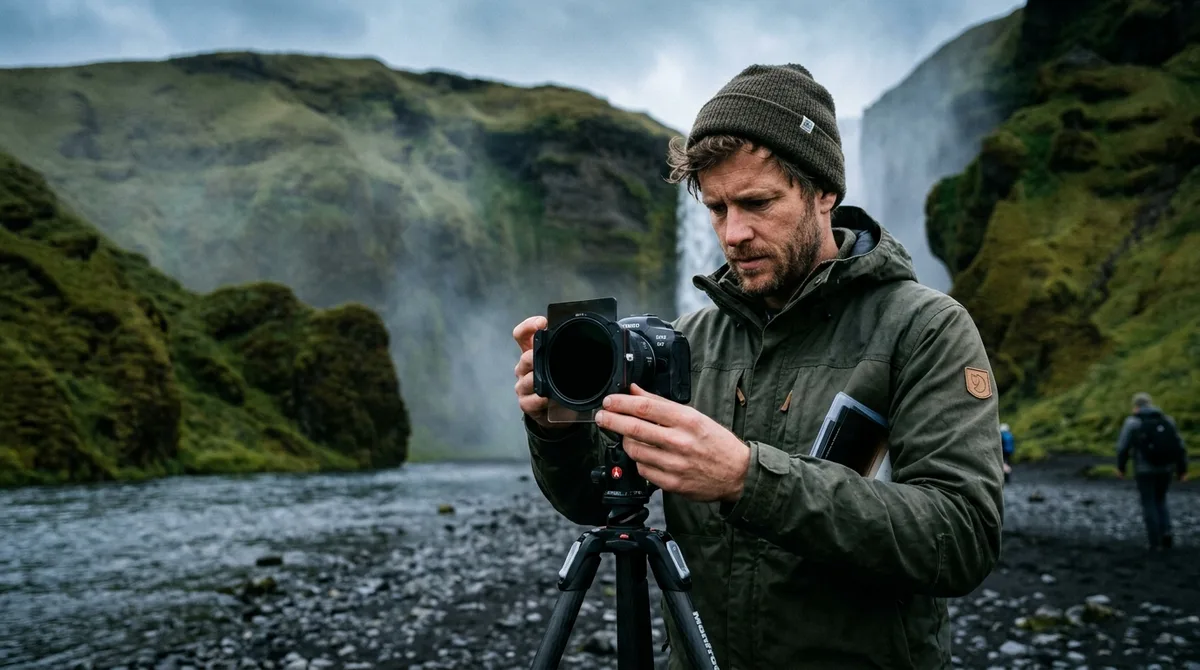
Iceland, a land forged by fire and ice, offers a photographic playground unlike any other. From thundering waterfalls and black sand beaches to vast, ethereal landscapes under an ever-changing sky, every turn presents a breathtaking vista. Yet, capturing the true majesty of these scenes often requires more than just a keen eye and a quality camera. The dynamic light, extreme contrasts, and pervasive water elements demand specialized tools. This is precisely where high-quality filters for Iceland landscape photography become not just accessories, but indispensable instruments. Source: Icelandphotomap source.
For source context on filters are often considered essential for achieving professional-level results in Iceland, see Iceland Photo Tours source.
For the discerning photographer, filters are the secret weapon to transform good shots into extraordinary ones. They enable you to tame Iceland's notoriously bright skies, smooth out turbulent waters into silky streams, and intensify the vibrant colors that define this Nordic island. This comprehensive guide from Iceland Photo Map will delve into the essential filters you need for your 2026 Iceland adventure: the Circular Polarizer (CPL), Neutral Density (ND), and Graduated Neutral Density (GND) filters. We'll explain how each works, provide practical applications specific to Iceland's unique environment, and offer expert tips to elevate your photography.
Why Filters are Indispensable for Iceland Landscape Photography
Iceland's photographic allure is undeniable, but it comes with unique challenges that filters are perfectly designed to address. The island's position near the Arctic Circle means exceptionally long daylight hours in summer, with the sun often staying low on the horizon, casting dramatic, soft light for extended periods. Conversely, winter brings short, intense bursts of golden light. This dynamic range, often characterized by bright skies contrasting sharply with darker foregrounds, is a constant battle for your camera's sensor.
Consider the iconic waterfalls like Skógafoss or Seljalandsfoss, where immense volumes of water create reflections and spray. Without a CPL filter, these reflections can obscure detail and mute colors. Similarly, capturing the ethereal flow of water in a long exposure requires an ND filter to reduce light, allowing for longer shutter speeds even in broad daylight. The vast, open landscapes, such as the Jökulsárlón glacier lagoon or the plains near Vík, often present a bright sky that can easily be overexposed while the foreground remains dark. This is where a graduated ND filter becomes invaluable, balancing the exposure across the scene.
In essence, filters for Iceland landscape photography are not about altering reality, but about helping your camera see and capture the scene more accurately, or more creatively, than it could on its own. They reduce glare, manage reflections, control dynamic range, and enable creative long exposures, making a significant difference in common scenarios like:
- Waterfalls: Achieving that silky smooth water effect.
- Glaciers and Ice Lagoons: Reducing glare on ice and water, enhancing color.
- Coastal Scenes: Capturing the movement of waves or balancing bright skies over dark basalt columns.
- Vast Landscapes: Ensuring balanced exposure from foreground to sky.
The Circular Polarizer (CPL) Filter: Cutting Glare and Boosting Color
The Circular Polarizer, or CPL filter, is arguably the most fundamental filter for any landscape photographer, and it holds particular importance in Iceland. Its primary function is to reduce reflections from non-metallic surfaces and enhance color saturation and contrast.
How a CPL Filter Works
Light from the sun travels in waves that vibrate in all directions. When this light bounces off a non-metallic surface like water, glass, wet rocks, or foliage, it becomes "polarized"—meaning the waves vibrate predominantly in one plane. A CPL filter consists of two rings: one that screws onto your lens and another that rotates freely. By rotating the outer ring, you align the filter's polarizing material to block specific wavelengths of polarized light, effectively reducing or eliminating reflections and glare.
Practical Examples for a CPL Filter in Iceland
For an CPL filter Iceland trip, its benefits are immediately apparent:
- Waterfalls and Rivers: Imagine photographing Seljalandsfoss. Without a CPL, the water's surface might appear bright and reflective, obscuring the rocks beneath or the depth of the pool. A CPL can cut through this glare, making the water more transparent, revealing intricate details, and deepening the colors of the surrounding moss and rocks.
- Blue Skies: On a clear day, a CPL can dramatically deepen the blue tones of the sky, making white clouds pop with greater contrast. This is especially effective when the sun is at a 90-degree angle to your camera.
- Foliage: Iceland's moss-covered lava fields and green hillsides (especially in summer) can suffer from a whitish sheen due to reflections. A CPL removes this glare, making the greens richer and more vibrant.
- Haze Reduction: By cutting through atmospheric haze, a CPL can increase the clarity and contrast of distant landscapes, making mountain ranges appear sharper.
Tips for Proper Use and Common Mistakes
- Rotation is Key: The effect of a CPL varies depending on its rotation relative to the sun. Slowly rotate the outer ring while looking through your viewfinder or at your LCD screen until you achieve the desired effect.
- Sun Angle: The polarizing effect is strongest when the sun is at a 90-degree angle to your lens. If you're shooting directly into or away from the sun, the effect will be minimal.
- Over-Polarization: Be careful not to over-polarize, especially in skies. Too much polarization can result in an unnatural, uneven sky, particularly with wide-angle lenses where the effect might be stronger on one side of the frame than the other.
- Light Loss: CPL filters inherently reduce the amount of light entering your lens by 1-2 stops. Account for this in your exposure settings.
- Wide-Angle Lenses: With very wide-angle lenses (e.g., 16mm on a full-frame camera), the polarizing effect across the sky can be uneven, leading to dark bands. Compose carefully or consider reducing the polarization.
Neutral Density (ND) Filters: Mastering Long Exposures in Iceland
Neutral Density (ND) filters are essentially sunglasses for your camera. Their purpose is to reduce the amount of light entering the lens without affecting the color balance of the scene. This reduction in light allows you to use slower shutter speeds or wider apertures than would otherwise be possible in bright conditions, opening up a world of creative possibilities.
Solid ND Filters vs. Variable ND Filters
When considering an ND filter Iceland setup, you'll encounter two main types:
- Solid ND Filters: These filters have a fixed density, meaning they block a consistent amount of light. They come in various "stops," such as 3-stop (ND8), 6-stop (ND64), or 10-stop (ND1000). Solid NDs are generally preferred for critical landscape photography due to their superior optical quality, consistent color rendition, and lack of potential X-pattern issues.
- Variable ND Filters: These filters combine two polarizing elements that rotate against each other to provide a range of light reduction, typically from 2 to 8 stops or more. They offer convenience, as one filter can replace several solid NDs. However, they can sometimes introduce color shifts (especially at higher densities) or create an undesirable "X" pattern or cross-polarization effect, particularly with wide-angle lenses or at their maximum density settings. Many photographers find solid NDs generally offer superior optical quality for critical landscape photography due to their consistent color rendition and lack of potential X-pattern issues, making them often preferred for Iceland's demanding light.
Understanding 'Stops' and Creative Effects
The "stop" rating of an ND filter indicates how much light it blocks, with each stop halving the amount of light. This directly impacts how much you can slow down your shutter speed:
- 3-Stop (ND8): Ideal for slightly extending shutter speeds in moderate light, perhaps to introduce a subtle blur to moving water or clouds without completely smoothing them out. Useful for sunrise/sunset or overcast days.
- 6-Stop (ND64): A versatile choice for many long exposure scenarios, allowing you to smooth out waterfalls and give clouds a sense of motion in brighter conditions. This is often a good starting point for general long exposure work in Iceland.
- 10-Stop (ND1000): The "big gun" for extreme long exposures, even in bright daylight. Perfect for turning turbulent ocean waves into mist, completely smoothing out waterfalls into a silky veil, or creating dramatic streaky clouds. Essential for capturing the ethereal quality of Iceland's coastlines and powerful rivers.
Choosing the Right ND Filter Strength for Iceland
For Iceland's bright conditions, especially during summer's extended daylight, a 6-stop and a 10-stop ND filter are highly recommended. A 3-stop can be useful for transitional light or more subtle effects. Many photographers find a combination of a 6-stop and a 10-stop covers most needs. If you're planning to shoot during the shoulder seasons or winter, a 3-stop might see more use as ambient light levels are lower.
When selecting your ND filters, remember that quality matters. High-quality glass with multi-coatings will minimize color shifts and internal reflections, crucial for sharp, color-accurate images. For exploring prime long-exposure locations, check out our dedicated Waterfall Maps to find the best spots for silky water shots.
Graduated Neutral Density (GND) Filters: Balancing Bright Skies and Dark Landscapes
Graduated Neutral Density (GND) filters are designed to address the common problem of high dynamic range in landscape photography: a bright sky and a much darker foreground. Unlike solid ND filters, GND filters are clear on one end and gradually transition to a neutral density on the other, allowing you to balance the exposure between these two areas of your scene.
Types of GND Filters and Their Application in Iceland
Understanding the different types of GND filters is crucial for their effective use, especially with an graduated ND filter Iceland setup:
- Soft-Edge GND: These filters have a gradual transition from dark to clear. They are best suited for scenes without a distinct horizon line, such as mountains, rolling hills, or forests, where a hard line would look unnatural. They blend seamlessly into the scene, making the transition almost invisible.
- Hard-Edge GND: Featuring a sharp, distinct line between the dark and clear portions, hard-edge GNDs are ideal for scenes with a perfectly flat horizon, like seascapes or open plains. They provide a precise reduction in light for the sky while leaving the foreground untouched.
- Reverse GND: A specialized type, the reverse GND is darkest at the center of the filter, with the density gradually decreasing towards the top, while the bottom remains clear. This design is perfect for sunrises and sunsets where the brightest part of the scene (the sun) is often on the horizon. It allows you to control the intense light directly around the sun without making the very top of the sky too dark.
Illustrating Common Iceland Scenarios
- Sunrises/Sunsets over Mountains: A soft-edge GND is excellent for balancing the bright, colorful sky over the jagged peaks of the Highlands or the Snaefellsnes Peninsula, where the horizon isn't a straight line.
- Vast Open Landscapes: For scenes like the black sand beaches of Reynisfjara or the endless plains leading to a distant mountain range, a hard-edge GND might be appropriate if the horizon is flat and distinct. However, often a soft-edge or even a reverse GND (for sunrise/sunset) will be more versatile.
- Coastal Scenes: When the sun dips near the horizon over the Atlantic, a reverse GND can effectively manage the intense light, preventing the sky from blowing out while keeping the foreground rocks or waves properly exposed.
Tips for Proper Alignment and Avoiding Visible Transitions
- Use a Square Filter System: GND filters are almost exclusively used with square/rectangular filter systems (discussed below) because they allow you to slide the filter up or down to align the transition line precisely with the horizon in your composition.
- Live View is Your Friend: Use your camera's Live View mode (if available) to accurately preview the filter's effect and adjust its position. Zoom in to check the transition.
- Feathering the Edge: If using a soft-edge GND, try to position the transition slightly below the actual horizon to ensure a smooth blend.
- Composition is Key: While filters help, strong compositions that naturally lead the eye through the scene will always enhance the impact of your filtered shots. For inspiration, explore our Iceland Landscape Maps.
Filter Systems for Iceland: Screw-in vs. Square/Rectangular Systems
Choosing the right filter system is as important as choosing the filters themselves, particularly for an environment like Iceland where conditions can change rapidly and flexibility is key. Your choice will largely depend on your budget, convenience preferences, and photographic needs.
Screw-in Filters: Compact and Cost-Effective
Screw-in filters attach directly to the front thread of your lens. They are:
- Advantages:
- Compact: Easy to pack and carry, taking up minimal space.
- Cost-Effective: Generally less expensive than a full square filter system.
- Secure: Once screwed on, they are very secure and less prone to falling off.
- Disadvantages:
- Lens-Specific: You need a filter for each lens diameter, or a set of step-up rings to adapt a larger filter to smaller lenses.
- No GNDs: Not suitable for GND filters, as you cannot adjust their position relative to the horizon.
- Stacking Issues: Stacking multiple screw-in filters (e.g., CPL + ND) can lead to vignetting (dark corners) on wide-angle lenses and can be cumbersome to manage.
Screw-in CPL and solid ND filters are excellent for photographers on a tighter budget or those prioritizing a lightweight setup. For an filter systems for Iceland trip, a screw-in CPL is almost universally recommended regardless of other choices.
Square/Rectangular Filter Systems: Flexibility and Precision
Square or rectangular filter systems consist of several components:
- Holder: This mounts onto an adapter ring on your lens.
- Adapter Rings: These fit your specific lens thread sizes (e.g., 77mm, 82mm) and allow the holder to attach.
- Filters: These are typically 100x100mm (for NDs) or 100x150mm (for GNDs) and slide into slots on the holder.
- Advantages:
- Versatility: A single set of filters can be used across multiple lenses (with different adapter rings).
- GND Use: Essential for GND filters, as they allow precise vertical positioning to align with the horizon.
- Stacking: Designed for easy stacking of multiple filters (e.g., CPL, solid ND, and GND) with minimal vignetting, thanks to wider filter slots and slim frames.
- Quick Changes: Filters can be swapped in and out quickly, which is crucial in rapidly changing Icelandic weather.
- Disadvantages:
- Bulkier: The holder and larger filters take up more space and weigh more.
- More Expensive: The initial investment for a holder and a few high-quality filters is significantly higher.
- Vulnerability: Filters can be accidentally dropped or scratched more easily when sliding them in and out.
Recommendations for Iceland Travel
- Budget-Conscious / Minimalist: Start with a high-quality screw-in CPL and perhaps a 6-stop or 10-stop screw-in ND filter. Use step-up rings if you have multiple lens diameters.
- Serious Landscape Photographer: Invest in a quality square filter system. A holder, adapter rings for your primary lenses, a 6-stop ND, a 10-stop ND, a soft-edge GND (e.g., 2- or 3-stop), and a reverse GND (e.g., 2- or 3-stop) will provide immense flexibility. You can still use a screw-in CPL that attaches to your lens *before* the filter holder, or some advanced systems offer a dedicated CPL slot within the holder itself.
Essential Accessories
- Step-Up Rings: Invaluable for adapting larger filters to smaller lens threads, saving you money on buying multiple filters.
- Cleaning Kits: Absolutely critical in Iceland. Microfiber cloths, lens cleaning fluid, and a blower brush are non-negotiable.
- Filter Pouches/Cases: Protect your valuable filters from scratches and impact during travel.
Practical Tips for Using Filters in Iceland's Challenging Environment
Iceland's beauty often comes with challenging conditions: relentless wind, pervasive mist from waterfalls, and cold temperatures. Mastering your filters here means preparing for these elements.
Keeping Filters Clean
This is perhaps the biggest battle in Iceland. Water spray from waterfalls (like Dettifoss or Skógafoss) and coastal waves (like at Reynisfjara) can instantly coat your filters. Wind can whip up dust and sand.
- Be Proactive: It's highly advisable to keep a clean microfiber cloth and a blower brush readily accessible.
- Shield Your Lens: Use your body, a hat, or an umbrella to shield your lens and filter from spray between shots.
- Quick Wipe: For water droplets, a quick, gentle wipe with a clean microfiber cloth is usually sufficient. For persistent mist, a more thorough cleaning with lens fluid might be needed once you're away from the spray.
- Dust/Sand: Use a blower brush first to remove any loose particles before wiping, to avoid scratching the filter.
- Dedicated Cloths: Keep separate cloths for filters and lens elements to prevent cross-contamination.
Stacking Filters Effectively and Avoiding Vignetting
You'll often need to stack filters, for example, a CPL, a solid ND, and a GND.
- Order Matters: Generally, the CPL goes closest to the lens, followed by solid NDs, and then GNDs on the outermost slot of a square holder. This allows you to rotate the CPL independently and position the GND.
- Vignetting: With wide-angle lenses, stacking too many filters or using thick-rimmed screw-in filters can cause vignetting. Use thin-profile screw-in filters and slim-frame square filters whenever possible. Some square filter holders are designed to be "slim" to minimize this.
- Test Shots: It's good practice to take a test shot after stacking filters and zoom in to check the corners for vignetting or unwanted color casts.
Shooting in Cold Weather and Managing Condensation
Icelandic winters and even shoulder seasons can be cold, leading to condensation issues.
- Acclimatization: Allow your camera and filters to slowly adjust to temperature changes. Keep them in your camera bag when moving between warm interiors and cold outdoors.
- Dessicant Packs: Keep silica gel packets in your camera bag to absorb moisture.
- Breath: Avoid breathing directly on your filters or lens, as your warm breath will condense in cold air.
- Warmth: Carry hand warmers or keep spare batteries in an inside pocket to maintain their charge in the cold.
Compositional Tips When Using Filters
Filters are tools for artistic expression.
- Long Exposure Composition: When using ND filters for long exposures, consider what elements will blur and what will remain sharp. Static elements like rocks or structures will provide contrast to blurred water or clouds.
- GND Alignment: Carefully align your GND with the horizon or natural transition points. A slightly misaligned GND can create an unnatural line in your image.
- Polarizer Effect: Pay attention to the direction of light when using a CPL. Rotate it to achieve the desired effect, but be mindful of uneven polarization with wide lenses.
Recommended Filter Kits and Brands for Iceland Photographers
Investing in quality filters is crucial for professional results. Cheap filters can introduce color casts, reduce sharpness, and be prone to scratching. For Iceland's demanding conditions, optical clarity and durability are paramount.
Suggested Filter Combinations for Iceland
- Beginner/Intermediate:
- Screw-in CPL (matching your largest lens diameter, with step-up rings for smaller lenses).
- Screw-in 6-stop ND filter.
- Screw-in 10-stop ND filter.
- Advanced/Professional (Square Filter System):
- High-quality square filter holder (e.g., Kase, Nisi, Lee, Haida).
- Adapter rings for your primary lenses.
- 100x100mm 6-stop ND filter.
- 100x100mm 10-stop ND filter.
- 100x150mm Soft-Edge GND (2- or 3-stop).
- 100x150mm Reverse GND (2- or 3-stop) for sunrises/sunsets.
- A high-quality screw-in CPL that can attach to the lens before the filter holder, or a CPL designed for the square system.
Reputable Filter Brands
When making your selection, look for brands known for their optical quality, durable construction, and effective coatings. Some top contenders include:
- Breakthrough Photography: Known for their "Dark CPL" which combines a CPL with an ND filter, and their excellent X4 ND series. For general understanding of ND filters, resources like Photography Life offer valuable insights into filter technology.
- NiSi: Offers a comprehensive range of high-quality square filter systems, including excellent ND, GND, and CPL filters, often praised for color neutrality.
- Kase: Another top-tier brand, particularly known for their Wolverine series filters which are highly durable and color-neutral.
- Lee Filters: A long-standing favorite among landscape photographers, known for their high-quality resin filters (though glass options are now available).
- Haida: Offers a strong balance of quality and value, with good optical performance for both screw-in and square systems.
- H&Y: Innovators with magnetic filter systems, offering quick and secure filter changes.
- B+W / Marumi / Hoya: Excellent choices for screw-in CPL and ND filters, known for their optical glass and coatings. For a comprehensive guide to various filter types, B&H Photo Video's Explora blog is a great resource.
What to Look For When Investing in Filters
- Glass Quality: Opt for optical glass over resin for superior sharpness and durability.
- Coatings: Multi-coatings reduce reflections, repel water and oil, and make cleaning easier – a huge plus in Iceland.
- Color Neutrality: High-quality filters should not introduce a color cast. While some slight warming or cooling might occur, it should be minimal and easily correctable in post-processing. Read reviews and look for tests that measure color shifts.
- Build Quality: Robust frames and precise threading (for screw-ins) or sturdy holders (for square systems) ensure longevity.
Conclusion: Unlock the Full Potential of Your Iceland Photography
Iceland is a photographer's dream, but its unique light and dramatic landscapes demand more than just a camera. By equipping yourself with the right filters—a CPL to cut glare and boost color, ND filters to master long exposures, and GND filters to balance dynamic skies—you gain unparalleled control over your images. These tools don't just solve photographic problems; they unlock new creative avenues, allowing you to capture the ethereal beauty of Iceland with stunning clarity and artistic flair.
Experimentation and practice are key to truly mastering these filters. Understand how they interact with light, learn to anticipate their effects, and develop your unique style. With a well-chosen filter kit, you'll be able to transform ordinary scenes into extraordinary photographic masterpieces, preserving the magic of Iceland long after your trip. We encourage you to delve deeper into specific locations and techniques, and remember that the best photos often combine technical skill with a deep understanding of the environment.
Ready to explore Iceland's stunning landscapes with your newly acquired filter knowledge? Browse our comprehensive Iceland Photo Maps to discover the perfect locations for your next filtered masterpiece!
Frequently Asked Questions
Do I really need filters for Iceland landscape photography?
While you can certainly take beautiful photos in Iceland without filters, they are often considered essential for achieving professional-level results, especially in challenging light conditions. Filters allow you to manage reflections, balance extreme dynamic range (bright skies, dark foregrounds), and create long exposure effects that are impossible to achieve in-camera otherwise. For the serious landscape photographer, they are an essential part of the kit.
What's the most important filter to bring to Iceland for a beginner?
For a beginner, the most important filter to bring to Iceland is a high-quality Circular Polarizer (CPL) filter. It's incredibly versatile, helping to reduce glare from water and wet surfaces (prevalent in Iceland), deepen blue skies, and enhance color saturation. Its effects are often difficult or impossible to replicate convincingly in post-processing, making it a foundational tool for improving your landscape shots.
Can I use a variable ND filter for all my long exposures in Iceland?
While convenient, variable ND filters are generally not recommended for critical long exposure work in Iceland, especially for professional-grade results. They can introduce color shifts, vignetting, or an undesirable "X" pattern at higher densities or with wide-angle lenses. For the best optical quality and color neutrality, it's preferable to use solid ND filters (e.g., 6-stop and 10-stop) for your long exposures in Iceland. You can read more about the nuances of ND filters at resources like Adorama's learning center.
How do I keep my filters clean in Iceland's windy and wet conditions?
Keeping filters clean in Iceland is a constant battle. It's highly recommended to carry a dedicated cleaning kit that includes a blower brush (to remove dust/sand without scratching), clean microfiber cloths, and lens cleaning fluid. When near waterfalls or the coast, shield your lens and filter from spray as much as possible, and be prepared to wipe them frequently and gently. Avoid touching the filter surface directly, and use the blower first before wiping to dislodge any abrasive particles.
Are expensive filters worth it for Iceland landscape photography, or are budget options sufficient?
For Iceland landscape photography, investing in good quality filters is definitely worth it. Cheaper filters can introduce noticeable color casts (which are hard to correct), reduce image sharpness, and be less durable against scratches or impact. Given the incredible landscapes and the effort to travel to Iceland, you want your images to reflect the highest quality possible. High-quality filters from reputable brands (as mentioned above) offer superior optical clarity, color neutrality, and durability, ensuring your photos are as stunning as the scenes you capture.