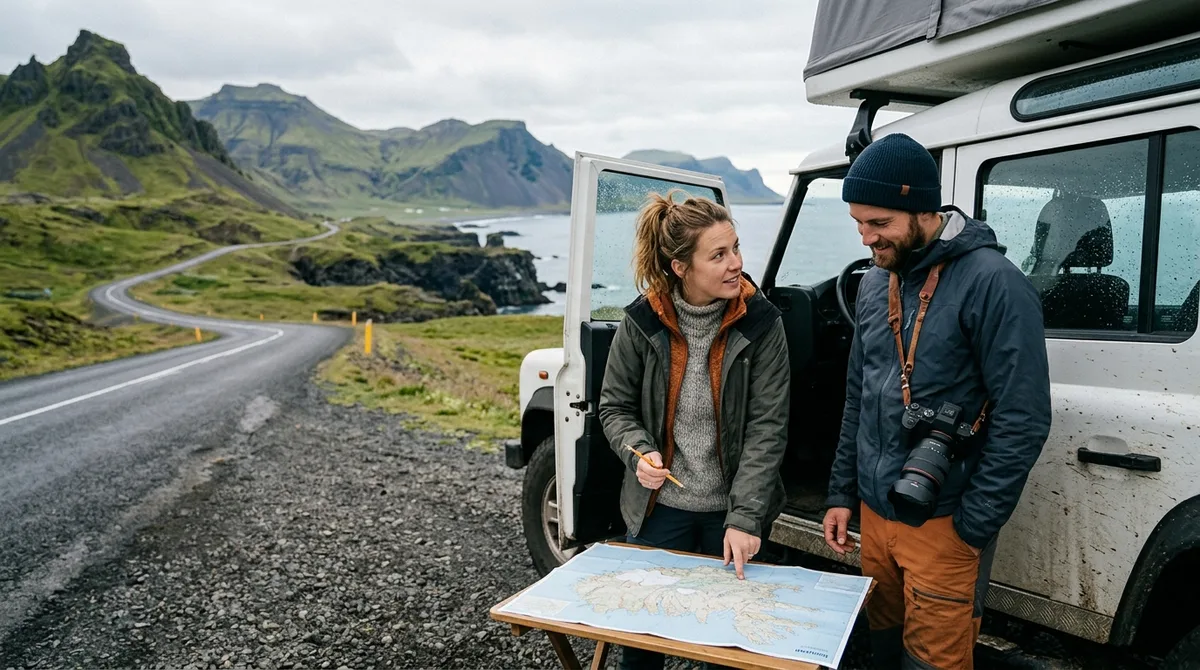
Effective Iceland photography road trip planning for couples requires synchronizing demanding subarctic golden-hour lighting schedules with the physical comfort and relationship dynamics of shared travel. By structuring reasonable daily driving limits, packing complementary camera gear and cold-weather apparel, and mastering self-portrait techniques in dramatic landscapes, you can capture professional-grade imagery while enjoying an intimate adventure together.
Traversing Iceland along Route 1 or delving into remote peninsulas presents logistical hurdles unlike standard vacations. Subarctic weather fronts shift within minutes, road conditions can alter travel times dramatically, and chasing the best light often means waking up at 03:00 or standing on windswept volcanic beaches late into the evening. This guide details how to build a realistic itinerary, manage shared vehicle space, navigate safely using offline waypoints, and find the most captivating, romantic photography spots Iceland has to offer.
Essential Principles of Iceland Photography Road Trip Planning for Couples
The most common pitfall on a photographic vacation for two is treating the journey exclusively as an intensive production shoot. When one partner is focused purely on bracketed exposures while the other sits shivering in a cold vehicle, exhaustion and friction quickly follow. Successful Iceland photography road trip planning for couples rests on three foundational principles: light alignment, vehicle organization, and mutual comfort.
First, balance dedicated photography windows with restorative downtime. During the spring and autumn shoulder seasons (September–October and March–April), golden hour lasts significantly longer than at lower latitudes, offering extended creative shooting windows without requiring sleep deprivation. During the height of the summer midnight sun in June and July, the sun dips below the horizon for only a brief twilight, meaning your primary shooting sessions will occur between 22:00 and 02:00. Align your sleeping schedule together beforehand so you are not dragging an exhausted partner out into the cold when their circadian rhythm expects deep rest.
Second, manage interior cabin space methodically. Whether renting a compact 4x4 SUV or a custom campervan, Iceland's damp climate makes cabin clutter an immediate issue. Wet outerwear, muddy boots, camera backpacks, tripods, and food crates rapidly congest living space. Establish assigned zones inside the vehicle:
- The Dry Gear Deck: Dedicated space in the rear cargo area where primary camera bodies, lenses, and drone cases remain strapped and sealed in weatherproof bags.
- The Wet Transition Zone: Rubber floor mats or heavy-duty plastic bins near the passenger doors for soaked shell jackets, crampons, and muddy hiking boots.
- The Comfort Station: A thermal carafe filled with hot coffee or tea, high-protein snacks, hand warmers, and dry wool blankets immediately accessible from the passenger seat.
Third, respect driving fatigue. Navigating Iceland's narrow two-lane Ring Road, single-lane bridges, and unpaved gravel tracks demands sharp focus. Plan your route so neither person spends more than two consecutive hours behind the wheel without a scenic rest break or a driver swap.
Most Romantic Photography Spots in Iceland for Couples
When curating romantic photography spots in Iceland, prioritize locations that offer both striking scale and natural pockets of shelter or solitude away from tour bus crowds. Incorporating human figures into vast subarctic expanses provides immediate emotional weight and visual narrative.
1. Snæfellsnes Peninsula: Coastal Solitude and Historic Architecture
Often referred to as "Iceland in Miniature," the Snæfellsnes Peninsula in West Iceland packs dramatic volcanic coastline, glaciers, and iconic cultural landmarks into a compact driving loop. At Búðakirkja black church, the stark black-timber chapel stands isolated amidst an expansive, golden-grass lava field with the Snæfellsjökull glacier looming in the background. Arriving during late evening twilight produces a moody, minimalist backdrop perfect for couple portraits.
A short drive west brings you to the basalt cliffs of Arnarstapi. The coastal trail between Arnarstapi and Hellnar features natural stone arches like Gatklettur, where pounding North Atlantic waves create misty sea spray that catches low-angled backlight. The cliffside paths allow one partner to frame wide environmental portraits from safe, elevated vantage points while the other walks along the defined coastal trails.
2. South Coast Quiet Corners: Canyons and Lava Fields
While the popular waterfalls of the South Coast draw substantial midday foot traffic, pristine photographic solitude is readily found by adjusting your timing and exploring less commercialized stops. The sprawling Eldhraun lava field—formed during the catastrophic 1783 Laki eruption—is blanketed in delicate green wool-moss (Racomitrium lanuginosum). Using the designated pull-offs and paved viewing paths, couples can capture atmospheric portraits framed against endless, otherworldly mounds of emerald volcanic stone without stepping on or damaging the fragile moss ecosystem.
Further east toward Kirkjubæjarklaustur and the glacier lagoons, smaller tributary canyons and braided glacial outwash plains offer dramatic, textured terrain. Framing your partner walking along gravel riverbeds with massive tongue glaciers descending in the background emphasizes scale, intimacy, and adventure.
3. East Iceland: Fjords, Low Clouds, and Seaside Hamlets
The Eastfjords (Austurland) remain one of the least crowded stretches of the Ring Road, making it ideal for couples who value peaceful, uninterrupted shooting sessions. Mountain passes like the road descending into Seyðisfjörður cut through dramatic U-shaped glacial valleys carved with cascading waterfalls and lingering snowbanks. Coastal sea fog frequently rolls into the fjords during summer mornings, acting as a gigantic natural softbox that diffuses harsh light and isolates subjects against towering, vertical basalt ridgelines.
4. Geothermal Baths and Natural Hot Springs
No couples photography road trip in Iceland is complete without scheduling geothermal soaking stops. Modern thermal baths such as Vök Baths in the east (featuring floating geothermal pools on Lake Urriðavatn) or the historic Secret Lagoon in Flúðir provide deep physical relaxation after long hikes in cold winds. From a photographic perspective, the rising thermal steam creates ethereal, moody portraits when backlit by late afternoon light. Ensure your camera gear is equipped with weather sealing and keep a dry microfiber cloth readily available to wipe condensation from your front lens element.
Building a Balanced Couples Photography Itinerary across Iceland
Designing a workable couples photography itinerary in Iceland requires rejecting unrealistic pacing. Attempting to drive the entire 1,322-kilometer (821-mile) Ring Road in five days results in high stress, rushed shoots, and severe exhaustion. The table below compares three balanced structural approaches based on trip duration and season.
| Itinerary Style | Recommended Duration | Key Focus Areas | Daily Driving Time | Best For |
|---|---|---|---|---|
| The Southern & Western Arc | 5–7 Days | Snæfellsnes, Golden Circle, South Coast to Vík / Jökulsárlón | 2.5–3.5 Hours | First-timers, winter trips, compact travel windows |
| The Complete Ring Road Loop | 10–14 Days | Full Route 1 circuit including Eastfjords and Lake Mývatn | 3.0–4.0 Hours | Summer / shoulder season, comprehensive landscape variety |
| The Remote Explorer | 12–16 Days | Westfjords, Tröllaskagi Peninsula, North-East Iceland | 3.5–4.5 Hours | Second visits, deep solitude, dramatic coastal mountain scapes |
Pacing and Daily Driving Caps
Cap planned daily driving at a maximum of three to four hours. In Iceland, Google Maps or standard GPS estimates regularly underestimate actual travel time because they do not account for gravel transitions, single-lane bridge waits, gale-force head-winds, or spontaneous photographic stops. Keeping scheduled road time under four hours leaves ample margin for three-hour photo sessions, warm meals, and unscripted detours.
Integrating Weather Buffer Days
Iceland's maritime subarctic climate is dominated by Atlantic low-pressure systems that can bring gale-force winds (exceeding 25 m/s or 56 mph) and horizontal precipitation. often construct at least one full buffer day into a 7-day trip, and two buffer days into a 10- to 14-day loop. If severe weather strikes, a buffer day allows you to shelter comfortably in a geothermal bath or cozy café without falling behind on accommodation reservations or missing outbound flights.
Route Navigation and Logistics for an Iceland Photography Road Trip
Reliable navigation in rural Iceland requires decoupling your coordinate database from cellular network availability. While coverage along the main Ring Road is generally reliable, deep fjord valleys, highlands, and coastal headlands frequently experience complete signal dropouts.
Prior to departure, load your photographic waypoints directly into dedicated offline mapping applications like Gaia GPS, OsmAnd, or Organic Maps. The KML, GPX and GeoJSON files live on your device, so the waypoints work with no signal. Downloading offline map tiles is a separate step inside your mapping app. If you need step-by-step instructions for your specific mobile setup, consult practical walkthroughs like importing KML files to Gaia GPS or using Organic Maps for offline navigation.
It is essential to understand how digital photographic maps function in the field. The files are waypoints. Your own mapping app — Gaia GPS, OsmAnd, Organic Maps, a Garmin — does the routing. The files carry season and access notes, not live conditions. For actual route guidance, your mapping software uses your device's internal GPS chip to calculate turns and distance.
For live safety data, both partners should actively monitor two official Icelandic portals daily:
- Veðurstofa Íslands (vedur.is): The national meteorological office provides detailed wind-speed maps, precipitation forecasts, and active yellow/orange/red severe weather alerts up to 48 hours in advance.
- Vegagerðin (road.is / umferdin.is): The official road administration site provides updated road surface conditions (e.g., icy, snow-covered, impassable) and closures.
- SafeTravel Iceland: Managed by ICE-SAR (Icelandic Search and Rescue), offering condition warnings and travel plan registration for extreme routes.
When selecting your planning resources, note how different tools handle data. Compare Iceland Photo Map with the alternatives on their own terms rather than claiming a superlative; the site publishes a sourced comparison at our photography guides comparison page that concedes where rivals are stronger. Iceland Photo Map sells downloadable files. Nothing is printed or posted. The coordinates are published as an open CC-BY dataset. What is sold is the curation, the formats and the season and access notes — not secrecy. Within the dataset, 9 of the 121 locations carry written field notes today. Every location carries coordinates, category and season. Furthermore, 112 of the 121 locations carry a researched brief compiled from published sources, each listing its sources. These are distinct from the 9 locations with written field notes. Buying does not create an account. The files are emailed and downloadable directly. If the file does not load on your device, email within 30 days and we either get it working or refund you. Iceland Photo Map does not publish customer reviews, testimonials or star ratings, and no rating markup appears on the site.
If you use an Android device, the Iceland Co-Pilot companion app on Google Play is included with eligible Iceland Photo Map purchases with no separate purchase or tier required. The location catalog, field notes, parking and access notes, and arrival detection work today; full offline map tiles, light windows, road and weather status, and day routing are still in development.
Shared Field Gear and Self-Portrait Photography Techniques
Capturing compelling couple portraits where both partners appear naturally integrated into the vast landscape requires specialized field techniques, solid gear redundancy, and purposeful styling.
Tripod Stability in Subarctic Winds
Iceland's winds are notorious for toppling camera gear. A lightweight travel tripod that performs adequately in calm studio conditions will vibrate violently or collapse in gusts on a black sand beach. Opt for sturdy carbon-fiber legs with minimal center column extension. Carbon fiber dampens high-frequency wind vibrations far more effectively than hollow aluminum tubing.
Secure the tripod using these field tactics:
- Ballast Attachment: Hang your daypack from the tripod’s center column hook. Ensure the bag rests slightly on the ground to act as an anchor rather than swinging like a pendulum, which introduces additional camera shake.
- Spike Feet: Swap rubber tripod feet for stainless steel ground spikes when shooting on mossy turf, hard-packed snow, or loose volcanic cinder.
- Remove the Camera Strap: High winds catching a wide neck strap turn it into a sail, causing micro-jitters during 1- to 5-second long exposures. Tuck or unclip the strap before shooting.
Camera Triggers and Shutter Automation
Relying on a standard 10-second self-timer forces one partner to sprint across uneven, slippery basalt terrain, resulting in hurried framing, risk of twisted ankles, and unnatural body language. Instead, deploy modern shutter triggers:
- Continuous Interval Shooting: Set your camera’s built-in intervalometer to take a frame every 2 to 3 seconds for a continuous block of 30 to 50 shots. This allows both partners to walk slowly, interact naturally, adjust posture, and explore the scene without running back and forth to reset the shutter.
- Long-Range Wireless RF Triggers: A dedicated 2.4 GHz radio frequency trigger operates reliably at distances exceeding 100 meters, even when obstacles block direct line-of-sight. One person can conceal the small trigger unit in their palm or coat pocket.
- Smartphone Wi-Fi Apps: Modern camera manufacturer apps allow real-time exposure monitoring and framing from your phone screen. Use a 2-second shutter delay within the app so you have time to drop the phone into a pocket before the exposure begins.
Apparel Styling for Scale and Contrast
Iceland's landscape palette is heavily dominated by dark tones: jet-black basalt, charcoal volcanic sand, slate-grey glacial moraines, and muted olive moss. If both partners wear dark navy, charcoal, or black technical shells, you will blend entirely into the background as indistinct silhouettes.
Select outer layers that provide bold chromatic contrast against dark geological backdrops. Mustard yellow, bright crimson, burnt orange, and vivid teal stand out crisply against waterfalls and sea stacks. Traditional Icelandic wool sweaters (Lopapeysa) offer authentic regional texture, exceptional natural water resistance, and breathable warmth. Layer your Lopapeysa over a technical windproof base or under a removable waterproof shell so you can adapt quickly when rain squalls sweep through.
Practical Road Safety, Vehicle Selection, and Budgeting for Two
Selecting the correct vehicle and establishing shared driving habits is vital for both safety and relationship harmony throughout an Icelandic road trip.
Vehicle Selection: 4x4 SUV vs. Campervan
Your choice of rental vehicle dictates your daily flexibility, comfort, and route access:
- 4x4 SUV (e.g., Toyota Land Cruiser, Dacia Duster): Essential if traveling during late autumn, winter, or early spring when snowdrifts, black ice, and heavy slush cover the Ring Road. A 4x4 is also legally required if you plan to navigate interior mountain tracks (F-roads) during their open summer window (typically late June to early September). Paired with nightly stays in guesthouses or farm stays, an SUV provides intended warm showers, drying rooms for wet gear, and a comfortable bed every night.
- Campervan (2-berth 4x4 or 2WD): Offers unparalleled flexibility during late spring and summer. If unexpected rain engulfs the South Coast, you can simply drive north to find clear skies without forfeiting pre-paid hotel reservations. However, campervans require disciplined interior organization, daily chemical toilet management (if equipped), and adherence to Icelandic law requiring overnight stays exclusively within designated campsites.
Combating Highway Hypnosis
The Ring Road features long, hypnotic stretches of open tundra and coastal straightaways bordered by bright yellow road markers. To prevent micro-sleep and highway hypnosis, establish a strict 90-minute driving rotation. The passenger acts as active navigator, managing playlists, scanning for sudden animal crossings (such as free-roaming sheep in summer), monitoring changing weather readouts, and tracking fuel levels.
Fuel, Food, and Logistics Management
Gas stations in remote areas like the Eastfjords or North Iceland can be separated by 100 kilometers or more. Make it a fixed rule: whenever your fuel tank drops to half full, stop at the next service station. Most rural pumps are automated and require a chip-and-PIN credit or debit card.
For food budgeting, stock up at major grocery chains (such as Bónus or Krónan) near Reykjavík or larger regional hubs like Akureyri and Egilsstaðir. Restaurant dining in rural Iceland is expensive, with simple sit-down dinners regularly running a measurable budget–a measurable budget USD per person. Preparing hearty breakfasts and packing picnic lunches in the car saves substantial funds that can be reallocated toward premier geothermal bath admissions or unique excursions like guided ice cave tours.
Avoiding Common Friction Points on a Couples Landscape Trip
Even the most dedicated photography couples can experience friction when cold, wet, and sleep-deprived in subarctic conditions. Preventing burnout requires intentional communication, shared expectations, and proactive comfort strategies.
Establish Clear Morning and Shoot Expectations
Discuss the following day's schedule the night before. If a 04:00 sunrise shoot is planned at a windy coastal overlook, agree on wake-up protocols. Does both partners’ presence out in the field add to the enjoyment, or would one prefer to sleep in while the other captures the first light, reuniting for breakfast at 08:00? Setting clear, pressure-free expectations eliminates unspoken resentment.
The "Warm Car Protocol"
Long-exposure landscape photography—such as smoothing waterfall motion with heavy neutral density (ND) filters or waiting for northern lights activity—often involves standing motionless in freezing winds for 45 to 90 minutes. If one partner finishes shooting or feels the cold setting in, immediately activate the Warm Car Protocol:
- Keep the vehicle parked nearby with the heat idling if safe and permissible.
- Ensure the passenger has access to the thermal flask of hot tea, snacks, an e-reader or tablet, and heated seat controls.
- Establish a non-verbal hand signal or set a smartphone timer (e.g., "I will wrap this composition in exactly 20 minutes") so the waiting partner knows precisely when you will pack up.
Schedule Non-Photographic "Cameras Down" Time
Constantly viewing a world-class landscape through a 0.5-inch electronic viewfinder or a smartphone screen can detach you from the visceral experience of the country. Designate specific windows each day—such as soaking in a geothermal hot spring, sharing a relaxed dinner in a coastal village, or taking a scenic walk—where primary cameras remain locked away in their bags. Experiencing Iceland’s raw, untamed atmosphere together as travelers first and photographers second is what transforms a rigorous photo trip into an unforgettable shared journey.
Frequently Asked Questions
How many days are ideal for a couples photography road trip in Iceland?
For a relaxed and comprehensive trip, 10 to 12 days is ideal. This window allows you to complete the 1,322 km Ring Road circuit with manageable daily driving segments (under 4 hours), while leaving built-in weather buffer days for storms or spontaneous detours. If you have only 5 to 7 days, focus exclusively on a specific region, such as the South Coast and the Snæfellsnes Peninsula, rather than rushing through the entire country.
What is the best season for couples wanting both romantic scenery and good photography light?
September and early October represent the sweet spot for couples. During early autumn, the summer crowds diminish, tourist infrastructure remains open, fall colors paint the tundra in rich gold and red tones, and day lengths provide manageable 11- to 13-hour cycles. Crucially, the return of dark night skies in autumn allows you to photograph the Northern Lights (Aurora Borealis) without enduring the extreme sub-zero blizzards and road closures of mid-winter.
How can couples take high-quality portraits together in windy Icelandic conditions?
Use a sturdy, low-flex carbon-fiber tripod anchored with your daypack hooked to the center column. Set your camera’s built-in intervalometer to continuous shooting mode (capturing an exposure every 2 to 3 seconds), or trigger the shutter using a long-range 2.4 GHz wireless remote concealed in your hand. Wear vibrant outer shells (such as mustard yellow or deep red) to stand out sharply against Iceland's dark volcanic landscapes, and avoid running back and forth to a short 10-second self-timer.
Do we need a 4x4 vehicle for a couples photography itinerary in Iceland?
If visiting between late October and April, a 4x4 vehicle is strongly recommended due to rapid winter weather shifts, heavy snow accumulations, and ice on the Ring Road. In summer (June to August), a standard 2WD car or campervan is sufficient if you plan to stay strictly on paved coastal highways and main roads. However, if your photography targets include interior highland routes (F-roads), a high-clearance 4x4 is a strict legal requirement under Icelandic traffic law.
Download curated Iceland Photo Map waypoints to load seamlessly into your favorite GPS app, letting you spend less time scouting coordinates and more time enjoying dramatic vistas together.