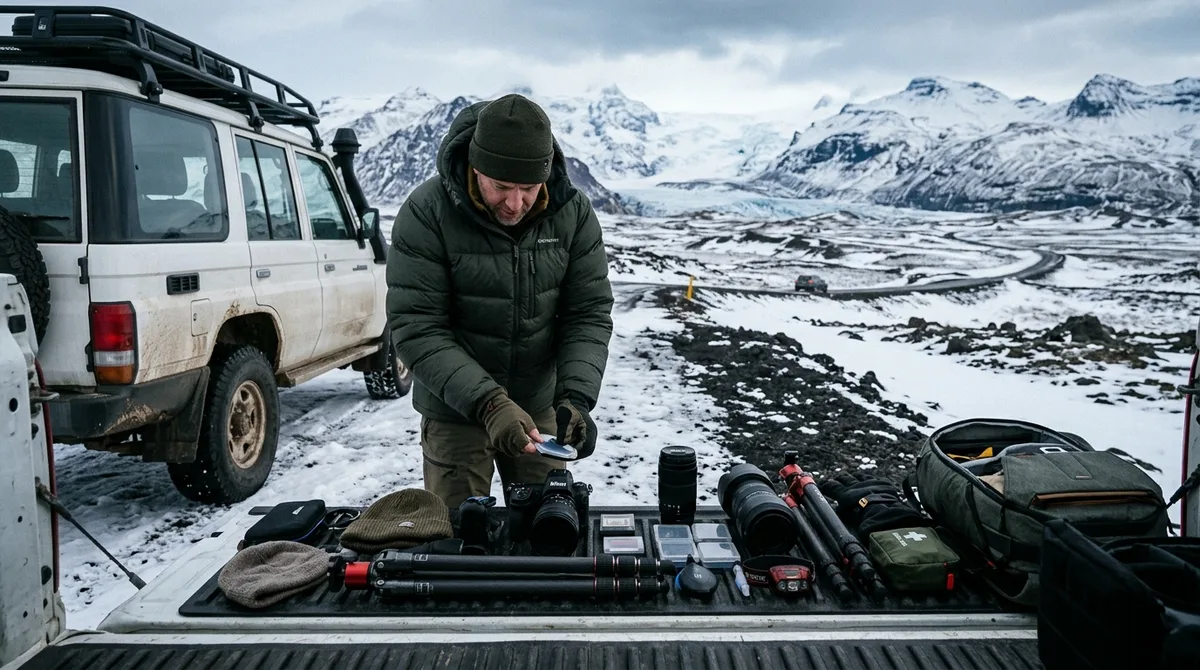
A successful winter shoot in the sub-Arctic requires a specialized gear strategy that balances thermal survival, hardware protection, and mobile field logistics. This definitive Iceland photography road trip packing list for winter outlines the exact technical apparel, optical gear, battery maintenance protocols, and emergency vehicle tools you need to stay operational in sub-zero maritime conditions.
Executing an Arctic photography expedition demands more than standard landscape equipment. Between hurricane-force gusts on coastal cliffs and sub-zero spray freezing instantly onto optical elements, having the right winter landscape photography gear determines whether you capture pristine imagery or suffer catastrophic equipment failure.
Arctic Conditions: What Your Winter Photography Gear Must Endure
These conditions place extraordinary stress on mechanical camera components, optical coatings, and electronic systems.
One of the most destructive hidden hazards is rapid thermal cycling. Transitioning an uninsulated camera body from a heated rental vehicle cabin directly into a -10°C ambient environment—and vice versa—causes rapid temperature differentials. When bringing freezing gear back into a warm, humid car, moisture immediately condenses inside lens barrels, behind rear elements, and across sensor glass, risking internal fungal growth and electronic short circuits.
Specific geological locations present aggressive environmental threats:
- Volcanic Sand Abrasion: Along coastal zones like Reynisfjara and the black sand plains of the South Coast region, gale-force winds propel basaltic tephra. This microscopic grit penetrates zoom rings, compromises rubber gaskets, and scratches exposed front elements.
- Glacio-Fluvial Spray: Major cascades such as Skógafoss and Seljalandsfoss generate vast plumes of mist. In sub-zero temperatures, this moisture supercools and flash-freezes across optical glass, tripod leg locks, and filter threads within seconds of exposure.
- Salt-Laden Marine Mist: High-energy Atlantic surf produces airborne saline moisture that coats front elements with a sticky, hydroscopic film that resists standard dry lens cloths.
Core Camera Hardware and Cold Weather Camera Protection
Selecting robust, weather-sealed equipment is essential for operating in the Arctic. While modern professional mirrorless systems feature magnesium alloy chassis and extensive silicone environmental sealing, supplementary cold weather camera protection is required when facing sustained wind-driven precipitation.
To minimize hazardous lens changes in blowing sand or snow, prioritize a versatile "holy trinity" zoom kit or fast weather-resistant primes:
- Ultra-Wide Zoom (14–24mm or 16–35mm f/2.8): Essential for expansive landscapes, ice caves, and capturing broad atmospheric aurora displays against dramatic foregrounds.
- Standard Mid-Range Zoom (24–70mm f/2.8 or 24–105mm f/4): The primary workhorse for capturing roadside vistas, dynamic seascapes, and architectural subjects.
- Telephoto Zoom (70–200mm or 100–400mm f/4–5.6): Critical for isolating distant volcanic peaks, mountain ridges, and compression shots of braided river systems.
Protecting these optical systems requires a disciplined defensive strategy in the field:
- Storm-Proof Rain Sleeves: Deploy heavy-duty polyurethane or coated ripstop nylon sleeves featuring cinchable optical ports and dedicated neoprene eyepiece attachments. Avoid thin, crinkly polyethylene bags, which shatter in sub-zero winds.
- Silicone Skins & Neoprene Wraps: Thick silicone body skins provide thermal insulation against freezing ambient air while cushioning bodies from accidental tripod impacts in icy terrain.
- Mechanical Barrel Maintenance: In heavy blizzard conditions, external zoom mechanisms can pull moisture into the barrel assembly as they telescope. Use internal zoom lenses where possible, or keep zoom barrels locked at a fixed focal length beneath a protective cover.
- The Ziplock Condensation Protocol: Before entering a warm vehicle or accommodation, place your cold camera and lenses inside heavy-duty, airtight gallon ziplock bags with a 50g silica gel packet. Seal the bag completely while still outside. Allow the equipment to warm up gradually over 45 to 60 minutes inside the sealed bag so condensation forms on the exterior plastic rather than across your internal electronics and sensor.
Power Strategy: Battery Care and Mobile Charging on Winter Road Trips
Chemical battery performance declines precipitously in sub-zero environments. Lithium-ion cells rely on liquid electrolytes that become viscous at lower temperatures, slowing ion transport between the cathode and anode. According to research on discharging lithium-ion batteries at low temperatures from Battery University, cold temperatures temporarily increase internal cell resistance, resulting in steep voltage drops under operating loads. This leads camera power management systems to register a battery as fully depleted even when substantial chemical energy remains stored inside.
To maintain continuous power across multi-hour winter landscape shoots, you must implement an active battery rotation cycle and an in-vehicle charging workflow.
Thermal Battery Rotation Protocol
rarely leave spare batteries inside an unheated backpack. Store active backup batteries in an interior, zippered base-layer pocket where your core body heat keeps them above freezing. When your camera alerts you to a depleted battery in the field, swap it with a warm internal spare. Place the cold, "depleted" cell back into your body-heated pocket; as its core temperature rises, the cell's internal resistance will decrease, restoring usable capacity for later shooting.
In-Vehicle Power Systems
Your vehicle is your primary mobile charging hub. A robust electrical setup should include:
- Pure Sine Wave Inverter (300W–500W): Plugs directly into your vehicle’s 12V auxiliary port to safely charge drone batteries, laptop workstations, and specialized camera charging docks without electrical harmonic distortion.
- High-Wattage USB-C Power Delivery (PD) Multi-Chargers: Fast 65W–100W dual-port adapters capable of charging modern mirrorless bodies and power banks simultaneously while driving between photo stops.
- Cold-Resistant Power Banks: Pack at least two 20,000mAh to 27,600mAh USB-C PD power banks rated for low-temperature operation. Store these inside insulated pouches alongside disposable air-activated hand warmers to prevent passive power drainage.
- Continuous External Power for Time-Lapses: When shooting multi-hour aurora or night-sky sequences, run an external USB-C dummy battery or direct PD tether from an insulated power bank wrapped with an active 5V thermal heating band. This bypasses internal battery limits entirely.
Tripods and Support Gear Built for Gale-Force Winds and Ice
To capture sharp long exposures at exposed coastal and glacial locations, your support system must prioritize mass, stiffness, and mechanical reliability.
Carbon Fiber vs. Aluminum in Freezing Climates
High-density carbon fiber is superior to aluminum for Arctic fieldwork. Carbon fiber features superior vibrational damping characteristics and does not conduct ambient cold into your hands as rapidly as metal. Aluminum leg sections contract in extreme cold, often seizing collar locks, and can become brittle when exposed to sub-zero freeze-thaw cycles combined with high-impact stresses.
| Support Criteria | Carbon Fiber (High-Density Multi-Layer) | Standard Aluminum Alloy |
|---|---|---|
| Vibration Damping | Superior absorption of high-frequency wind gusts | Transmits wind harmonic vibrations to camera sensor |
| Thermal Conductivity | Low conductivity; safer to handle with bare fingers | High conductivity; rapid skin freeze hazard |
| Locking Mechanism Reliability | Maintains consistent tolerances across thermal shifts | Prone to collar seizing due to metal contraction |
| Weight-to-Stiffness Ratio | Optimal; allows thick leg diameters without excess weight | Requires heavy mass to match comparable carbon stiffness |
Essential Tripod Adaptations for Winter Landscapes
Standard rubber tripod feet slip instantly on glacial sheet ice and hard-packed snow. Equip your tripod with 3-inch stainless steel spikes to anchor the legs directly into frozen turf or compact ice. For black sand beaches, attach wide snow/sand baskets above the spikes to keep the tripod from sinking into saturated volcanic sediment.
Cold temperatures also thicken standard petroleum lubricants inside tripod heads, causing ball heads and pan axes to bind or seize completely at -15°C. Select heavy-duty ball heads that utilize low-viscosity synthetic dry lubricants or grease-free PTFE-coated components. often ballast your rig by hanging your heavy camera bag from the center column hook, keeping the center of gravity low to prevent high-wind blow-overs.
Layering Systems for Your Iceland Photography Road Trip Packing List for Winter
Photographing dynamic sub-Arctic landscapes involves alternating between long, stationary waits during aurora vigils and intense physical exertion while hiking up snowy mountain trails. Managing your body's microclimate requires a technical three-tier layering system based on moisture management, insulation, and environmental protection.
When compiling your Iceland photography road trip packing list for winter, prioritize natural wools and advanced synthetics over cotton, which retains moisture and drastically increases the risk of hypothermia.
1. Next-to-Skin Base Layer (Moisture Regulation)
Wear heavyweight (250–300 g/m²) merino wool top and bottom baselayers. Merino wool wicks sweat away from your skin during strenuous hikes while retaining its insulating properties even when damp.
2. Intermediate Thermal Mid-Layers (Static Warmth)
Combine a breathable high-loft grid fleece with an insulated jacket. For active daytime shoots, a synthetic mid-layer (such as PrimaLoft Gold or Coreloft) excels because it resists internal condensation. For long, stationary night shoots, pack an expedition-weight 800+ fill-power hydrophobic down parka designed for sub-zero static exposure.
3. Weatherproof Outer Shell (Gale & Sleet Defense)
Your outer layer must consist of a rugged, 3-layer GORE-TEX Pro or equivalent hardshell jacket and matching bib trousers with fully taped seams. The shell must be windproof and waterproof to protect against horizontal sleet and ocean spray near coastal landmarks.
Photographer-Specific Glove Systems
Standard ski gloves make it impossible to adjust camera dials or access touchscreen menus, leading photographers to remove their gloves and risk frostnip. Implement a modular handwear system instead:
- Base Liner: Form-fitting merino wool or Polartec Power Stretch liner gloves with high-sensitivity conductive fingertips for operating dials and rear LCDs.
- Outer Shell: Heavyweight windproof photography mittens featuring fold-back magnetic finger caps and thumb flaps, allowing instant manual dexterity without removing the insulated mitten body.
- Thermal Boost: Insert air-activated chemical hand warmers into dedicated zippered pockets built into the backs of the photography mittens.
Footwear, Traction, and Facial Protection
Cold feet will cut a photo shoot short faster than almost anything else. Pack high-cut, waterproof, insulated winter boots rated to at least -20°C, paired with thick merino wool expedition socks. Pack high-performance traction aids like Kahtoola MICROspikes or aggressive crampons; walking on frozen trails near locations featured in our waterfalls directory without reinforced steel spikes presents an immediate fall hazard.
To protect exposed facial skin from wind-blown volcanic dust and ice pellets, pack a windproof fleece-lined balaclava, a merino neck gaiter, and polarized, anti-fog storm goggles.
Night Sky and Aurora Kit: Staying Operational in the Dark
Photographing the aurora borealis requires specialized optics and environmental controls designed for multi-hour night vigils in sub-zero conditions. A complete aurora photography kit requires dedicated hardware to prevent frost accumulation and maintain pinpoint focus in low light.
Fast wide-angle prime lenses (f/1.4, f/1.8, or f/2.8) with focal lengths between 14mm and 24mm maximize light gathering, allowing you to keep exposure times between 2 and 8 seconds to freeze dynamic structural ribbons in the aurora. However, exposed front elements radiate heat into the clear night sky, causing surface glass temperatures to drop below the ambient dew point and forming frost patterns across your frame.
Prevent frost accumulation by installing a 5V USB-powered lens heater strip around the objective barrel just behind the front element. Power the heating element continuously via a portable power bank secured to the tripod leg. often verify manual infinity focus using a bright star or distant landmark via magnified live view, and use gaffer tape to lock the focus ring in position against accidental bumps in the dark.
Equip yourself with a headlamp featuring a dedicated, high-lumen red LED mode. Red light preserves your eyes' natural scotopic vision and prevents stray light from contaminating your own or neighboring photographers' long exposures. Additionally, pack a hardwired shutter release cable or intervalometer; wireless smartphone apps drain mobile device batteries rapidly in freezing conditions and are difficult to operate with heavy gloves.
Navigation Tools and Vehicle Emergency Gear for Winter Road Trips
Winter road trips across Iceland demand complete navigation and vehicle self-reliance. Cellular coverage is generally strong along Ring Road 1, but deep fjord systems, mountainous passes, and remote coastal valleys can quickly drop your mobile connection.
Prepare your field navigation before departing by loading full coordinate datasets into offline mapping tools. If you use Gaia GPS, you can import KML files into Gaia GPS for offline field access. Similarly, outdoor photographers utilizing dedicated hardware can follow steps to import Garmin GPX offline waypoints to ensure route access independent of local cell networks. The KML, GPX and GeoJSON files live on your device, so the waypoints work with no signal. Downloading offline map tiles is a separate step inside your mapping app.
Safe winter travel also requires daily monitoring of regional authorities. The files carry season and access notes, not live conditions. Check vedur.is and road.is for current weather and road status before setting out each morning. The Icelandic Meteorological Office (Veðurstofa Íslands) issues critical yellow, orange, and red weather alerts for approaching gale-force systems, while Road.is (Vegagerðin) provides essential infrastructure reports detailing mountain pass closures, black ice hazards, and blowing snow conditions across the national road network.
Your rental vehicle should be a high-clearance 4x4 fitted with studded winter tires. Equip your vehicle with the following mandatory safety and emergency items:
- Heavy-duty telescopic snow shovel and brass-edge ice scrapers.
- A lithium-ion jump starter power bank should be kept inside the vehicle cabin for emergencies.
- Heavy-duty kinetic tow recovery strap and rated D-shackles.
- Two-way satellite communication messenger (such as a Garmin inReach or ZOLEO) for emergency SOS signaling outside cellular range.
- Emergency thermal foil bivy sacks and chemical body-warmer packs.
- High-visibility reflective safety vests are strongly recommended when stepping onto road shoulders.
The Master Iceland Photography Road Trip Packing List for Winter Checklist
Use this comprehensive packing checklist to audit your gear inventory before packing your bags for departure.
1. Camera Bodies, Optics & Support
- [ ] 2x Weather-sealed full-frame camera bodies (primary and operational backup)
- [ ] Ultra-wide fast lens (14–24mm f/2.8 or prime equivalent)
- [ ] Standard zoom lens (24–70mm f/2.8 or 24–105mm f/4)
- [ ] Telephoto zoom lens (70–200mm f/2.8 or 100–400mm)
- [ ] Heavy-duty carbon fiber tripod with spiked feet
- [ ] Fluid/ball head with low-temperature synthetic lubrication
- [ ] Neutral density (ND) and circular polarizing (CPL) filters
- [ ] Rocket air blower and 20+ individually sealed microfiber lens cloths
- [ ] Storm-proof camera rain cover / polyurethane cold covers
- [ ] Airtight heavy-duty gallon ziplock bags with 50g silica gel desiccant packs
2. Power, Cables & Electronics
- [ ] 5–6x Dedicated OEM camera batteries
- [ ] Dual-channel fast battery charger
- [ ] 300W–500W Pure sine wave 12V vehicle inverter
- [ ] 2x 20,000mAh+ USB-C PD power banks rated for low temperatures
- [ ] 5V USB-powered optical lens heater strips
- [ ] Hardwired intervalometer / shutter release cable
- [ ] High-speed UHS-II / CFexpress memory cards (cold-rated)
- [ ] Red LED headlamp with extra AAA batteries or USB charging lead
- [ ] Multi-outlet travel power strip with European Type C/F plugs
3. Specialized Cold-Weather Apparel
- [ ] 2–3x Heavyweight merino wool thermal base-layer tops and bottoms
- [ ] Polartec or grid fleece intermediate insulation layers
- [ ] Hydrophobic down parka (800+ fill power) or heavy synthetic jacket
- [ ] 3-Layer GORE-TEX Pro waterproof/windproof shell jacket
- [ ] 3-Layer GORE-TEX waterproof/windproof shell pants or bibs
- [ ] Modular photography gloves (conductive liner gloves + fold-back insulated mitts)
- [ ] Insulated, waterproof winter boots (rated to -20°C or lower)
- [ ] 4–5x Heavyweight merino wool expedition socks
- [ ] Kahtoola MICROspikes or steel crampons
- [ ] Windproof fleece balaclava and merino wool neck gaiter
- [ ] Polarized anti-fog ski/storm goggles
- [ ] 20+ Air-activated chemical hand and toe warmers
4. Vehicle Safety, Emergency & Navigation
- [ ] Offline navigation app preloaded with full KML/GPX waypoint datasets
- [ ] Two-way satellite communication device (Garmin inReach / SOS messenger)
- [ ] High-output lithium jump starter pack (1500A+)
- [ ] Heavy-duty telescopic snow shovel
- [ ] 1-Liter stainless steel insulated vacuum thermos for hot liquids
- [ ] Emergency thermal space blanket / foil bivy sack
- [ ] High-visibility reflective vest
- [ ] Multi-tool / heavy-duty pliers for frozen tripod collar adjustments
When packing for air transit, check commercial airline safety regulations: all spare lithium-ion batteries and high-capacity power banks must be carried in your cabin baggage. rarely pack loose lithium cells in checked luggage due to cargo fire safety regulations.
Frequently Asked Questions
How many camera batteries do I need for a winter photography trip to Iceland?
Pack a minimum of 4 to 6 original equipment manufacturer (OEM) batteries per camera body. In sub-zero temperatures, battery output can drop by many to many due to increased internal resistance. Keeping 2 warm spares in an inside jacket pocket and recharging depleted cells via a 12V vehicle inverter during drive times will keep you shooting continuously throughout the day.
How do I prevent camera lens condensation when getting back into the car?
Seal your cold camera and lenses inside an airtight ziplock bag with a silica gel desiccant packet before stepping out of the cold and into a warm car cabin or hotel room. Leave the equipment sealed inside the bag for 45 to 60 minutes so the temperature can equalize slowly; this ensures that ambient moisture condenses on the outside of the bag rather than on your internal camera optics and sensor glass.
Do I need microspikes or full crampons for shooting winter waterfalls?
Microspikes (such as Kahtoola MICROspikes) are essential for navigating standard winter trails, parking lots, and icy waterfall viewing platforms. If you plan to descend steep, glaciated slopes, walk on frozen outlet tongues, or approach close-range spray zones around dynamic waterfalls, upgrade to semi-rigid, 10-point to 12-point mountaineering crampons paired with B2-rated winter boots for secure footing.
Can standard aluminum tripods break in Iceland's sub-zero winter temperatures?
Standard aluminum tripods rarely shatter outright, but they perform poorly in Arctic conditions. Aluminum contracts significantly in sub-zero temperatures, which can cause twist-lock collars to freeze or bind. Aluminum also conducts cold rapidly to your hands and lacks the vibration-damping capacity of carbon fiber when subjected to 40+ knot wind gusts on coastal cliffs.
How do I keep my camera dry while shooting near freezing waterfalls like Skógafoss?
Use a professional, fitted polyurethane rain cover with cinched lens openings rather than disposable plastic bags. Keep your lens cap on until your tripod is locked and your framing is set. Use a dedicated lens hood to deflect airborne spray, and carry plenty of dry microfiber cloths in a warm pocket to dab the front element dry immediately before opening the shutter.
Explore our curated GPS waypoints and seasonal shooting notes to plan your route efficiently, and download the KML/GPX files to your navigation app for offline field access across Iceland. Discover our complete library of verified photo locations across the Iceland Photo Map catalog to streamline your winter itinerary.