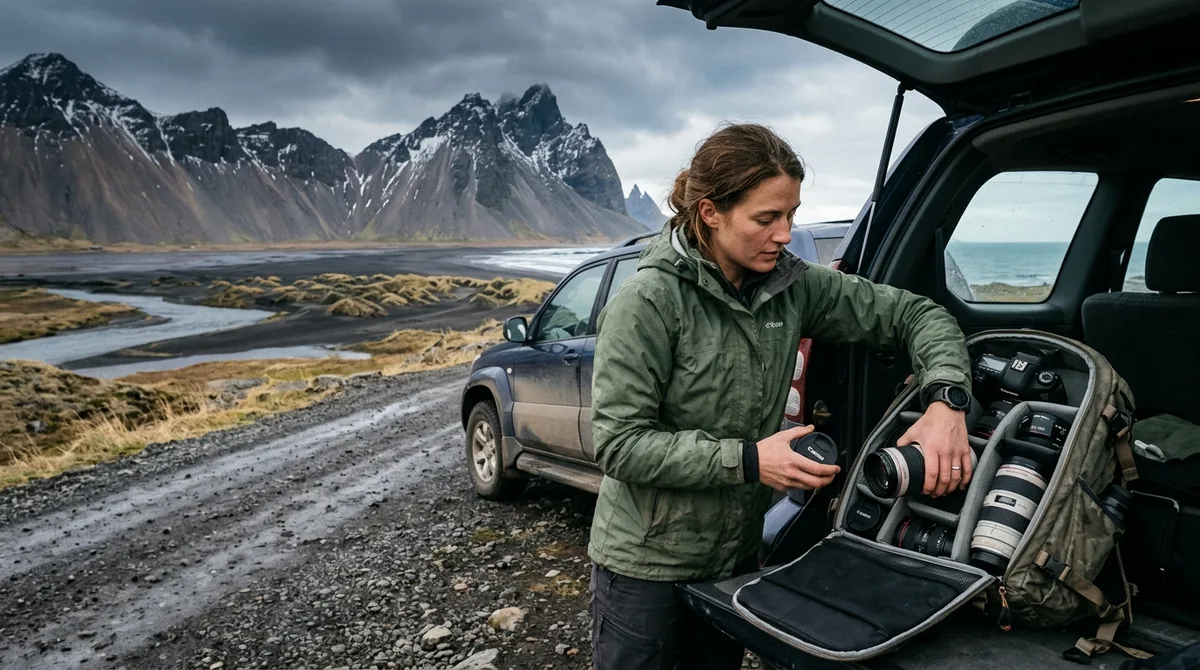
Choosing to rent specialized camera lenses in Reykjavik rather than hauling heavy, fragile glass through international airports saves vital carry-on weight, eliminates transit damage risks, and gives you direct access to high-end, weather-sealed optics suited for harsh subarctic weather. This comprehensive Iceland photography lens rental guide breaks down the optimal focal lengths for every region, rental shop logistics, damage liabilities, and field durability practices you need to capture Iceland's demanding terrain without compromising your gear or your mobility.
Pack or Pick Up: Strategic Reasons to Rent Glass for Subarctic Expeditions
Transporting photographic equipment across the North Atlantic presents logistical friction that many landscape photographers underestimate. Transatlantic and European carriers servicing Keflavík International Airport (KEF)—including Icelandair, Play, and regional flag carriers—strictly enforce carry-on baggage dimensions and weight thresholds. Cabin luggage limits typically fluctuate between 8 kg and 10 kg (17.6 to 22 lbs). A dedicated camera backpack containing two pro-grade mirrorless bodies, a standard f/2.8 zoom trinity (14–24mm, 24–70mm, 70–200mm), robust L-brackets, filter pouches, and batteries routinely exceeds 12 kg to 14 kg. Checking critical camera glass into aircraft holds exposes thousands of dollars of sensitive optical alignment mechanisms to sub-zero cargo holds and rough handling.
Opting to secure heavy super-telephoto lenses or specialized wide-angle optics upon arrival drastically mitigates this operational liability. By reserving equipment for in-country pickup, you preserve your carry-on allowance for your camera bodies, core batteries, and personal essentials. Furthermore, renting locally transfers the logistical risk of accidental airline loss, delayed luggage connections, and in-transit impact damage to a scheduled, intended local handoff.
Renting also enables economical access to specialized, top-tier optics you might not own. Fast f/1.4 or f/1.8 wide-angle primes dedicated to aurora borealis imaging, or massive 400mm to 600mm telephotos needed for coastal bird cliffs, carry steep capital costs. Instead of purchasing glass that sits dormant on a home shelf for the rest of the year, local rental lets you mount native-mount, professional-tier glass—such as Sony G Master, Canon L-series, or Nikon S-line optics—solely for the duration of your trek.
Iceland Photography Lens Rental Guide: Match Focal Lengths to Diverse Landscapes
Iceland's geological diversity requires deliberate lens selection. Subarctic lighting changes rapidly, and coastal weather frequently forces compositions under high-velocity wind and driving moisture. A proper Iceland photography lens rental guide must consider not just field of view, but also optical performance under severe environmental constraints.
| Focal Range | Primary Field Utility | Key Iceland Locations | Recommended Rental Models |
|---|---|---|---|
| 14–24mm / 16–35mm (Ultra-Wide) | Interior ice caves, massive basalt canyons, dynamic foreground sea stacks, night aurora displays. | Stuðlagil Canyon, Katla Ice Cave, Reynisdrangar, Vestrahorn. | Sony FE 14-24mm f/2.8 GM, Canon RF 15-35mm f/2.8L, Nikon Z 14-24mm f/2.8 S. |
| 24–70mm (Standard Zoom) | General landscape framing, mid-distance coastal vistas, stormy squalls where swapping lenses risks camera sensor exposure. | Skógafoss, Diamond Beach, Thingvellir, Kirkjufell. | Sony FE 24-70mm f/2.8 GM II, Canon RF 24-70mm f/2.8L, Nikon Z 24-70mm f/2.8 S. |
| 70–200mm / 100–400mm (Telephoto Zoom) | Compressing distant volcanic ridges, isolating glacial braiding, mountain peaks, calving glacier tongues. | Landmannalaugar, Fjallsárlón, Kerlingarfjöll, Highland riverbeds. | Sony FE 70-200mm f/2.8 GM II, Canon RF 100-500mm f/4.5-7.1L, Nikon Z 100-400mm f/4.5-5.6 S. |
Ultra-wide-angle lenses (14–24mm or 16–35mm) are mandatory for tight, dramatic environments. Inside natural subarctic ice caves formed within the Kötlujökull or Vatnajökull ice sheets, tight quarters demand focal lengths wider than 20mm to capture both the sculpted ceiling ice and foreground meltwater channels. Similarly, framing monolithic basalt columns alongside pounding North Atlantic surf requires dramatic optical expansion to keep nearby sea stacks from losing their imposing scale.
The standard 24–70mm f/2.8 zoom functions as an expedition workhorse. During gale-force conditions along the southern shoreline, airborne black sand and horizontal drizzle create an environment hostile to open lens mounts. Exposing an open camera chamber to airborne basalt dust invites sensor contamination and internal shutter degradation. A sealed 24–70mm allows you to shoot broad coastal scenes, intermediate geological textures, and medium waterfall vistas without detaching the optic during inclement weather.
Conversely, many landscape photographers arrive in Iceland without realizing how critical telephoto compression is. A 70–200mm or 100–400mm zoom allows you to isolate patterns across distant volcanic terrain. When looking across high-altitude plains, wide-angle lenses tend to flatten dramatic peaks into insignificant background strips. A telephoto lens compresses distance, stacking braided glacial outwash plains, steaming geothermal fumaroles, and jagged volcanic peaks into layered, high-impact compositions.
Finding the Best Focal Length for Iceland Landscapes by Geographic Terrain
Selecting the best focal length for Iceland landscapes depends directly on the specific regions and geological features mapped across your route.
Along the South Coast, massive cascades and volatile black sand beaches dominate the landscape. When framing iconic waterfall photography locations such as Skógafoss or Seljalandsfoss, an ultra-wide focal length can place you dangerously close to the turbulent spray zone. A focal length between 24mm and 35mm provides the ideal compromise: it maintains enough width to capture falling plumes and surrounding green cliffs, while giving you sufficient working distance to protect the front glass element from heavy mist.
Venturing into the Highlands (F-Roads like Fjallabaksleið Nyrðri to Landmannalaugar) changes the compositional equation entirely. Here, the landscape features repeating rhyolite mountains stripped bare of vegetation, intersected by intricate braided river systems. The best focal length for these environments shifts squarely to 70–300mm. By standing on elevated ridgelines and using telephoto focal lengths, you isolate the surreal color gradients—ochre, sulfur yellow, obsidian black, and moss green—compressing intricate river braids into dynamic geometric abstracts.
For wildlife photographers targeting the coastal sea cliffs between mid-May and mid-August, focal requirements change again. While Atlantic puffins nesting at Borgarfjörður Eystri or the Látrabjarg cliffs can occasionally be approached within several meters, ethics and local conservation regulations dictate keeping a respectful distance. To capture tight behavioral portraits, flight shots against oceanic backgrounds, or nesting interactions without encroaching on fragile burrowing ground, a dedicated 400mm or 600mm telephoto lens is indispensable. Carrying these hefty lenses on flights is impractical, making local rental the most logical approach for dedicated bird photography.
Renting Camera Gear in Reykjavik: Shop Logistics, Advance Booking, and Returns
Successfully renting camera gear in Reykjavik requires understanding regional retail logistics. The primary professional camera rental infrastructure in Iceland is centered in the capital city, Reykjavik, rather than at Keflavík Airport.
Specialized gear rental companies and photographic pro shops—such as Reykjavík Foto and Beco—stock extensive native lens collections for Sony E-mount, Canon RF-mount, Nikon Z-mount, and cinema platforms. However, pickup logistics require strategic planning:
- Geographic Location & Airport Transit: Keflavík International Airport sits roughly 50 kilometers (31 miles) southwest of Reykjavik. Standard rental shops do not operate permanent pickup counters inside the airport terminal. Photographers arriving on early morning international flights must collect their expedition vehicles, drive into Reykjavik via Route 41, and schedule their gear collection during local commercial operating hours.
- Operating Hours & Weekend Closures: Standard retail operations in Iceland typically run Monday through Friday from 09:00 to 18:00, with truncated hours on Saturdays and frequent full closures on Sundays. If your itinerary involves landing late on a Saturday or departing early on a Sunday morning, you must arrange out-of-hours pickup or drop-off lockers with the rental provider ahead of time.
- Seasonal Lead Times: Demand for professional camera gear peaks twice a year: the midnight-sun summer window (June through August) and the core aurora-viewing season (September through March). Super-telephotos (100–400mm, 400mm f/2.8) and ultra-fast wide primes (14mm f/1.8, 24mm f/1.4) are in limited supply. For a trip planned using a structured 7-day Iceland photography itinerary, reserve your rental glass in advance and confirm mount compatibility.
- Deposits and Credit Authorizations: Local rental shops place a pre-authorization hold on a major credit card matching the equipment's replacement or deductible value. Ensure your domestic credit card limits accommodate several thousand dollars in temporary authorizations without triggering fraud holds or limiting your travel spending power.
Insurance coverage boundaries require meticulous review. Standard photographic equipment rental insurance usually covers mechanical failure and accidental drop damage under normal operation. However, virtually all subarctic equipment rental contracts contain explicit liability exclusions for environmental contamination. Volcanic black ash ingestion, damage from saltwater spray immersion, and catastrophic wind-blown grit are frequently excluded from standard damage waivers. Inspect the fine print regarding your personal financial liability should a catastrophic gust pull a lens down at a volcanic black sand beach.
Field Durability Checklist in an Iceland Photography Lens Rental Guide Context
When assembling your gear list, optical quality alone is not enough; mechanical construction matters just as much. The subarctic climate actively penalizes flimsy equipment. Review this field durability checklist before finalizing your rental contract:
1. Zoom Mechanism: Internal vs. External Barrel Extension
Lenses with internal zoom mechanisms (such as standard 70–200mm f/2.8 designs) keep optical elements moving entirely inside a fixed, sealed outer barrel. Conversely, many compact zooms feature barrels that telescope outward as focal lengths change. In dry volcanic plains—such as the black sand desert of Skeiðarársandur—or along windblown coastal plains, high winds blast micron-sized basalt dust across your rig. Telescoping barrels can draw abrasive dust past internal felt wipers directly into the zoom helicoids, causing grinding and mechanical failure. Whenever possible, choose internally zooming lenses.
2. Mount and Gasket Weather Sealing
rarely take entry-level or non-weather-sealed optics into an Icelandic storm. Verify that every rental lens features a substantial, pliable rubber gasket along its metallic bayonet mount. This gasket creates a compression seal against your camera's lens mount, preventing moisture from creeping into the electronic contacts or sensor box. Professional lines (Canon L-series, Sony GM, Nikon S-line) feature extensive internal O-rings around switches, zoom rings, and front optical groups designed to withstand driving rain.
3. Front Element Thread Compatibility
Many ultra-wide lenses feature bulbous, protruding front elements without filter threads, requiring massive, specialized 150mm filter holders. If you plan to shoot daytime long exposures using Neutral Density (ND) filters or need a Circular Polarizer (CPL) to cut glare off wet volcanic basalt, confirm whether your rental lens accepts standard screw-in filters (such as 77mm or 82mm threads) or requires an external rigging adapter. Bringing a set of 82mm filters is useless if your rented ultra-wide features an integrated, curved lens hood.
Protecting Rented Glass from Spray, Basalt Dust, and Freezing Fog
Returning rented glass without damage fees requires practical field care. Iceland's elements attack camera equipment through abrasive mechanics, fine mist, and thermal shock.
Basalt sand is fundamentally crushed volcanic glass: it is extremely sharp and abrasive. If wind deposits dark volcanic dust on your lens's front element, rarely wipe it with a microfiber cloth . Dry wiping immediately grinds microscopic glass particles into the front element's anti-reflective coatings, leaving permanent scratches that will trigger total element replacement fees upon return. Instead, carry a high-output rubber rocket blower to physically dislodge loose particles first. If stubborn residue remains, apply liquid optical cleaning fluid generously to float the grit before gently dabbing with a fresh lens tissue.
Waterfalls create heavy, continuous spray zones that challenge front elements. At locations like Aldeyjarfoss, falling water mixes with powerful canyon downdrafts, creating persistent, swirling mist. Shield your rented gear using dedicated waterproof rain sleeves. Keep your lens cap on while framing your composition, step back from the direct spray line to set your tripod, frame the shot, and use a dedicated absorbent microfiber towel to wipe the front element clear one second before releasing the shutter. After shooting, quickly replace the lens cap before adjusting compositions.
Condensation is another hazard when moving between environments. In winter and shoulder seasons, shooting at sub-zero temperatures followed by entering a heated expedition vehicle causes warm, humid air to condense on cold metallic and glass surfaces. Internal condensation can lead to internal moisture trapped between lens groupings. To prevent this, seal your camera and rented lenses inside your camera backpack before entering the vehicle. Let the entire pack warm up gradually over 30 to 45 minutes, allowing ambient temperature changes to equalize safely without condensation forming on internal glass surfaces.
Navigating to Remote Compositions with Offline Navigation Files
Having optimal focal lengths does little good if you waste fleeting subarctic light searching for unmarked pull-offs, access tracks, or precise vantage points. Iceland's most compelling vantage points often sit far from paved roads, where cellular infrastructure drops out entirely behind deep valleys, sea cliffs, and mountain passes.
Relying on live mapping apps or spotty cellular data to locate compositions is a common planning error. When sudden squalls or shifting cloud breaks illuminate a distant ridge, you need instant clarity on your vehicle's physical relationship to the landscape. Importing structured navigation files into a dedicated device or offline mapping tool allows you to pull directly into designated parking areas, locate marked footpaths, and align your telephoto or ultra-wide setups before changing light windows vanish.
Setting up your workflow in advance is straightforward: you can use a step-by-step Gaia GPS import guide to load structured spatial datasets directly into your mobile device. The KML, GPX and GeoJSON files live on your device, so the waypoints work with no signal. Downloading offline map tiles is a separate step inside your mapping app. Because Icelandic mountain passes and interior tracks change status dynamically based on seasonal snowpack and thaw cycles, travelers must maintain active situational awareness. The files carry season and access notes, not live conditions. Check vedur.is and road.is for current weather and road status, as well as general travel guidance from safetravel.is before setting out on any unpaved or Highland F-road.
Frequently Asked Questions
Is it cheaper to rent lenses in Reykjavik or carry them from home?
For standard focal lengths you already own (such as a 24–70mm workhorse), carrying your own glass is generally more economical than local rentals. However, for specialized glass—such as a 400mm f/2.8 for puffin colonies or a 14mm f/1.4 for aurora photography—renting in Reykjavik is often more cost-effective than buying a lens for a single expedition, paying airline overweight luggage fees, or buying third-party international travel insurance riders.
What is the single best focal length for Iceland landscapes if I only take one lens?
If you must limit yourself to a single lens, a professional 24–70mm or 24–105mm f/4 weather-sealed zoom is the best focal length for Iceland landscapes. It covers everything from wide coastal seascapes and expansive waterfalls at 24mm to compressed ridgelines and isolated geological formations at the long end, all while keeping your camera mount safely sealed against volcanic ash and rain.
Does standard equipment rental insurance cover damage from volcanic black sand or waterfall spray?
Typically, no. Most photographic equipment rental contracts and credit card travel insurance policies include specific exclusions for environmental hazards, including volcanic ash abrasion, sand ingestion, and water damage caused by salt spray or waterfall mist. Renters are generally held liable for the full repair or replacement cost of glass damaged by abrasive wiping or water infiltration. often confirm exclusions directly with your rental provider.
Can I pick up and drop off rented camera gear outside Reykjavik or at Keflavik Airport?
Most professional gear rental shops are located in downtown or suburban Reykjavik, roughly 45 minutes from Keflavík International Airport. While some shops offer courier delivery to airport hotels or provide after-hours secure locker pickups for an additional fee, drive-up airport terminal collection is generally unavailable. Plan your arrival and departure schedule around shop business hours.
Pair your rented lenses with precision waypoint coordinates. Iceland Photo Map sells downloadable files. Nothing is printed or posted. The KML, GPX and GeoJSON files live on your device, so the waypoints work with no signal, helping you reach optimal vantage points before the light fades.