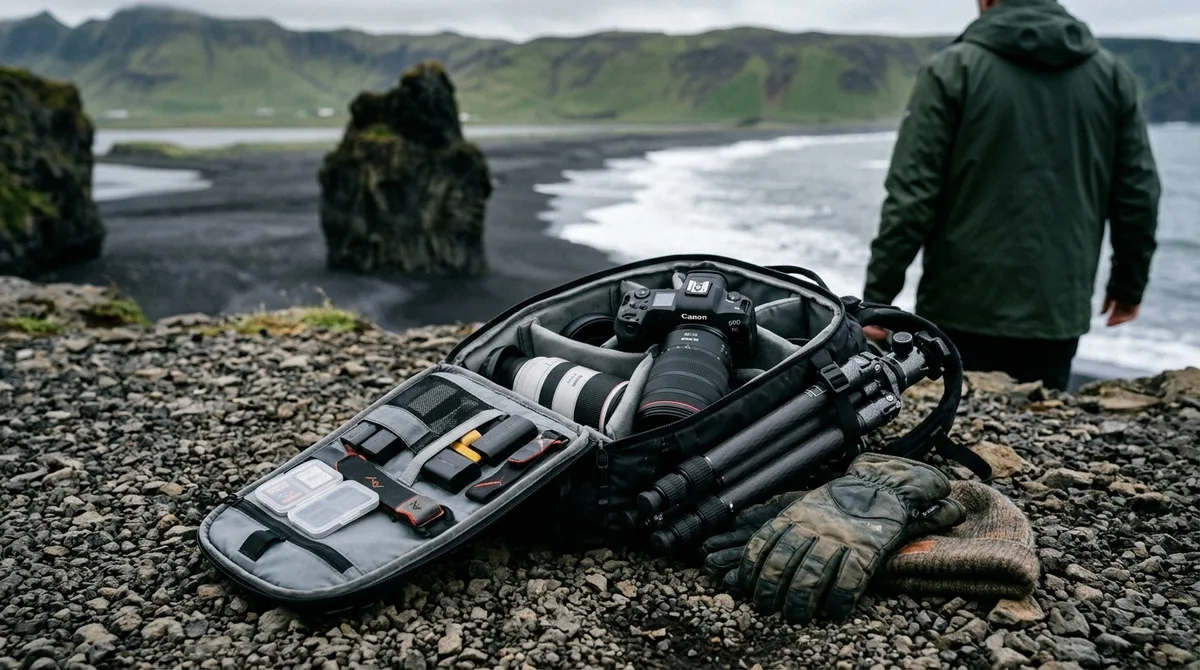
The short answer: an Iceland photography packing list in one paragraph
An effective Iceland photography packing list covers camera gear, weather protection, and offline navigation files. For hardware, pack a weather-sealed camera body, a 16-35mm wide lens, a 70-200mm telephoto lens, a sturdy tripod with a ballast hook, four spare batteries, two fast memory cards, a circular polariser, a 6-stop neutral density filter, and a rain cover. For clothing, pack merino base layers, a fleece mid-layer, a taped-seam waterproof jacket, waterproof over-trousers, and touchscreen liner gloves. For navigation, store waypoint coordinates as GPX, KML, or GeoJSON files on your phone before departure. The files provide exact coordinates; your mapping app handles routing once cellular service drops.
Essential camera gear for Iceland: what earns its weight
Self-drive landscape photography requires strict weight control. You must balance airline carry-on limits against sub-Arctic field demands. Pack light. You do not need five prime lenses or heavy studio equipment on the road. Durable, weather-sealed equipment is essential. Gear must withstand relentless glacial mist, blowing volcanic sand, and sustained gale-force winds without mechanical failure.
Focal lengths and location requirements
Two zoom lenses cover almost every shooting scenario across the island:
- A 16-35mm f/2.8 or f/4 wide zoom is mandatory for close-quarter canyon waterfalls and sweeping coastal volcanic flats. At Aldeyjarfoss (65.3665° N, 17.3374° W) in North Iceland, an ultrawide perspective captures the symmetrical basalt columns flanking the plunge pool without cropping the canyon rim. Framing the narrow gorge at Barnafossar (64.7016° N, 20.9712° W) in West Iceland similarly demands an ultra-wide field of view to hold churning turquoise water and the dark lava shelf in one frame.
- A 70-200mm f/4 telephoto zoom isolates distant mountain ridges, glacial textures, and distant wave action. Long focal lengths compress background basalt stacks against crashing surf along southern cliffs and pick out nesting birds on coastal sea stacks. An f/4 version saves weight over an f/2.8 lens.
- A 24-70mm midrange zoom is optional. It helps for single-lens walking setups, but wide and telephoto zooms offer greater compositional range when bag weight is limited.
Tripods: stability against sub-Arctic wind
Wind causes camera blur. It is the primary mechanical failure point for landscape cameras in Iceland. Cold is secondary. Light travel tripods with thin leg segments flex under moderate coastal gusts, creating blurred exposures even at shutter speeds of 1/15s. Bring a rigid carbon-fibre or heavy-gauge aluminium tripod with top-section leg diameters of at least 28mm.
Stability matters. Ensure your centre column or tripod canopy includes a solid ballast hook. Hanging your loaded camera pack from the hook lowers the centre of gravity and dampens high-frequency vibrations caused by wind striking the carbon tubes. Remove the camera neck strap or tuck it tightly around the ball head before shooting. A loose strap catches wind and introduces camera shake during multi-second exposures.
Filters: controlling spray and shutter speeds
Two filter types are essential camera gear for Iceland:
- A circular polariser (CPL) cuts specular reflections from wet basalt rock under overcast skies, restoring saturated blacks to volcanic sand and bringing out deep greens in moss-covered lava fields. It also clarifies glacial river pools beneath cascade aprons.
- A 6-stop neutral density (ND) filter extends exposure times to render moving water smoothly without forcing excessively long shutter speeds during sudden wind gusts. A 10-stop filter is often too dark under heavy clouds, forcing 60-second exposures in strong gusts.
Battery management in sub-zero temperatures
Cold drains lithium cells fast. Lithium-ion battery performance is affected by operating temperature, with documented moderate degradation rates between 0°C and 25°C and steeper performance drop-offs below freezing. Carry three to four dedicated camera batteries. Keep spares out of exterior backpack pouches. Store them inside an interior fleece pocket close to your torso so your body heat preserves charge. When a battery registers depleted on location, warming it in an inner pocket often recovers enough voltage to capture several extra frames.
Storage and backup redundancy
Pack spare cards. Carry at least two 64GB or 128GB high-speed memory cards. Iceland's wet environment makes changing cards in the field risky; blowing spray can easily introduce moisture into an open camera card slot. Use cards large enough to handle a full day of RAW shooting without opening the door. For evening backups, carry an external SSD and a portable USB-C hub or SD card reader to duplicate files without relying on accommodation Wi-Fi.
Waterproof housing and spray management
Waterfall spray drives horizontally. Standard camera weather-sealing cannot withstand continuous horizontal water penetration at locations like Dettifoss or Seljalandsfoss. Pack a dedicated polyurethane or coated nylon rain cover with cinch cords for both the lens barrel and the viewfinder. Keep a dry bag inside your camera pack to seal wet gear away from dry lenses, and stock at least five large, individually bagged microfibre cloths in waterproof ziplock pouches. Once a cloth absorbs damp mist, it merely smears water across your front element. Swap to a dry cloth immediately.
What to pack for Iceland photography beyond the camera bag
Cotton traps moisture. Staying warm, dry, and mobile requires a strict outdoor layering system that excludes cotton entirely. Your technical camera gear is useless if your body gets soaked through thirty minutes into a four-hour outdoor shoot.
Safe travel in changing sub-Arctic conditions requires dedicated self-reliance, a standard emphasised by SafeTravel Iceland for all independent drivers heading outside urban areas. Sudden temperature drops, driving rain, and wind speeds exceeding 15 metres per second occur across all seasons.
The 3-layer system
- Merino wool or high-wicking synthetic long-sleeve tops and bottoms rated at 200g/m² to 250g/m². Wool retains insulation when damp from exertion during steep climbs to viewpoints. Cotton traps moisture and chills your core.
- A high-loft fleece jacket or a lightweight synthetic-fill jacket for mid-layer insulation. Synthetic fills such as PrimaLoft maintain thermal loft if moisture breaches your outer shell.
- A hardshell jacket featuring a membrane rated to at least 20,000mm hydrostatic head with fully taped seams and an adjustable storm hood that cinches tightly against wind.
- Waterproof over-trousers with side zips that pull on over boots. Waterfall spray and persistent horizontal drizzle will soak standard hiking trousers within fifteen minutes.
Footwear and microspikes
Pack rugged boots. Wear sturdy, waterproof hiking boots that provide firm ankle support across rugged lava terrain. Terrain around volcanic viewpoints features loose gravel, sharp basalt scree, and saturated boggy turf. Ensure the tread lugs are deep and flexible. If you are travelling between October and April, pack a set of slip-on traction microspikes. Spray from roadside falls freezes over rock trails, creating sheets of clear ice where bare rubber soles offer zero friction.
Gloves, headwear, and facial protection
Operate your camera dials with a two-part glove system. Wear thin, wind-resistant liner gloves with capacitive fingertips as your base layer. These let you adjust dials, rotate filters, and interact with mapping files without exposing bare skin to freezing wind. Over these, wear insulated, windproof mittens that slip off when you are ready to compose and trip the shutter. Pack a windproof fleece beanie and a merino wool neck gaiter to seal out drafts around your jacket collar.
The navigation layer most packing lists forget
Most packing guides detail camera sensors and jackets while omitting the data layer required to find the exact viewpoints. Self-drive photographers routinely lose daylight driving past unmarked trailheads or stopping in passenger-car turnouts that offer poor compositions.
Route 1 and the regional access routes run through remote volcanic valleys, deep fjords, and coastal bluffs where cellular networks drop out completely. When your phone displays no service, browser-based maps and search engines stop loading.
Solving this problem requires storing vector waypoints directly on your device before you land at Keflavík Airport. Geographic points of interest are structured using open standards. Waypoint data is formatted according to the Topografix GPX format specification, an XML schema holding GPS coordinates, elevation, and location labels. Spatial boundaries and styling operate via Keyhole Markup Language, as outlined in the Google KML documentation for cross-platform mapping tools.
The KML, GPX and GeoJSON files live on your device, so the waypoints work with no signal. Downloading offline map tiles is a separate step inside your mapping app. If you use an iPhone or an Android handset, you must import the files into an app that reads vector data offline.
Every paid map downloads as GPX, KML and GeoJSON in one purchase, for import into the mapping or GPS app you already use. The free sample is GPX only. To verify how your mapping tool handles waypoint files before leaving home, download our free sample map. The free sample at /sample is five real waypoints from the catalog, in the same format as the paid files, as one GPX file. No account, no expiry, nothing to install; leaving an email is optional.
Depending on your current phone configuration, consult our dedicated device guides to import your files correctly:
- Importing waypoints to Organic Maps
- Importing waypoints to OsmAnd
- Importing KML files to Gaia GPS
- Importing GPX to Google Maps on iPhone requires importing the file on desktop first, as the mobile app does not directly support GPX files.
- Importing GPX files to Garmin handhelds
- Importing spatial data to Locus Map
- Importing KML files to Google Earth
If you prefer an all-in-one catalog covering every region, the Complete Iceland Photo Map provides 121 field-checked locations across the island. The files are waypoints. Your own mapping app (Gaia GPS, OsmAnd, Organic Maps, or a Garmin) does the routing.
Power, data and the November light window
GPS navigation drains phones fast. Power management in rental cars requires forward planning. Navigating via continuous GPS and keeping screen brightness elevated quickly exhausts smartphone batteries.
In-vehicle charging setups
Do not rely on standard built-in USB ports in rental vehicles. Many factory car ports provide a trickle charge of only 0.5A (2.5W), which fails to keep up with an actively navigating phone screen. Bring a heavy-duty 12V cigarette-lighter adapter equipped with dual USB-C Power Delivery (PD) ports rated at 30W or higher. Pack braided silicone charging cables that will not turn brittle or crack in freezing vehicle footwells.
Power banks are critical. Carry a dedicated 10,000mAh to 20,000mAh external power bank inside your camera bag. This keeps your phone powered while hiking to remote viewpoints and provides emergency camera charging via USB-C between locations.
Managing the late-autumn shooting window
Daylight is brief in November. In South Iceland, usable photographic light spans roughly 10:00 to 16:00. In North Iceland and the Westfjords, the sun clears the horizon for less than five hours, tracing a low, continuous golden-hour arc across the southern sky without ever reaching a high midday overhead position.
Because the daylight window is compact, you cannot schedule six disparate locations into a single day. Select two primary shooting locations per day: one for the morning light transition and one for the afternoon. Build transit intervals around the dark hours before 09:30 and after 16:30 so you spend daylight standing behind your tripod.
Check forecasts daily. The files carry season and access notes, not live conditions. Check vedur.is and road.is for current weather and road status every single morning before departing your accommodation. Wind speeds, black ice, and river levels dictate whether an access track is passable.
What not to bring, and what to buy on arrival
Reducing pack weight makes you more agile on uneven ground. Trimming redundant equipment protects your stamina across a multi-day self-drive trip.
Gear to leave at home
- Drones face strict prohibitions at major photography stops. Reynisfjara, Seljalandsfoss, Skógafoss, and Jökulsárlón enforce posted drone bans to protect wildlife and visitor safety. Unless you plan open-country backcountry filming, leave the aircraft at home.
- Heavy video gimbals struggle in sub-Arctic weather. Sustained winds cause motorized gimbal arms to overload, drain batteries, and introduce motor-jitter into footage. Standard tripods deliver superior stability.
- Bulky printed guidebooks add pack weight, absorb moisture, and lack exact GPS coordinates for roadside turnouts.
- Leave speedlights at home. Changing weather and low sun angles make artificial speedlights impractical for landscape work.
Items to acquire in Iceland
Buy fuel locally. Airlines strictly prohibit camping gas canisters in both carry-on and checked luggage. If you are operating a campervan or hiking with a camp stove, purchase gas canisters at service stations in Keflavík or Reykjavík upon arrival. You can also pick up windscreen washer fluid formulated for extreme sub-zero conditions, which cuts road salt and volcanic grit far better than standard water mixes.
Loading your Iceland photography packing list before you fly
A pre-departure routine ensures your digital navigation tools are fully verified before you leave your home Wi-Fi network:
- Download the sample file from our sample page to check how coordinates render on your smartphone.
- Open the file inside Organic Maps, OsmAnd, or your Garmin handheld GPS. Check that waypoint labels and coordinates populate on screen.
- Select and download offline map packages covering South Iceland, North Iceland, and the Westfjords inside your mapping app. Verify them by switching your phone to flight mode. Map contours and roads must remain visible offline.
- Choose the map package for your itinerary. The Complete Iceland Photo Map covers all 121 locations for $29. If your trip focuses solely on river canyons and cascades, the Waterfall Photo Map covers individual falls for $14. Iceland Photo Map is a one-time payment, not a subscription. The Complete map (all 121 locations) is $29. Each single-category map (Landscape, Waterfall, Lighthouse, Church) is $14, so all 4 bought separately cost $56. The download link serves the current files for a year.
- Check your email immediately following checkout. Buying does not create an account. The files are emailed and downloadable directly.
If the file does not load on your device, email within 30 days and we either get it working or refund you.
A printable checklist, grouped by bag
Cross-verify your gear systematically before zipping your luggage.
Camera backpack (carry-on)
- Camera body (weather-sealed) with sensor cleaning kit
- 16-35mm wide zoom lens (with front and rear caps)
- 70-200mm telephoto zoom lens (f/4 or f/2.8)
- Rigid tripod with ball head and ballast hook (pack in carry-on or checked bag per airline rules)
- Circular polarising filter (sized to your primary lens thread)
- 6-stop neutral density filter (plus any required step-up rings)
- 3 to 4 dedicated camera batteries (kept in interior pockets during transit)
- 2 high-capacity memory cards (64GB or larger, minimum V30 rating)
- Silicone or nylon camera rain cover
- 5 individually bagged dry microfibre cloths
- Portable USB-C memory card reader and backup drive
Clothing and worn layers
- 2 sets of merino wool base layer tops and bottoms
- 1 mid-layer fleece or synthetic insulation jacket
- 1 waterproof, windproof outer shell jacket (taped seams, 20,000mm rating)
- 1 pair of waterproof, breathable over-trousers
- 1 pair of waterproof hiking boots with rugged vibram or lugged soles
- 1 set of slip-on traction microspikes
- 1 pair of thin touchscreen-compatible liner gloves
- 1 pair of windproof outer mittens or cold-weather gloves
- 1 windproof fleece beanie and 1 merino wool buff
- 3 to 4 pairs of heavy merino wool hiking socks
Navigation and vehicle accessories
- Smartphone loaded with offline vector map files and downloaded base tiles
- Dual-port 12V USB-C Power Delivery car charger (minimum 30W)
- 2 durable braided USB-C charging cables
- 1 10,000mAh to 20,000mAh external battery power bank
- 1 small dry bag for keeping phones and navigation devices dry in rain
- Headlamp with red-light mode and spare AAA batteries or USB-C charging port
Documents and vehicle administration
- Valid physical driver's licence
- Rental vehicle confirmation and insurance paperwork
- Credit card with chip and PIN enabled (required for automated fuel pumps across Iceland)
- Pre-planned route coordinates and parking reference notes
Frequently asked questions
What to pack for Iceland?
Pack layers, boots, and mapping files. A functional three-layer outdoor clothing system includes a merino base layer, a fleece or synthetic mid-layer, and a seam-taped waterproof hardshell jacket with over-trousers. You also need waterproof ankle-high boots and a dual-port 12V car charger. Cotton garments absorb moisture and lead to rapid chilling in Arctic winds. You also need offline mapping tools loaded onto your phone to navigate rural routes lacking mobile service.
What camera gear do I actually need for an Iceland photography trip?
Bring essential focal lengths. You need one weather-sealed camera body, a wide zoom (16-35mm), a telephoto zoom (70-200mm), a sturdy tripod with a weight hook for ballast, a circular polariser, a 6-stop ND filter, three to four spare batteries, and multiple sealed microfibre cloths. A dedicated camera rain cover is essential to protect your setup from horizontal waterfall mist and coastal rains. Avoid bringing multiple fast prime lenses, which force risky lens changes in wet, dust-heavy winds.
Do I need a tripod for Iceland in November?
Yes. A tripod is mandatory. Daylight is limited to approximately four to six hours of low-intensity sun, requiring longer shutter speeds to register detail in dark volcanic rock and moving water. A tripod is also necessary for shooting the aurora borealis during nighttime windows. Ensure your tripod has strong leg locks and a ballast hook to anchor it against sudden, violent wind gusts.
How do I load Iceland waypoints into Google Maps or Gaia GPS before I lose signal?
For Gaia GPS, import stored GPX or KML files through the application interface or web portal to sync points to your account; consult our Gaia GPS KML import guide for platform-specific steps. For Google Maps on desktop, import the KML file into Google My Maps so the custom layer syncs to your phone under Saved Maps. Before leaving cellular range, download the regional base map tiles inside your chosen app so geographic features stay visible offline.
What should I pack for Iceland photography that most lists leave out?
Most packing guides forget the offline data files, a high-output 12V car charger, and a proper ballast method for tripods. Navigating to unmarked parking pads along gravel tracks requires pre-saved GPX coordinates because cellular networks drop across vast stretches of Route 1. Standard low-amp car USB ports fail to keep up with phone battery consumption during GPS tracking, making a fast 12V adapter critical. Finally, carrying multiple dry microfibre cloths in individual ziplock bags ensures you can dry wet front elements without smearing moisture.
Download the free sample at /sample (five real waypoints as one GPX file, no account required) and import it into your app this week. If it loads cleanly, get the complete 121-location map for $29 as GPX, KML and GeoJSON on our Complete Map purchase page. To review individual viewpoints and coordinates across different regions, inspect our index of Iceland photography locations and our step-by-step workflow guide.