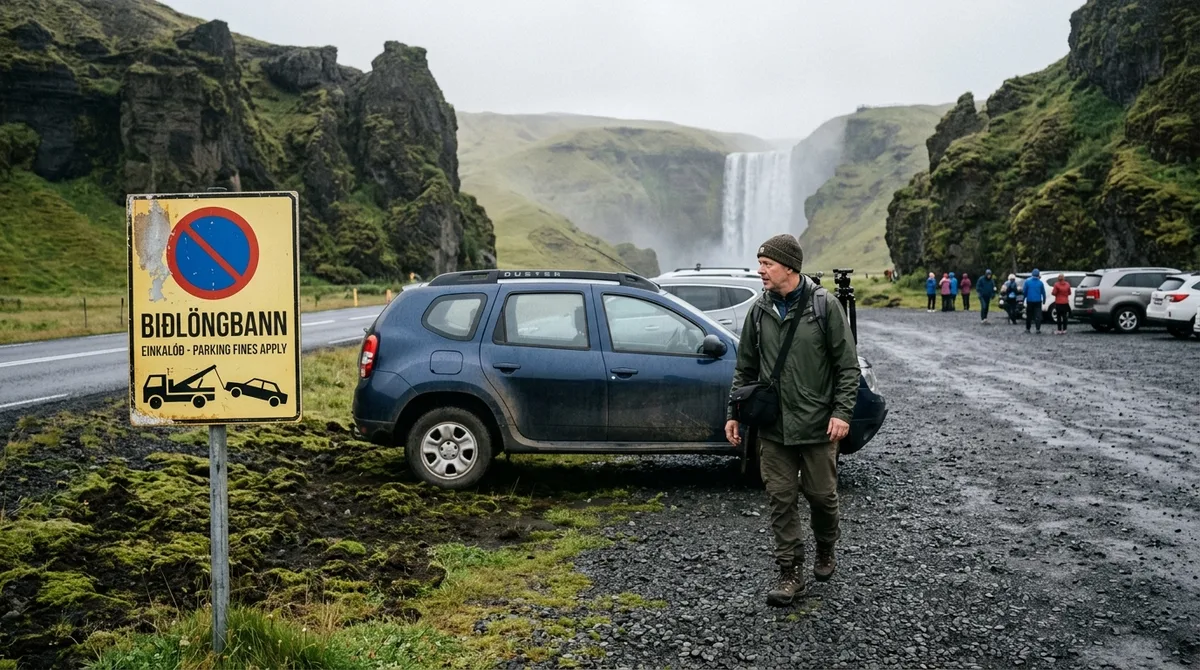
Navigating Iceland photography road trip parking rules correctly is critical to avoiding unexpected fines and rental agency processing fees while chasing light across the island. Automated camera systems, digital pay portals, and strict conservation laws now govern parking at virtually all major natural landmarks in Iceland, making pre-trip preparation essential for every landscape photographer.
Navigating Iceland Photography Road Trip Parking Rules and Digital Payment Systems
Over the past several years, Iceland has systematically modernized parking enforcement across its most popular landscape destinations. To handle high visitor volume without physical toll booths or manned booths, local municipalities, national parks, and private landowners utilize Automatic License Plate Recognition (ANPR) camera systems. As your vehicle turns off the main highway into a parking area, high-definition overhead cameras log your registration plate number along with a precise timestamp. A matching camera records your exit, calculating your total stay duration automatically.
Understanding the payment mechanics is vital for avoiding automated Iceland photo spot parking fines. The vast majority of fee-paying locations rely on two digital platforms: Parka.is and EasyPark. While physical pay stations with touchscreen terminals and credit card readers exist in main lots, relying solely on physical kiosks can be risky during winter blizzards or late-night aurora shoots when touchscreens may freeze or malfunction.
The standard payment grace period is typically 24 hours from the time your vehicle enters the lot, though some private lands require payment before departure or by midnight on the calendar day of entry. If you fail to settle the fee within the designated window, the system automatically queries the Icelandic Transport Authority (Samgöngustofa) database to identify the registered vehicle owner. For non-residents driving rental vehicles, the system issues an unpaid toll invoice directly to your rental car company.
When a car rental agency receives an automated parking violation notice, they settle the base parking fee (typically 1,000 to 1,500 ISK) and instantly apply an administrative fee to your credit card. This rental agency surcharge generally ranges between 3,000 ISK and 6,000 ISK per violation. A photographer who visits three un-paid waterfall lots during a single golden-hour run can easily incur over 18,000 ISK (roughly a measurable budget USD) in administrative penalties alone—far exceeding the original cost of the parking tickets.
Beyond automated fee collection, photographers must understand Icelandic environmental legislation regarding roadside stopping. Under Article 31 of the Icelandic Nature Conservation Act ( Lög um náttúruvernd no. 60/2013 ), driving or pulling off onto unpaved shoulders, moss beds, or volcanic ash plains outside designated parking zones is strictly illegal across the entire country. Icelandic sub-arctic vegetation grows extremely slowly; tire ruts compressed into fragile moss or sub-alpine soil can take decades to recover naturally. Police and park rangers issue heavy fines for vehicles parked illegally on fragile terrain.
Site Rules for Parking at Iceland Waterfalls: Seljalandsfoss, Skógafoss, and Gullfoss
Waterfalls along the Ring Road represent some of the highest-traffic areas in the country, and rules regarding parking at Iceland waterfalls vary significantly from site to site. Photographers planning a South Coast photography itinerary must understand the specific rules for each major stop.
Seljalandsfoss
The parking area at Seljalandsfoss operates under a strict, 24/7 ANPR camera system managed via Parka.is. The standard parking fee is 1,000 ISK for a standard passenger vehicle, valid for up to 24 hours. A critical operational detail for landscape photographers: this fee applies at all hours of the day and night. Arriving at 2:00 AM for midnight-sun photography or mid-winter aurora shoots does not exempt you from payment. The overhead infrared cameras capture license plates in complete darkness. Crucially, your paid ticket at Seljalandsfoss also covers the parking access for Gljúfrabúi, the canyon waterfall located approximately 500 meters down the gravel path.
Skógafoss
Day-use parking directly in front of Skógafoss requires a parking fee of 1,000 ISK for standard passenger cars stopping to view or photograph the waterfall during the day. However, photographers must pay close attention to lot boundaries. The area immediately adjacent to the main day lot is a designated campsite. Parking your vehicle in the camping zone without paying the overnight camping registration fee will result in a ticket from campsite attendants. If you plan to capture early morning light, ensure your vehicle remains strictly within the marked day-use stalls.
Gullfoss
Located on the Golden Circle, Gullfoss features both an upper visitor center parking lot and a lower parking area closer to the falls. Both lots are free for day visitors, managed by the Environment Agency of Iceland and local landholders. However, lane markings and no-parking zones near the access ramps are strictly enforced. Parking on the approach road or blocking tour bus turning circles will result in immediate police towing or municipal fines.
During the winter season (November through April), parking availability and lot conditions change dramatically across all South Coast locations. Heavy snowfall can bury line markings and narrow available turning areas. Furthermore, melt-and-freeze cycles turn unpaved gravel lots into solid ice sheets. Always carry microspikes or traction cleats in your camera bag; slipping on icy parking surfaces while carrying heavy tripods and camera lenses is one of the most common sources of injury for visiting photographers. When scouting dedicated waterfall photography locations, ensure your vehicle has adequate ground clearance to traverse packed snow berms at lot entrances.
Avoiding Iceland Photo Spot Parking Fines in National Parks and Nature Reserves
Iceland's national parks and nature reserves enforce strict parking regulations designed to control visitor traffic and raise revenue for ecosystem maintenance. Failing to pay at these locations is the primary cause of automated rental vehicle fines.
Þingvellir (Thingvellir) National Park operates an interconnected ANPR parking network divided into several key zones: Hakið (P1), Valhöll (P2), Steinstaðir (P5), and Silfra. When you register and pay the parking fee (currently 1,000 ISK per day for standard vehicles under 8 seats) via Parka.is or the on-site terminals, your registration plate is validated for all official parking lots inside Þingvellir National Park for the remainder of that calendar day. You do not need to pay a second time if you move your car from the upper Hakið visitor center down to the Öxarárfoss or Silfra lots.
Skaftafell (part of Vatnajökull National Park) utilizes a similar ANPR portal. Upon driving past the entry sensors, your vehicle registration is logged. The daily parking fee (1,000 ISK) is valid until midnight on the day it is paid, allowing photographers to complete long day hikes to Svartifoss or shoot the glacier tongues at Sjónarnípa without time pressure. Revenue generated from these fees directly finances park ranger patrols, toilet facility sanitation, trail stabilization, and emergency rescue infrastructure.
Jökulsárlón Glacier Lagoon and Diamond Beach represent another critical fee-controlled node. The main lagoon lot (P1) and the two Diamond Beach lots flanking the bridge on the south side of Highway 1 (P2 North and South) are managed under a unified camera system. A single parking fee paid on entry covers all parking lots around Jökulsárlón and Diamond Beach for that calendar day. Photographers shooting sunrise at the beach and afternoon light at the lagoon can freely move between these lots without double-paying, provided the vehicle plate is correctly entered in the app.
| Location / Region | Enforcement Method | Primary Payment Portal | Key Parking Rules & Notes |
|---|---|---|---|
| Seljalandsfoss | 24/7 ANPR Camera | Parka.is | Fee applies 24/7. Covers both Seljalandsfoss and Gljúfrabúi access paths. |
| Þingvellir National Park | 24/7 ANPR Camera | Parka.is / On-site Kiosk | Single daily pass valid across all internal park lots (P1, P2, P5). |
| Skaftafell (Vatnajökull NP) | 24/7 ANPR Camera | Parka.is / On-site Kiosk | Daily pass supports park maintenance and trail maintenance. |
| Jökulsárlón & Diamond Beach | 24/7 ANPR Camera | Parka.is | One daily ticket covers both main lagoon lot and Diamond Beach side lots. |
| Day-use parking directly in front of Skógafoss requires a parking fee of 1,000 ISK for standard passenger cars stopping to view or photograph the waterfall during the day. | Attendant / Manual Checks | N/A (Day Use Free) | Day parking free; overnight stay requires paid camping area registration. |
| Kirkjufell / Kirkjufellsfoss | ANPR Camera | Parka.is | Strictly enforced. Parking on highway shoulder outside lot is illegal. |
Common pitfalls leading to Iceland photo spot parking fines in national parks include:
- Typographical errors during entry: Entering "GY-X89" instead of "GYX89" or confusing the letter "O" with the number "0". The ANPR database requires exact character matching.
- Assuming dawn or dusk is free: Cameras run on independent power systems with infrared night vision; time of day does not impact fee enforcement.
- Misinterpreting lot boundaries: Parking in grass overflow areas beyond designated boundary posts during summer peak crowds.
Essential Iceland Photography Road Trip Parking Rules for Remote Locations and Fjords
When leaving major tourist corridors to explore remote regions like the Westfjords, Eastfjords, or North Iceland, primary Iceland photography road trip parking rules transition from digital camera enforcement to road safety and land-use statutes enforced by the police and the Icelandic Road and Coastal Administration (Vegagerðin).
Along single-lane paved highways or narrow fjord passes, landscape photographers frequently encounter striking light conditions that prompt immediate impulses to stop. Stopping, standing, or parking directly on the paved driving lane of Route 1 or any rural secondary road is strictly illegal under Article many of the Icelandic Traffic Act ( Umferðarlög no. 77/2019 ). Iceland's main roads are narrow, often elevated on gravel embankments without paved shoulders, and feature heavy commercial traffic, including livestock trucks and tour buses. Stopping on the highway creates severe collision risks, particularly in rain, fog, or blowing snow.
To safely pull over for photos, drivers must locate designated roadside turnouts. These fall into two distinct categories:
- Official Lay-bys (M-Signs): Identified by a blue square traffic sign marked with a white capital "M" (Mætistaður). These paved or gravel turnouts are designed specifically for passing oncoming traffic on single-lane roads or providing safe, temporary emergency stopping points. While you may pull into an M-sign turnout briefly to let a faster vehicle pass, parking your car long-term to set up a tripod and shoot long-exposure photography is prohibited, as it blocks passing access for other drivers.
- Designated Viewing Pull-Outs: Paved or heavily gravelled loops extending clear of the highway lane, often marked with an informational sign or camera symbol. These spots permit short-term parking for landscape viewing and photography. Ensure all four tires are situated entirely behind the solid edge-line of the highway.
In rural areas, photographers frequently encounter farm gates and agricultural access tracks leading toward sea cliffs, turf houses, or rivers. Private property signs ( Einkavegur ) must be respected. rarely park across a farm gate or agricultural tractor lane, even for a five-minute photo. Farmers move livestock and heavy equipment at all hours, and blocked access gates frequently result in vehicles being towed or reported to regional police.
When visiting remote locations like Aldeyjarfoss in the North Highlands or the black sand church at Búðakirkja on the Snæfellsnes Peninsula, always utilize the dedicated gravel parking areas established near the site entrances. At Búðakirkja, park strictly within the marked gravel lot near the hotel and church grounds; driving onto the surrounding lava field or grass knolls carries severe statutory fines.
Overnight Parking, Campervan Regulations, and Drone Restrictions Near Camera Spots
Landscape photographers frequently travel in campervans or modified 4WD SUVs to maintain flexibility for midnight-sun light or night-time aurora hunting. However, overnight parking regulations in Iceland are exceptionally strict.
In 2015, the Icelandic government amended environmental protection laws to prohibit wild camping in vehicles. It is illegal to sleep overnight inside a car, campervan, or tent outside designated, commercial campsites anywhere in Iceland, unless you have explicit written permission from the private landowner. Parking lot facilities at photography locations—including Skógafoss, Reynisfjara, Kirkjufell, Jökulsárlón, and Þingvellir—are day-use facilities only. Police officers and environmental rangers actively patrol landscape parking lots at night. If you are caught sleeping in your vehicle in a day-use lot, you will receive a fine and be instructed to move immediately to an official campsite.
For photographers aiming to capture early dawn light without long drives, locate official campsites (Tjaldsvæði) nearest to your target shooting spot. Most campsites operate year-round or offer basic off-season parking access with honesty-box or digital app payment options.
Drone operations around photography parking areas are subject to strict oversight by the Environment Agency of Iceland (Umhverfisstofnun) and local municipality regulations. Launching or flying a drone within or directly above parking lots is universally restricted for safety and privacy reasons. Rotating drone propellers pose direct hazards to visitors, while low-flying drones create noise pollution that disturbs both tourists and nesting bird colonies.
Key drone rules relative to landscape parking areas include:
- National Parks and Nature Reserves: Drone flying is prohibited without a specific scientific or commercial permit inside Þingvellir, Vatnajökull National Park (including Skaftafell and Jökulsárlón), and nature reserves like Fjaðrárgljúfur, Reynisfjara, and Skógafoss. Signs displaying a crossed-out drone symbol are posted prominently at lot entrances.
- Launch Zones: In locations where drones are permitted, pilots must walk away from the parking lot, road, and visitor infrastructure before taking off. Maintain a minimum distance of 150 meters from built infrastructure and crowds.
- Wildlife Protection: Avoid flying near sea cliffs (such as Dyrhólaey or Reynisfjall) during puffin and fulmar nesting season (May through August). Disturbing protected bird species from the air can result in equipment confiscation and prosecution under wildlife protection acts.
Integrating Parking Notes into Your Offline Scouting and Mapping Workflow
Executing a flawless landscape photography road trip requires pre-loading exact parking coordinates, access conditions, and site rules directly into your offline navigation tools before setting out into cell-service dead zones.
When scouting spots across remote fjords or highland margins, mobile cellular coverage can drop without warning. Relying on live web searches to look up parking app codes or entry rules while sitting at a trail junction leads to missed light windows or accidental parking violations. The standard approach for professional landscape workflow is to export high-precision waypoint files (GPX, KML, or GeoJSON) into specialized mapping software running on smartphone or tablet hardware.
Iceland Co-Pilot is live on Google Play, Android only, and included free with any Iceland Photo Map purchase — it is not sold separately and there is no separate Co-Pilot tier. The location catalog, field notes, parking and access notes, and arrival detection work today; full offline map tiles, light windows, road and weather status, and day routing are still in development.
The KML, GPX and GeoJSON files live on your device, so the waypoints work with no signal. Downloading offline map tiles is a separate step inside your mapping app. The files are waypoints. Your own mapping app — Gaia GPS, OsmAnd, Organic Maps, a Garmin — does the routing. Photographers interested in importing GPX files into mapping apps can seamlessly cross-reference spatial coordinates against custom land-use layers.
When organizing location datasets, verify how specific field details are compiled. Across our master dataset of 121 locations, 9 of the 121 locations carry written field notes today, while 112 carry researched briefs compiled from published sources, each listing its sources. Every location carries exact GPS coordinates, category tagging, and optimal seasonal recommendations. To evaluate different digital planning resources, photographers can review our sourced comparison of Iceland photography guides to examine how various tools structure access data and offline support.
Furthermore, regarding transparency and editorial standards: Iceland Photo Map does not publish customer reviews, testimonials or star ratings, and no rating markup appears on the site. All mapping datasets and access notes are maintained through ongoing editorial research and verified official publications.
A Checklist for Frictionless Parking on Your Icelandic Photo Expedition
Follow this operational checklist to ensure your focus stays on capturing light rather than managing parking disputes and administrative fines:
Pre-Departure Setup
- Download Digital Payment Apps: Install both Parka.is and EasyPark on your mobile device before departing Keflavík International Airport. Create user accounts and link an active international credit card.
- Register Vehicle Plate Immediately: As soon as you pick up your rental car, enter the vehicle registration plate number correctly into both apps. Double-check for typos, distinguishing clearly between similar characters (e.g., zero vs. the letter O).
- Pre-Load Offline Waypoints: Import verified GPX or KML datasets containing precise parking lot coordinates into your offline mapping app (Gaia GPS, OsmAnd, Organic Maps, or Garmin). Ensure base map tiles are fully downloaded for offline viewing.
Daily Execution Routine
- Check Weather and Road Portals: Review real-time wind speeds, precipitation forecasts, and road hazard maps every morning via Vedur.is (Icelandic Meteorological Office) and Road.is (Vegagerðin). Seasonal access roads can close rapidly due to ice or river flooding.
- Verify Pay Station Prompts on Arrival: Upon entering any camera-enforced parking area (Seljalandsfoss, Þingvellir, Jökulsárlón, Skaftafell, Kirkjufell), open Parka.is to verify if the site code automatically populates, or check on-site physical boards for lot codes. Pay immediately upon arrival to prevent forgetting after an exhausting multi-hour shoot.
- Inspect Terrain Before Parking: In winter, assess ice buildup in gravel lots before pulling into a stall. Ensure your vehicle is equipped with studded winter tires or 4WD capability if parking on unplowed gravel ramps.
- Respect Boundaries and Private Property: rarely park on moss, tundra, or unpaved shoulders. Avoid blocking farm gates, emergency access tracks, or campervan turnarounds. If a lot is completely full, proceed to the nearest legal overflow area rather than inventing temporary stalls on roadside grass.
Frequently Asked Questions
How do automated parking payment apps like Parka.is work at Icelandic photo spots?
Automated parking lots in Iceland use high-definition Automatic License Plate Recognition (ANPR) cameras positioned at entry and exit points. When your car enters the lot, the camera reads your license plate and records a timestamp. To pay, you open an application like Parka.is or EasyPark, select the correct parking zone from a map or list, enter your vehicle's plate number, and pay via credit card. The system links your payment record to the camera entry log automatically.
What happens if I forget to pay for parking before leaving a waterfall or national park?
If you leave a pay-to-park location without settling the fee, you typically have a 24-hour grace period (or until midnight on the day of entry, depending on the operator) to process the payment online via Parka.is. If the window passes without payment, the parking manager issues a violation notice to your rental car company. The rental agency will pay the base ticket and charge your credit card for the fine plus an administrative processing fee, which usually ranges from 3,000 to 6,000 ISK per incident.
Is pulling off onto the gravel shoulder legal to take a quick landscape photo in Iceland?
No. Pulling off or stopping directly on the shoulder of a paved highway or rural road is illegal under Article many of the Icelandic Traffic Act unless it is a genuine medical or mechanical emergency. Police and park rangers issue heavy fines for vehicles parked illegally on fragile terrain. Photographers must use official gravel or paved lay-bys (marked turnouts) or designated parking lots.
Are parking fees in Iceland charged per person or per vehicle?
Parking fees at Icelandic landscape sites, national parks, and waterfalls are charged per vehicle, not per person. A standard passenger vehicle ticket (typically around 1,000 ISK per day) covers all occupants inside the car. However, passenger capacity matters: larger passenger vans (9+ seats) and commercial buses fall into higher pricing tiers at sites managed by Parka.is and national park authorities.
Download our offline GPX and KML waypoint maps to get exact parking lot coordinates, accessibility notes, and seasonal guidance pre-loaded directly onto your device.