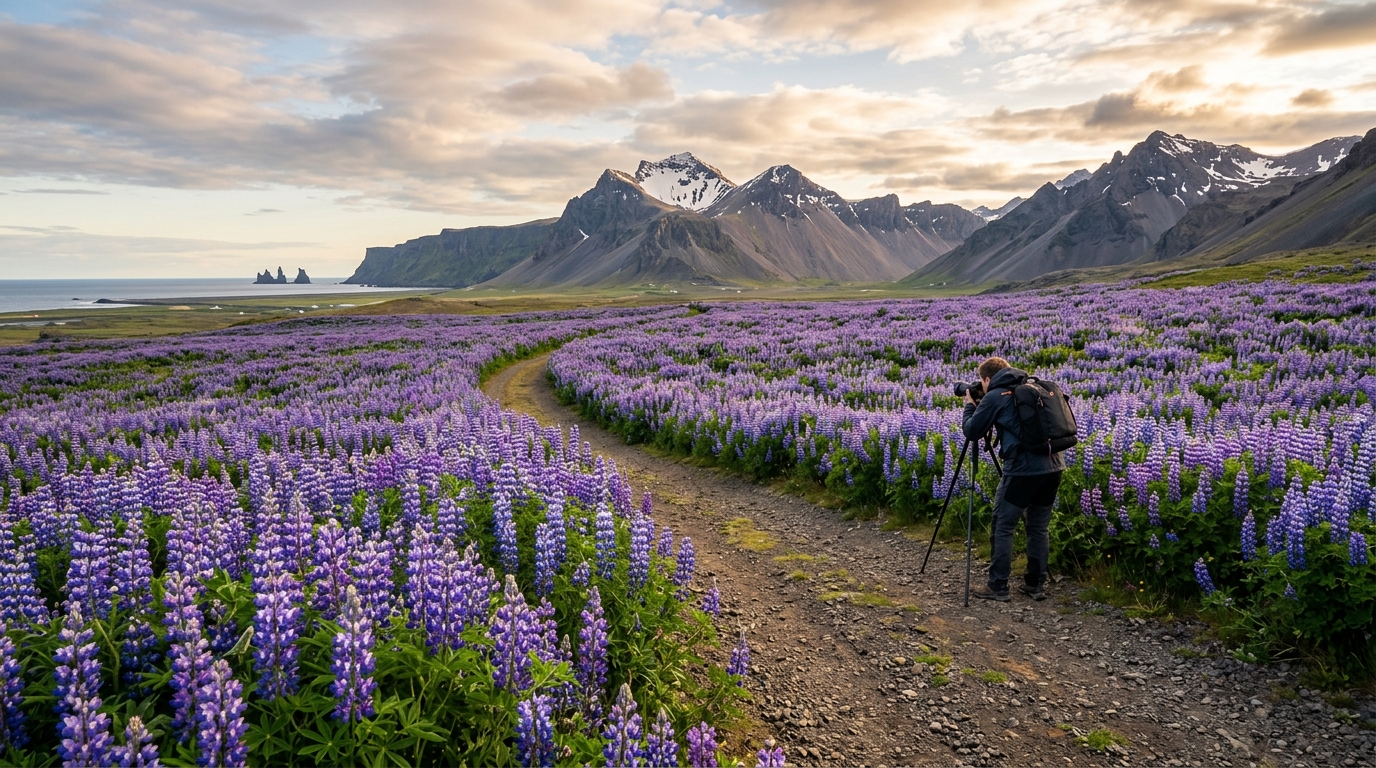
Every summer, the dramatic volcanic landscapes of Iceland undergo a breathtaking, vivid transformation. If you are planning a trip to the land of fire and ice, finding the ultimate Iceland lupine photography spots is likely at the top of your creative bucket list. From early June through July, vast swathes of the country are painted in vibrant shades of violet, blue, and purple. This explosion of color is courtesy of the Nootka lupine (Lupinus nootkatensis), a plant that has profoundly reshaped the visual character of the Icelandic summer.
For landscape photographers, these endless purple fields offer an extraordinary contrast against black volcanic sands, cascading waterfalls, and jagged mountain peaks. Whether you are a seasoned professional or an enthusiastic amateur, capturing this seasonal phenomenon requires careful planning, precise timing, and an understanding of the unique geographical features of the island. This comprehensive guide will walk you through everything you need to know to photograph Iceland’s purple fields in 2026, from exact locations to expert camera techniques.
Understanding the Lupine Season in Iceland: When to Visit
Timing is everything when planning a photography trip centered around wildflowers. The lupine season iceland is relatively short but spectacular, demanding precise scheduling to capture the plants at their absolute peak before they begin to fade and go to seed.
The typical timeline for the lupine bloom in Iceland begins in late May, when the first green shoots rapidly climb and display tight, green buds. By early June, the lower elevations—particularly along the southern coast—begin to turn purple. The absolute peak of the bloom generally occurs from mid-June to mid-July for the most vibrant displays. During this window, the fields are dense, the colors are incredibly saturated, and the plants are at their tallest and healthiest. Source: South source.
However, local weather variations play a significant role in the bloom's duration and intensity. A warm, sunny spring can accelerate the bloom, pushing the peak to the beginning of June. Conversely, a cold, overcast spring may delay the peak until late June or even early July. By early July, the flowers at lower elevations and southern exposures will begin to fade, dropping their lower petals and forming fuzzy green seed pods, though you can still find pristine patches in the cooler northern regions and higher altitudes until mid-July.
When planning your 2026 summer photography trip, aligning your visit with the peak bloom also grants you the ultimate creative asset: the midnight sun. In mid-to-late June, Iceland experiences nearly 24 hours of daylight. The sun dips just below the horizon for a few hours, creating an incredibly prolonged golden hour that bleeds directly into a pastel-hued blue hour. Photographing the purple fields under this soft, warm, everlasting light is a transformative experience, allowing you to shoot at 1:00 AM with zero crowds and optimal atmospheric conditions.
Top Iceland Lupine Photography Spots Along the South Coast
The southern strip of the island is the undisputed capital of summer wildflowers. The combination of dramatic geological formations and a slightly milder maritime climate makes the South Coast home to some of the most iconic Iceland lupine photography spots you can find.
The Vik i Myrdal Church (Víkurkirkja)
Perhaps the most famous composition in all of Iceland during June is the picturesque, red-roofed church of Vík i Mýrdal framed by a sea of purple. The church sits high on a hill overlooking the coastal town. In summer, the entire hillside slope below the church becomes a dense, cascading carpet of lupines.
To capture this shot, position yourself at the base of the hill looking up toward the church, using the purple flowers to fill the lower two-thirds of your frame. Alternatively, walk up the paths behind the church to shoot downward, capturing the red roof contrasted against the deep purple fields, the black sand beach, and the dramatic Reynisdrangar sea stacks rising from the ocean in the background.
The Cliffs of Dyrhólaey
Just a short drive west of Vík lies the massive stone arch and peninsula of Dyrhólaey. The flat plateaus surrounding the access roads and the lower viewing areas are heavily colonized by lupines. By positioning your tripod low to the ground near the edge of these fields, you can frame the dramatic, sheer cliffs of Dyrhólaey and the crashing white surf of the Atlantic Ocean in the background, bordered beautifully by a vibrant purple foreground.
Seljalandsfoss and Skógafoss Meadows
While tourists flock to these legendary waterfalls for their sheer power, photographers in the know look to the surrounding meadows. Near Seljalandsfoss, particularly along the footpaths leading to the hidden waterfall Gljúfrabúi, you will find pockets of lupines that allow you to compose shots featuring a soft, out-of-focus waterfall in the background behind a sharp, colorful foreground. Near Skógafoss, the riverbanks occasionally host patches of lupines, offering a unique juxtaposition of rushing glacial water and delicate summer flora.
Safety and Traffic Along the Ring Road
Because these South Coast locations are highly accessible, they attract significant traffic. According to the driving safety guidelines from SafeTravel Iceland, stopping or parking on the side of the highway to photograph a field of flowers is extremely dangerous. The Ring Road (Route 1) is narrow, often lacking shoulders, meaning any stopped vehicle poses an immediate hazard. To ensure safety, drivers are strongly advised to use designated parking lots or official gravel pull-offs, as recommended by the Icelandic Road and Coastal Administration (Vegagerðin), and walk to their destination. Be mindful of sudden weather changes, wind gusts that can catch car doors, and high tourist density during peak daytime hours.
Capturing Iceland Purple Flowers Photography in West and North Iceland
If you want to escape the crowds of the South Coast and explore more rugged, isolated landscapes, heading west and north reveals incredible opportunities for iceland purple flowers photography.
The Snæfellsnes Peninsula and Búðakirkja
For those wondering where to find lupines in iceland that offer a minimalist, moody aesthetic, the Snæfellsnes Peninsula is the answer. The iconic black wooden church of Búðakirkja sits in the middle of a vast lava field. During June, patches of purple lupines bloom in the sandy soil surrounding the church grounds. The contrast between the pitch-black wood of the church, the yellow-green moss of the lava field, the purple flowers, and the snow-capped Snæfellsjökull glacier in the distance is visually spectacular.
Further along the peninsula, near the town of Grundarfjörður, you can find fields of lupines that can be used as a colorful foreground for shots of the iconic, arrowhead-shaped mountain Kirkjufell.
Northern Hotspots: Húsavík and the Arctic Coast
In North Iceland, the lupine season often starts slightly later than in the south, with the southern coast typically flowering a week or two earlier than higher inland areas, and often peaking in late June or early July. The rolling hills surrounding the whale-watching hub of Húsavík are blanketed in thick purple carpets. Photographing these fields with the deep blue waters of Shaky Bay (Skjálfandi) and the snow-dusted mountains of the Víknafjöll range in the background provides a classic northern composition. Additionally, the dramatic fjords of the Tröllaskagi Peninsula offer roadside fields that run right down to the water’s edge.
The Remote Westfjords
For the ultimate crowd-free experience, make the journey to the Westfjords. Because this region is older geologically, the fjords are incredibly steep and dramatic. Lupines have been planted extensively along the steep slopes of the fjords to prevent mudslides and erosion. Here, you can photograph massive, sweeping mountainsides covered in purple that plunge directly into mirror-like fjords, with virtually no other photographers in sight.
Whether you are shooting in the east, west, or north, utilizing professional landscapes resources to locate these fields will save you hours of aimless driving and ensure you hit the best spots during optimal light.
Composition and Camera Gear Tips for Iceland Lupine Photography Spots
Photographing vast fields of a single flower species presents unique creative challenges. Without careful composition, a massive field of lupines can easily look like a flat, chaotic purple blob in a two-dimensional photograph. To make your images stand out, you must utilize specific gear and compositional techniques tailored to these unique Iceland lupine photography spots.
Lens Selection: Wide-Angle vs. Telephoto
Both focal lengths have a place in your camera bag, but they yield vastly different results:
- Wide-Angle Lenses (16-35mm): Excellent for capturing the immense scale of the Icelandic landscape. When using a wide-angle lens, you must get incredibly close to your foreground. Position your camera just inches away from a particularly healthy, striking lupine stalk. This exaggerates the size of the flower in the foreground while allowing the massive background—such as a mountain or a church—to remain fully in the frame. Be careful, however: if the field is sparse, a wide-angle lens will emphasize the empty gaps between the flowers, making the field look thin.
- Telephoto Lenses (70-200mm or longer): This is the secret weapon of professional landscape photographers. A telephoto lens compresses the elements of your scene. By standing back and zooming in on a distant field, you compress the space between individual lupine plants, making the field appear incredibly dense, lush, and endless. It also allows you to pull distant mountains closer, creating a powerful, layered composition.
Compositional Techniques
To give your images depth and structure, focus on the following core principles:
- Low-Angle Shooting: Lower your tripod as close to the ground as possible. Shooting from a low perspective places the viewer directly in the flowers, making the lupines feel towering and immersive. It also helps to hide patches of bare dirt, creating a seamless sea of purple.
- Leading Lines: Look for natural pathways, small streams, or footpaths winding through the fields. Use these lines to guide the viewer’s eye through the colorful foreground and toward the main subject in the background, whether it is a waterfall, a volcanic peak, or a rustic building.
- Depth of Field Control: Decide whether you want a front-to-back sharp image or a dreamy, soft-focus look. For a fully sharp landscape, shoot at f/11 or f/16, and consider focus-stacking (taking multiple shots at different focus points and blending them in post-processing) to ensure both the close-up flowers and distant mountains are pin-sharp. For a romantic, fine-art look, shoot at a wide aperture like f/2.8 or f/4, focusing on a single lupine stalk and letting the rest of the field melt into a creamy, purple bokeh.
Managing Exposure Under the Midnight Sun
The purple-blue hues of the lupines can be tricky for camera sensors to interpret, often leading to oversaturated blues or clipped color channels. Keep a close eye on your camera's RGB histogram rather than just the standard brightness histogram. Ensure the blue and red channels are not clipping. Because you will often be shooting during the high-contrast golden hours of the midnight sun, consider bracketed exposures (shooting 3 to 5 images at different exposures) to capture the full dynamic range of the bright sky and the darker details within the shadows of the flower petals.
The Ecological Debate: The History of Nootka Lupine in Iceland
To truly capture the essence of the Icelandic landscape, a photographer must understand the story behind the subject. The sea of purple that blankets the country every summer is not actually a native feature of Iceland; it is the result of a massive, ongoing ecological experiment that remains highly controversial today.
Following centuries of overgrazing by sheep, harsh winters, and devastating volcanic eruptions, Iceland faced severe soil erosion and desertification by the early 20th century. Vast areas of the interior had been stripped of topsoil, leaving barren, black volcanic deserts. In 1945, the director of the Icelandic Forestry Service brought seeds of the Nootka lupine (Lupinus nootkatensis) from Alaska to combat severe soil erosion, a historical initiative documented by the Icelandic Forest Service (Skógræktin). The plant was chosen because it is incredibly hardy, thrives in cold, nutrient-poor environments, and is a nitrogen-fixer—meaning it extracts nitrogen from the atmosphere and deposits it into the soil, fertilizing the ground so other plants can eventually grow.
For decades, the lupine was seeded extensively across the country. It succeeded spectacularly, binding the loose volcanic sands, stopping dust storms, and creating fertile soil. However, the lupine proved to be *too* successful. Lacking natural competitors or predators, it spread rapidly, invading native habitats.
This has sparked a fierce ecological debate in Iceland:
- The Pros: The lupine successfully combats soil erosion, fertilizes barren lands, aids in reforestation efforts, and attracts tourists who love the stunning purple summer fields.
- The Cons: It is a highly invasive monoculture. It grows tall and dense, completely shading out and killing native, low-growing Icelandic vegetation, such as the delicate, slow-growing woolly fringe moss (Racomitrium lanuginosum), native wildflowers, and wild berry patches. Once lupine takes over, it is incredibly difficult to eradicate.
As a photographer, understanding this environmental context enriches your visual storytelling. Your images can reflect this tension: the beauty of the vibrant purple flowers contrasted against the fragile, ancient green mosses they are slowly replacing. It transforms your work from simple travel postcards into meaningful environmental documentation.
Safety and Etiquette: Photographing Lupines Responsibly
The Danger of Roadside Parking
As mentioned, stopping on the narrow shoulders of the Ring Road to take photos is a dangerous practice that contributes to safety concerns in Iceland. The gravel shoulders are often soft, leading to stuck vehicles, and the lack of visibility on winding roads poses a severe hazard to other drivers. Rarely park on the side of the road. If you spot a beautiful field, look for an official parking area, a designated scenic pull-off, or a nearby town road where you can park safely and walk back to the location.
Preventing Trampling and Damage
Lupines are tough, woody plants, but their stems can easily snap under the weight of human footsteps. When a path is trampled through a flower field, it destroys the plants, exposes the soil, and creates muddy scars that take years to heal. To protect the delicate Icelandic soil and surrounding vegetation, the Environment Agency of Iceland (Umhverfisstofnun) urges visitors to respect nature and avoid creating new footpaths.
To photograph responsibly, follow these simple rules:
- Use Existing Paths: Look for sheep trails, tractor tracks, or paths created by previous visitors. Walk within these pre-existing clearings to position yourself "inside" the field without crushing fresh flowers.
- Use Focal Length to Deceive: You do not need to walk deep into a field to make it look like you are surrounded by flowers. By placing your camera low to the ground at the very edge of a field and shooting with a telephoto lens, the compression will make it look like you are standing in the middle of a dense forest of purple, while you are actually standing safely on a gravel path.
- Respect Private Property: Many of the most beautiful lupine fields are located on private farmland. Respect all fences, closed gates, and "No Trespassing" signs. If a field is fenced off, shoot from the roadside boundary.
By adhering to the core principles of Leave No Trace—leaving what you find, respecting wildlife and landowners, and being considerate of other visitors—you protect the delicate Icelandic ecosystem and help preserve access for the global photography community.
Conclusion: Mapping Your Summer Photography Adventure
Photographing the purple lupine fields of Iceland under the endless glow of the midnight sun is an unforgettable experience. By targeting key locations like the Vík i Mýrdal church and the cliffs of Dyrhólaey along the South Coast, or seeking out the dramatic backdrops of Búðakirkja in the west and the rolling hills of Húsavík in the north, you can capture some of the most striking landscape images of your portfolio in 2026.
To successfully navigate these locations, precise planning and reliable mapping tools are essential. When developing our resources at Iceland Photo Map, we prioritize creating highly actionable, user-first guides. Our goal is to provide deep, practical value that goes far beyond surface-level travel tips, helping you locate the exact GPS coordinates where these natural spectacles occur. We have designed our interactive map features to ensure a seamless planning experience for photographers of all abilities, making it easy to find the best vantage points across the island.
Armed with the right gear, an understanding of the blooming season, and a commitment to photographing responsibly, you are ready to embark on an incredible summer photography adventure. Pack your wide-angle and telephoto lenses, prepare for long, beautiful nights under the midnight sun, and let the vibrant purple fields of Iceland inspire your creative vision.
Frequently Asked Questions
When is the absolute best week to photograph lupines in Iceland?
While the bloom is highly dependent on the weather, the period from mid-June to early July is often considered the peak for viewing the most vibrant displays across many regions. During this window, the flowers tend to reach their maximum height and density, offering deep, saturated purple hues before the plants begin to form seed pods. Source: South source.
Where is the easiest place to find lupines close to Reykjavik?
You do not have to travel far from the capital to find beautiful fields. Areas around the town of Hafnarfjörður (just a short drive from downtown Reykjavik) and the fields near the geothermal town of Hveragerði are sometimes mentioned as locations where lupines may be found. Additionally, the fields surrounding Lake Kleifarvatn on the Reykjanes Peninsula are known to host stunning, easily accessible backdrops of volcanic rock and purple flowers.
Is it legal to walk into the lupine fields for photos?
Generally, it is legal to walk near or photograph lupines, provided you are on public land or public rights-of-way. However, many fields are located on private agricultural land, where you must respect fences and private property boundaries. Regardless of ownership, photographers should aim to use existing sheep paths, tractor tracks, or shoot from the edges of the fields to avoid damaging the plants.
Do I need a special lens to photograph the purple flowers in Iceland?
You do not need specialized, expensive lenses to get stunning results. A standard zoom lens (such as a 24-70mm) is highly versatile. However, a telephoto lens (like a 70-200mm) can be particularly useful. As discussed earlier, the telephoto compression squeezes the perspective, making sparse flower fields look incredibly dense and lush, while bringing distant mountains closer to frame your subject beautifully.
Ready to capture the purple fields of Iceland? Unlock exact GPS coordinates for every lupine field, waterfall, and scenic viewpoint with our comprehensive Iceland Photo Map.