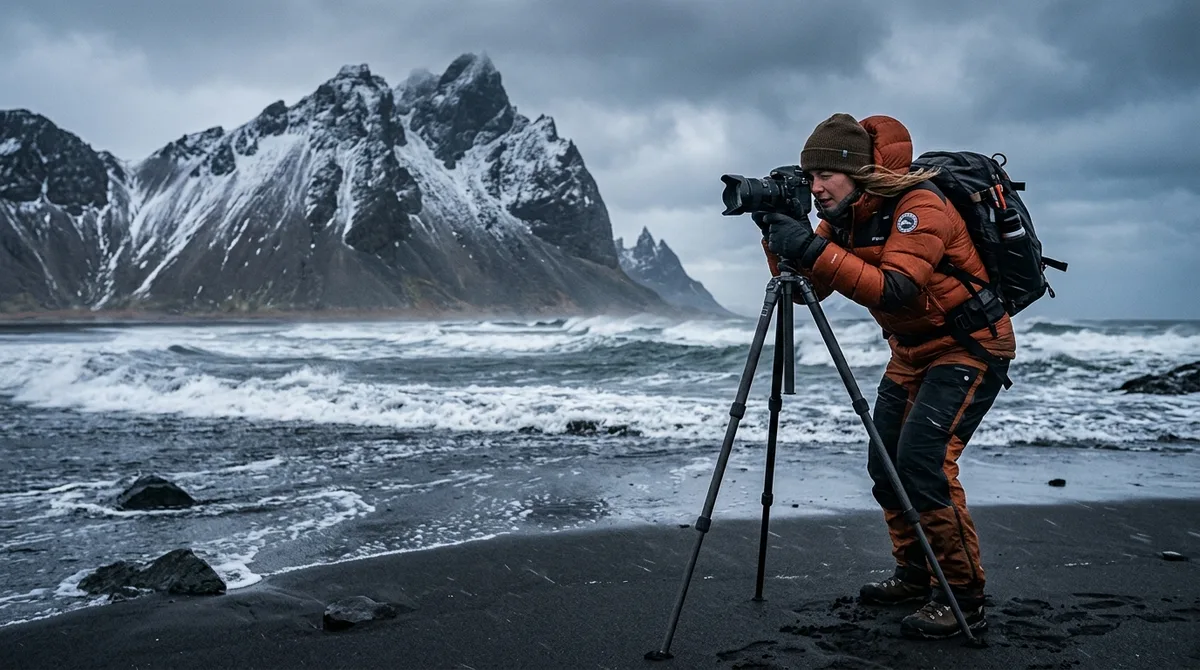
Executing successful arctic landscape shoots demands strict risk mitigation, specialized equipment safeguards, and constant situational awareness. Mastering essential Iceland photography safety tips ensures you capture dramatic volcanic vistas, glacial lagoons, and auroras without succumbing to hypothermia, sneaker waves, or vehicle-destroying gales.
Iceland's subpolar oceanic climate produces some of the most dynamic, volatile weather systems on Earth. For landscape photographers, the relentless quest for dramatic light, breaking surf, and atmospheric storms often brings them into direct conflict with severe environmental hazards. Staying safe Iceland photography expeditions require treating the landscape not as an outdoor studio, but as an active arctic wilderness where a single miscalculation can destroy thousands of dollars in gear or result in fatal accidents.
Essential Iceland Photography Safety Tips Before Leaving Your Base
Every safe photography excursion begins hours before you mount a lens to your camera body. In sub-arctic latitudes, environmental variables compound rapidly: daylight windows shift dramatically depending on the season, ambient temperatures drop precipitously when cloud cover breaks, and unpaved mountain roads can freeze within minutes.
Before leaving your accommodation, conduct a systematic pre-shoot assessment. Calculate your exact daylight parameters, civil twilight windows, and return routes. The files carry season and access notes, not live conditions. Check vedur.is (the Icelandic Meteorological Office) and road.is for current weather and road status across every mountain pass you intend to traverse.
Never rely on live cellular connections when navigating between remote shooting locations. Cellular towers in deep fjords and interior highland valleys are frequently blocked by basalt topography or disabled by heavy rime ice accumulation. The KML, GPX and GeoJSON files live on your device, so the waypoints work with no signal. Downloading offline map tiles is a separate step inside your mapping app. You can review how to set up your workflow through our tutorial on importing KML files into Gaia GPS or our guide for using OsmAnd offline maps.
The files are waypoints. Your own mapping app — Gaia GPS, OsmAnd, Organic Maps, a Garmin — does the routing. Always file an itinerary through SafeTravel Iceland (ICE-SAR) before heading into remote shooting zones, especially during shoulder and winter seasons.
Sneaker Waves and Coastal Hazards at Reynisfjara and Diamond Beach
The southern coastline of Iceland features some of the most treacherous littoral zones in the world. Locations like Reynisfjara black sand beach, Kirkjufjara, and the shoreline at Breiðamerkursandur (Diamond Beach) host powerful sub-oceanic geological features that generate deadly sneaker waves (infralittoral surges).
Unlike standard predictable wave trains, sneaker waves are formed when multiple offshore wave trains align, building immense kinetic energy without showing visible surface disruption until they strike the shelving seabed. The wave sweeps tens of meters higher up the shore than previous sets, accompanied by a powerful backwash undertow loaded with heavy basalt sediment that can pull an adult off their feet in seconds.
Follow these non-negotiable coastal photography protocols along the South Coast region:
- Maintain a 30-Meter Buffer: rarely position your tripod at the wet sand line. Wet sand indicates recent wave reach within the current tidal cycle, regardless of how calm the surf appears.
- rarely Turn Your Back on the Atlantic: Keep eyes on the incoming ocean swell at all times. When framing compositions or adjusting neutral density filters, position your body sideways so your peripheral vision monitors the surf line.
- Avoid Waders and Sealed Wellies in Heavy Surf: Chest waders are lethal in sneaker wave zones. If swept into the Atlantic, waders instantly fill with freezing water and fine black sand, acting as an anchor that prevents swimming or self-rescue. Wear standard waterproof boots with quick-release snow gaiters instead.
- Watch the Warning Lights: Pay attention to the automated zonal warning light system at Reynisfjara. When the flashing light turns yellow or red, stay well back on the upper gravel banks near the cliffs.
If caught in a surging wave, abandon your camera gear immediately. Drop your tripod, turn your body perpendicular to the backwash to reduce drag, dig your heels into the gravel substrate, and work laterally across the beach rather than fighting the current directly seaward.
Wind and Arctic Blizzards: Weather Hazards Iceland Photographers Must Respect
Violent katabatic winds and deep low-pressure systems present severe weather hazards Iceland photographers encounter year-round. Wind speeds in exposed coastal passes and near glacier outlets routinely exceed 30 to 40 meters per second (67–90 mph), generating localized gusts capable of shattering vehicle windows, blowing car doors clean off their hinges, and hurling heavy carbon-fiber tripods across volcanic boulder fields.
To safely handle extreme wind while executing long-exposure landscape photography, adopt specific mechanical stabilizing techniques:
- Lower Your Center of Gravity: Do not extend the thinnest, bottom leg sections of your tripod. Keep the center column fully dropped; an extended center column acts as an inverted pendulum that amplifies vibration and destabilizes the setup.
- Spike Feet Integration: Swap rubber tripod feet for 2-inch stainless steel spikes that bite directly into frozen turf, gravel, or packed ice.
- Controlled Mass Ballast: Hanging a heavy camera bag from your tripod's center hook can backfire in high winds, turning the bag into a swinging wrecking ball. Instead, rest your backpack on the ground directly beneath the tripod apex and secure it with a short, tensioned bungee strap.
- Vehicle Door Discipline: When exiting your vehicle, often park nose-first into the wind. Grip vehicle doors with both hands when opening them; insurance policies in Iceland specifically exclude wind-damaged door hinges from standard coverage.
Rapid transitions between -15°C arctic ambient air and heated vehicle interiors cause immediate internal condensation inside weather-sealed lenses and camera sensor chambers. When returning to your vehicle after a shoot, seal your camera body and lenses inside airtight dry bags before stepping inside. Allow the gear to warm up gradually over 45 minutes; condensation forms safely on the outside of the plastic bag rather than across internal optical elements and electronic circuit boards.
Geothermal Hotspots, Fumaroles, and Fragile Basalt Cliffs
Iceland's active volcanic zones—including Námafjall (Hverir), Seltún, and Reykjanes—present unique thermal and structural hazards. Geothermal crusts situated around boiling mud pots (solfataras) and steam vents (fumaroles) can be deceptively thin, often measuring only a few centimeters thick over reservoirs of acidic water reaching temperatures well above 100°C.
Stepping off marked boardwalks to capture an unhindered angle can result in severe, deep-tissue thermal burns if the mineral crust collapses under your boots. Furthermore, low-lying geothermal hollows accumulate heavy, toxic concentrations of hydrogen sulfide ($H_2S$) and carbon dioxide ($CO_2$), particularly on still, windless mornings when mist hangs close to the earth.
Basalt sea cliffs, such as those at Dyrhólaey, Arnarstapi, and Látrabjarg, present distinct structural risks. Volcanic basalt, palagonite tuff, and sea arches are prone to sudden structural spalling caused by continuous freeze-thaw cycles. Do not walk to the sheer overhangs of coastal turf edges; thick moss carpets frequently disguise undercut turf shelves that offer zero load-bearing support. A sudden 35 m/s wind shear at a cliff apex can easily destabilize a photographer peering through an optical viewfinder.
Additionally, respecting these boundaries preserves fragile volcanic moss (Racomitrium lanuginosum). This slow-growing flora takes decades to recover from human foot traffic. Staying on designated pathways protects both your physical safety and the integrity of the ecosystem.
Glacier Outlets and River Crossing Safety for Landscape Shooters
Iceland’s glacial tongues—including outlets from Vatnajökull, Mýrdalsjökull, and Langjökull—draw landscape photographers seeking pristine seracs, blue ice caves, and glacial lagoons. However, unguided glacier exploration is exceptionally hazardous.
Outlet glaciers are dynamic rivers of ice riddled with hidden crevasses, fragile snow bridges, and moulins (vertical meltwater shafts plunging hundreds of meters into the bedrock). rarely step onto glacier ice without professional glacier equipment (crampons, ice axes, harnesses) and qualified local glacier guiding credentials. Sub-glacial ice caves undergo continuous structural deformation, especially during autumn rains or sudden mid-winter warm spells; ceiling collapses occur without prior auditory warning.
At proglacial lakes such as Jökulsárlón and Fjallsárlón, rarely attempt to climb, sit on, or stand atop calved icebergs along the water’s edge. Glacial icebergs possess irregular underwater mass distributions; removing a small amount of weight or shifting shore balance can cause an iceberg to instantaneously rotate 180 degrees, pulling anyone on top into 0°C water and trapping them beneath submerged ice shelves.
For photographers navigating highland F-roads to access interior locations like Landmannalaugar or Askja, unbridged river crossings present major structural and logistical risks:
- Wade Before You Drive: If you cannot visually determine the riverbed depth and current velocity, put on river sandals or neoprene boots and physically wade the crossing line. Follow natural gravel bars; avoid deep, dark pools where silt deposits cause 4x4 vehicles to bottom out.
- Engage 4x4 Low-Range: Lock differentials before entering the water. Enter the river slowly to avoid throwing a bow wave over the vehicle's air intake, and drive diagonally downstream at a steady, controlled pace.
- Time Your Crossings: Glacial meltwater rivers swell dramatically in the afternoon and evening as solar radiation increases upstream melt rates. Cross challenging rivers during early morning hours when water volume is at its lowest diurnal baseline.
Personal Safety Iceland Travel: Cold-Weather Field Protocol and Survival Gear
Maintaining personal safety Iceland travel standards requires a clinical approach to thermal regulation. Landscape photography involves long periods of static inactivity—waiting hours in freezing sub-zero winds for cloud breaks or aurora displays—punctuated by short bursts of intense physical hiking across rugged scree.
To avoid rapid heat loss, configure a technical three-layer clothing system:
- Base Layer: Heavyweight (250–300 g/m²) Merino wool top and bottoms. Merino retains insulating properties when damp and pulls perspiration away from the skin. rarely wear cotton, which absorbs moisture and accelerates conductive heat loss.
- Mid Layer: High-loft fleece or breathable synthetic insulation (such as PrimaLoft Gold). Synthetic fills retain structural loft and thermal warmth even in high-humidity coastal fog.
- Outer Shell: 3-layer GORE-TEX Pro or equivalent waterproof-breathable hard shell (minimum 28,000mm hydrostatic head rating) with fully taped seams and an adjustable storm hood that accommodates a thermal balaclava.
When shooting cold-weather events like the Northern Lights, monitor yourself and your shooting partners for early indicators of mild hypothermia: involuntary shivering, slurred speech, loss of fine motor dexterity in the fingers (difficulty turning camera adjustment dials), and apathy. At the first sign of systematic shivering, terminate the shoot, return to your vehicle, and ingest warm, sugary fluids.
Keep a dedicated emergency kit inside your vehicle passenger cabin (not locked in the trunk, which can freeze shut in blizzards):
- Space blankets and a sub-zero rated emergency bivy bag.
- Microspikes (Yaktrax or Kahtoola) for walking on glazed road ice and frozen waterfall spray paths.
- High-output USB-rechargeable headlamps with spare lithium battery packs.
- Emergency high-calorie food bars and vacuum-insulated thermoses filled with boiling water.
Extreme cold drastically degrades camera battery performance. Lithium-ion chemistry suffers an internal resistance spike below freezing, causing camera battery monitors to drop from many to many unexpectedly. Keep spare camera batteries stored in zippered interior chest pockets close to your core body heat. Swap cold batteries into warm pockets to recover residual charge.
Emergency Preparedness Iceland: Communications, 112 App, and Incident Response
Establishing robust emergency preparedness Iceland protocols ensures that help can be mobilized if you experience equipment failure, vehicle strandings, or physical injuries in remote locations.
The single national emergency telephone number in Iceland is 112. Prior to departure, install the official 112 Iceland application on your smartphone. The app allows users to check in at remote locations and transmits precise GPS coordinates directly to emergency dispatchers when placing a distress call.
However, because cellular networks fail in severe weather and deep highland canyons, carrying a dedicated two-way satellite communicator (such as a Garmin inReach, ZOLEO, or ACR Bivy Stick) with an active Iridium satellite subscription is essential for any excursion off Route 1 (the Ring Road). These devices allow you to send SOS alerts and exchange text messages with search coordinates regardless of terrestrial network infrastructure.
If your vehicle leaves the road during a winter whiteout or becomes stuck in a snowdrift, adhere strictly to these survival rules:
- Stay With the Vehicle: Your car provides essential shelter and acts as a much larger visual and radar target for rescue crews than a lone hiker in a whiteout. Walking away from a vehicle during an active blizzard is a leading cause of exposure fatalities.
- Clear the Exhaust Pipe: Periodically check that drifting snow does not block your vehicle's exhaust outlet. A blocked tailpipe forces lethal carbon monoxide ($CO$) gas into the cabin while the engine runs for heat.
- Conserve Fuel and Battery: Run the engine and cabin heater for 10–15 minutes every hour to maintain survival temperatures while preserving fuel reserves. Keep one window cracked a few millimeters on the leeward (downwind) side to ensure fresh airflow.
Emergency operations in Iceland are managed by Landsbjörg (ICE-SAR), a world-renowned volunteer search and rescue association. Search teams deploy in extreme conditions, but response times in severe arctic storms can take many hours. Your primary line of defense is self-reliance and the judgment to abort a shoot before weather alerts turn critical.
Pre-Departure Checklist: Iceland Photography Safety Tips in Action
Integrate this 15-minute operational checklist into your daily morning workflow before leaving basecamp:
- Check Environmental Portals:
- Examine vedur.is for active yellow, orange, or red weather alerts and wind gust forecasts along your route.
- Examine road.is for road conditions (spots of ice, blowing snow, impassable sections, or closed mountain gates).
- Check SafeTravel Iceland for active safety warnings and submit an updated daily travel plan.
- Inspect Photographic & Safety Hardware:
- Ensure all primary and backup camera batteries are fully charged and packed in internal base-layer pockets.
- Confirm your two-way satellite communicator has a clear line of sight, active subscription, and full charge.
- Fit tripod legs with appropriate spikes or check rubber foot tightness; verify foul-weather camera rain sleeves are packed.
- Ensure microspikes and vehicle recovery straps are easily accessible within the vehicle passenger compartment.
- Confirm Navigation & Offline Access:
- Verify that all location waypoints and terrain map layers are cached offline in your mapping software.
- Review access paths, parking coordinates, and potential hazards for each planned composition.
- Establish Weather Abort Thresholds:
- Set concrete weather limits: sustained winds over 20 m/s (45 mph), sudden barometric drops, or zero-visibility freezing fog are definitive triggers to cancel shoots and return to shelter.
If you are exploring the vast array of locations across Iceland, remember that no photographic composition or portfolio image is worth risking your physical safety, your vehicle, or the lives of volunteer search and rescue personnel.
Frequently Asked Questions
What is the most dangerous hazard for landscape photographers in Iceland?
The two most acute hazards are sneaker waves along South Coast beaches (such as Reynisfjara and Kirkjufjara) and sudden violent windstorms exceeding 35 m/s. Sneaker waves surge far higher up the beach than regular sets and carry lethal undertows, while extreme gales can blow camera gear over cliff edges, tear car doors off hinges, and create blinding whiteout blizzards within minutes.
Can I walk out onto floating icebergs at Diamond Beach or Jökulsárlón to get a wide shot?
No, you should rarely step onto, sit on, or walk across icebergs at Diamond Beach, Jökulsárlón, or Fjallsárlón. Glacial ice floating in water is inherently unstable and can flip violently without warning. If an iceberg rolls while you are on it, you will be thrown into near-freezing water and trapped beneath the submerged ice mass, with almost zero chance of self-rescue.
How do I protect my camera tripod from falling over in extreme Icelandic winds?
To secure your tripod in heavy winds, keep the center column fully retracted, extend only the thickest leg sections, and install stainless steel spiked feet to anchor directly into frozen earth or gravel. Instead of hanging a camera bag from the center column hook—which can act as a sail and tip the setup—place your backpack flat on the ground directly below the tripod and secure it to the center hook using a tight, tensioned strap.
What should I do if my photography rental car gets stuck in a snowdrift or highland river?
If stuck in a winter snowdrift, stay inside your vehicle; it provides shelter and makes you visible to search teams. Ensure the exhaust tailpipe is completely clear of snow to prevent carbon monoxide poisoning, run the heater intermittently, and call 112 or contact ICE-SAR via the 112 app or a satellite messenger. If stranded in a highland river crossing, do not exit into rapid, deep water; climb onto the vehicle roof if water penetrates the cabin and immediately trigger your emergency distress beacon.
Is cell phone service reliable enough across Iceland for emergency location tracking?
While Route 1 and populated coastal towns have solid 4G/5G coverage, cellular reception is frequently lost in deep fjords, highland valleys (F-roads), and beneath steep basalt mountain passes. You should rarely rely solely on cellular networks for navigation or safety. Carry a dedicated two-way satellite messenger (such as a Garmin inReach) and ensure all your map data and location waypoints are downloaded for offline use before setting out.
Download curated Iceland Photo Map waypoints to keep tested shoot locations, parking coordinates, and terrain access notes stored directly on your offline mapping app before entering remote zones.